How droughts will affect South Africa’s broader economy

File 20190304 92277 zisww5.jpg?ixlib=rb 1.1
Shutterstock

Mmatlou Kalaba, University of Pretoria

Droughts have become more commonplace in South Africa in recent years. In the past two decades since 1990, 12 of those years were defined as drier years compared to only seven years in the previous 20 years.

The latest period included three consecutive years of drier conditions, between 2014 to 2016. In some regions, such as the Western Cape, the country’s second largest province in terms of economic contribution, the drought continued into 2017.

These droughts are associated with climate changethe effect of human behaviour on the planet’s temperature.

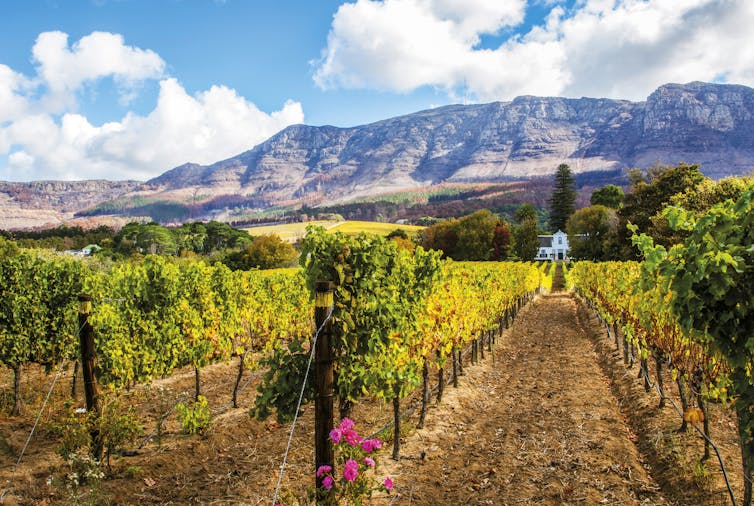
Over the past two years, the Western Cape was forced to set strict water restrictions – including curbs on irrigation – as dam levels dropped to below 20%. This had a direct effect on agriculture and food production, as well as ripple effects across the country.

In the province, more than R5 billion was lost to the economy, largely due to the drought. This matters for the country as a whole because the Western Cape contributes 22% to national agricultural GDP. And the deciduous fruit and wine industries, and increasingly the citrus industry, are key exports and contribute significantly to South Africa’s overall agri-economy.

The economic implications of all of these outcomes are dire. From 2015 to 2017 South Africa’s economy grew by a mere 1.1% average per annum, with the agricultural sector growing at a rate of less than 0.5%. That’s not enough to make a dent on the country’s biggest challenges, which include high rates of inequality, poverty as well as unemployment.

Western Cape as a case study

Tourism sector: The drought negatively affected the province’s tourism sector. Even though the impact hasn’t been quantified, the number of tourists visiting the province went down during the drought period. This was also reflected in the fact that year-on-year overnight guests in the region grew at a mere 1% from 2016 to 2017, compared with 7% a year earlier. Some hotels had bookings declining by between 10% and 15% in 2018, compared to 2017.

Tourism in the Western Cape is estimated to employ about 300 000 people.

Food prices: the impact of drought on food prices was severe with staple food items such as maize increasing. This affected mostly poor households which spend relatively large portions of their income on food – as much as 34% of their total income.

Also, lower agricultural production has affected food supplies. This, in turn, could increase food prices and food insecurity.

Jobs: The Western Cape has the biggest agricultural workforce in South Africa – nearly a quarter of the country’s farm workers are employed in the region. And agriculture and agro-processing are responsible for 18% of employment opportunities in the province.

The drought has led to job losses in the province’s agriculture sector. The 2017 third quarterly labour force survey showed that approximately 25,000 jobs were lost from the agricultural sector nationally. More than 20 000 of these were lost in the Western Cape province. Many were associated with the drought.

Most farm workers are unlikely to get jobs elsewhere, which means that job losses will worsen poverty.

Impact on the fiscus

If the pattern of drought continues, it’s likely to affect the country’s financial standing too. This is for a number of reasons.

Firstly, the National Treasury will have to continue spending money on disaster relief, as opposed to other economic activities. This year, for example, the South African government may need close to R3 billion sought by farmers severely affected by the drought.

Future assistance could be in the form of helping build infrastructure like boreholes and supporting farmers who need to reduce stock.

Secondly, continuing droughts could force up the country’s import bill. Declining agricultural production could lead to shortages of some food items like maize, wheat and some protein sources such as meat and eggs. This could, in turn, force South Africa to import more.

Thirdly, a shortage of local produce could push up prices. This could affect food inflation and push up the consumer price index. Given that the South African Reserve Bank uses interest rates to control inflation, this could lead to higher interest rates which will affect the broader economy.

Climate change a reality

Climate change poses a threat to everyone. Governments, farmers and society in general, need to take proactive steps to deal with the outcomes of changing weather patterns.

Over time, agricultural production will need to adapt to new methods and approaches. These may include the use of drought-resistant seed varieties, modern technologies to adapt and taking up more crop insurance. These approaches are readily available to farmers who have the resources. It’s the developing, smallholder and emerging farmers that remain at risk.

Governments can assist farmers by providing infrastructure support making new laws that support the conservation of resources. And the government can provide financial support for the development of new technologies as well as seed varieties that are adaptable and can withstand severe weather patterns.

This requires better planning. In addition, the government must work closely with the agricultural sector.The Conversation

Mmatlou Kalaba, Senior Lecturer in Agricultural Economics, University of Pretoria

This article is republished from The Conversation under a Creative Commons license. Read the original article.

Like this article? Subscribe for free to ZA Confidential to receive our newsletters: Click here


The battles of black business

By John Fraser

It could have started better.  On the eve of last week’s Black Business Council summit, there was a blistering attack on its president Sandile Zungu by his counterpart at BUSA, Sipho Pityana.  

Zungu had been close to Jacob Zuma, and the allegation was that he had been too close – and had been party to state capture.

Zungu, in turn, hit back, but the episode overshadowed his opening address and the whole row did little for the image of black business.

Having insisted that all delegates be there well before 9am on the first day, the session kicked off at 9.30.  After that, the over-stuffed agenda led to more and more time lapses, so that at the end of the day sessions were rattled off at insulting speed.

I am pretty sure I saw one panellist disappear in disgust at having to wait over an hour for his session.  Certainly, he was there on time, but he did not take part in the discussion.

Having experienced the disorganisation of Day 1, I avoided Day 2.

I did manage to listen to at least one excellent session, at which there was once again confirmation that Eskom’s vindictive delays in approving private sector power projects had led to manufacturing businesses going bust.

Even worse was the deplorable claim that some delays in state payments to small businesses have led to the owners committing suicide.

Unbelievable, and a strong reason for sorting out state procurement and payments, and for imposing strict penalties on those useless, scumbag civil servants who are anything but civil.

Public Enterprises Minister Pravin Gordhan came up with a figure of R419bn for Eskom’s debt, in what was otherwise the most political, (and least forceful) speech I have seen him give.

Meanwhile, Small Business Minister Lindiwe Zulu pulled out the race card, suggesting that corruption had begun in the apartheid era.

True, of course, but that does not diminish – as she seemed to imply – the large-scale looting carried out by the Guptas, Zumas and their many co-conspirators.

Two wrongs do not make a right.

The sooner her potentially-important – but actually waste-of-time – ministry is abolished, the better.   Our small businesses deserve proper attention, and they should be part of the mainstream discussion and government structure, not some ministerial backwater.

On balance, this was a worthwhile gathering, but the BBC has quite a way to go before it emerges as the unchallenged voice of black business.

If, indeed, we really need one in this multi-racial rainbow nation?

Like this article? Subscribe for free to ZA Confidential to receive our newsletters: Click here

Unions have Radebe by the balls over coal

1b5f4b3e-1a6b-47e9-aaf7-652b4dc2959c

By John Fraser

I have no idea about the size of Energy Minister Jeff Radebe’s testicles, and – despite the rumours – I have no great interest in this.

What I do know is that whether they are small, medium, large, or extra large, there are vice-like union hands squeezing them, and delaying the Minister’s move to a cleaner energy strategy.

Proof of this came today, Sunday.

There was no rest for the wicked – as we in the media are clearly regarded – because we were summoned to a ministerial sermon, far longer and less inspiring than the ones which (some of us) enjoy each Sabbath.

Radebe, in response to some prodding in the Q&A session, admitted that his grand plan for future energy strategy, which has been delayed time after time after time, after time to the power of ten, is in limbo.

Consultation is over, the broad lines are known – a move away from coal, no new nuclear, more gas and renewables.

However, Nedlac – that murky body in which government, the unions and business regularly shout at one another – has yet to deliver its blessing.

Without being too abusive to the unions, Radebe made it clear that their determination to hold on to jobs in a polluting extractive industry, for which no new bank finance or international agency funding will be forthcoming, is a major concern.

With an election looming, the ministerial globes are in hostile hands.

It was not his finest hour.  When asked about the corrupt and profligate Central Energy Fund and the incompetently run state energy firms under its (and ultimately his) control, he brushed the question aside, saying it was not the subject of this briefing.

It seems some things are too evil and satanic for a Sabbath session.

He was also reluctant to take any blame for the way in which the state-owned power utility Eskom has deliberately put the brakes on new projects by Independent Power Producers, even though he was a senior member of a past Cabinet which was supposed to oversee Eskom on behalf of the taxpayer.

Instead, he suggested things are back to normal now he is Energy Minister, conveniently forgetting the union bollock-battering that he is receiving, and the delays this is forcing in getting on with energy policy.

He admitted that Eskom’s influence forced out of business manufacturing firms linked to the renewable energy business.  But, seemingly, the buck has stopped a million miles away from his own door.

One can say of Radebe that he is an improvement on what came before.   Which is not saying a lot.

The recent return of revolving power cuts, constant reports of billions of rand purloined across Eskom, and the need for South Africa to meet its climate change obligations all demonstrate the need for courageous and decisive leadership.

Which was not evident in Jeff Radebe’s news conference today.

Like this article? Subscribe for free to ZA Confidential to receive our newsletters: Click here


Eskom is the big budget winner

By John Fraser

Make no mistake.  With R69bn over three years, the state power utility Eskom is the big winner in the budget.

Cash for investment incentives is steadily being eroded, belts are being tightened to uncomfortable level all around, there will be effective tax allowance rises for taxpayers through insufficient increases in personal allowance, and all the nice things in life – booze, cigarettes, petrol, will cost more.

The Carbon Tax will be with us in just a few months; there will be a carbon tax on fuel.

Efforts will be made to speed up the retirement of state employees, some of whom will undoubtedly be popping up again as better-paid consultants.

But Eskom aid dwarfs all this.

In a media conference, Finance Minister Tito Mboweni was on the defensive, as well he should have been.

He did clarify that although full-scale privatisation of Eskom is not on the cards, the generation and distribution sections will have all sorts of players, and he gave the example of the private renewable energy producers.

A Man from The Ministry – a sort of curator – will be parachuted into Eskom to keep an eye on things.

Wish him (her?) luck.

And when it comes to SAA, Toto knows he may not win the argument, but he has little enthusiasm for government bailouts there.

He suggested that whatever funds there are for transport should be directed to commuter taxis and to the railways – on which the majority of the population rely.

One footnote for the greenies among you.……

Disposable coffee cups and their lids, caps and containers, and plastic straws could all face a new tax.  Watch this space.

Time the fat cats in government drove local

By John Fraser

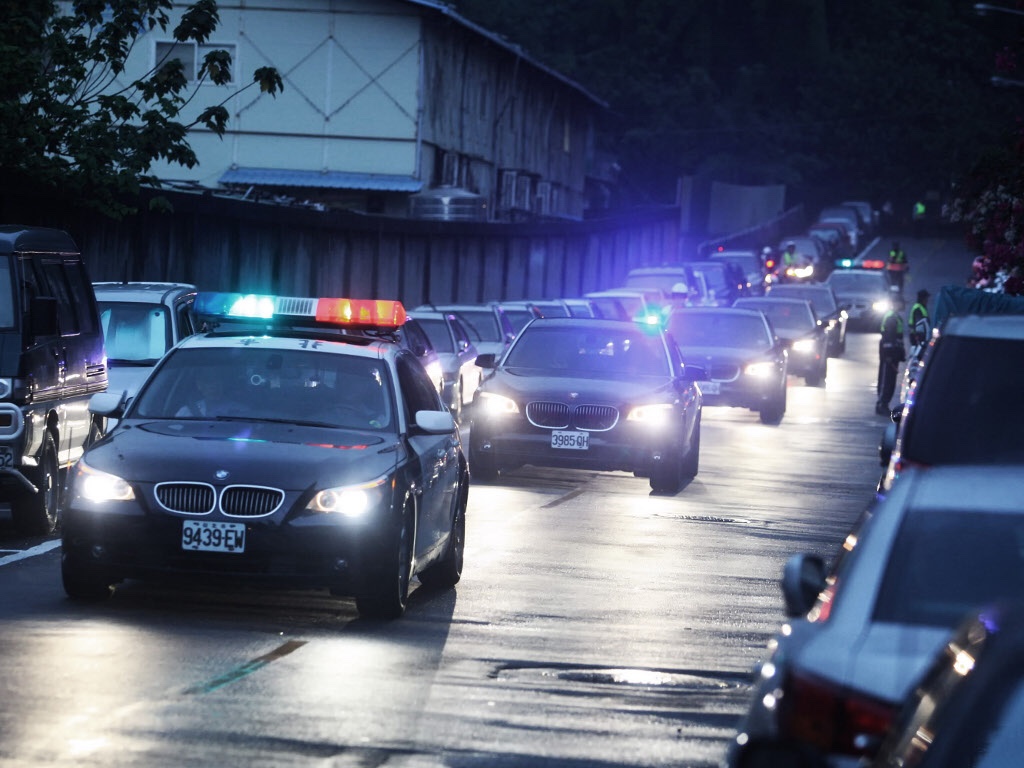
I always have two fingers at the ready when one of those blue light convoys tries to force me into a ditch as it whizzes by, with some self-important prat lounging in the back of the largest limo.

So far I am not aware whether any of my hopes have come true – that several bolts of lightning will descend upon the vehicles, microwaving the occupants, and saving a fortune in cremation fees.

However, a suggestion at a Toyota conference by my old chum Martyn Davies of Deloitte that government vehicles should be locally built did give me food for thought (the actual food at the event was very good – not a frequent occurrence at corporate events these days.)

It does seem immensely stupid that government pours billions of rand a year into the SA auto industry, to keep it anchored here and to encourage expansion, and yet so many cars in the state’s auto pool have been imported.

The mischievous might even suggest that there is an element of hypocrisy here, although this is rarely displayed by our political bosses and their bureaucratic lackeys.

Maybe, instead of trying to force us to pay ludicrous tolls and bombarding us with traffic fines (or bribes to make them go away) we could see something more effective.

Official vehicles should be lekkerly local as a strict rule, and should a state employee elect to display extra bling by purchasing an import, then they should enjoy no mileage allowance or any other vehicular perk.

The conference itself was interesting, despite the fawning awfulness of the MC, and Davies produced the shocking statistic that while only 66 electric vehicles were sold in SA last year, the figure for China was 1.1 million.

Toyota SA CEO Andrew Kirby was asked about local production of electric vehicles and hybrids, and he suggested it is some way off because of poor local demand.

This will change, but just not yet.

Like this article? Subscribe for free to ZA Confidential to receive our newsletters: Click here

Concentration camps in the South African War? Here are the real facts

File 20190218 56246 3rfis.jpg?ixlib=rb 1.1
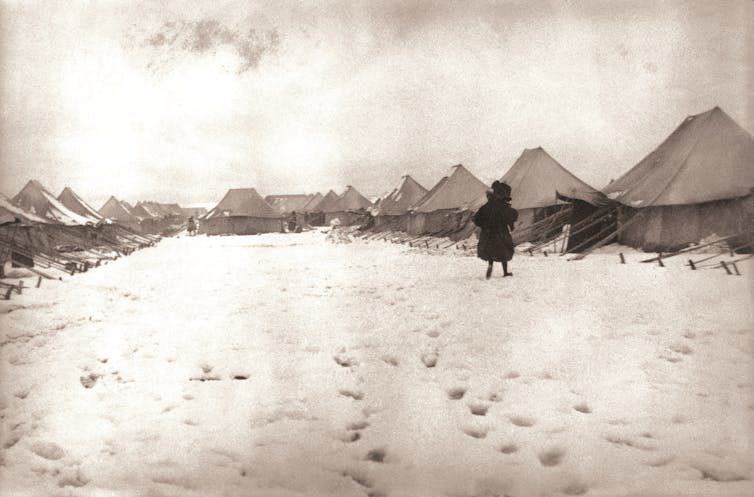
One of the Boer concentration camps.
Photographic Collection Anglo-Boer War Museum, Bloemfontein SA

Fransjohan Pretorius, University of Pretoria

More than a century after 48 000 people died in concentration camps in what’s known as the South African War between 1899 and 1902 – or the Anglo-Boer War – the events of that period are back in the headlines.

The camps were established by the British as part of their military campaign against two small Afrikaner republics: the ZAR (Transvaal) and the Orange Free State.

The scandalous campaign is back in the news following controversial comments by British Conservative MP Jacob Rees-Mogg on a BBC television programme.

Rees-Mogg’s statements have caused consternation because they were riddled with inaccuracies. It’s time to set the record straight and to refute his inaccuracies one by one. I do this based on the historical research I’ve done on the South African War for the last 49 years.

Setting the record straight

The claim that caused the most upset was Rees-Mogg’s allegation that the concentration camps had exactly the same mortality rate as was the case in Glasgow at the time.

This is simply factually incorrect.

In its recent Glasgow Indicators Project, the Glasgow Centre for Population Health gives the death rate of people in the city as 21 per 1000 per annum in 1901.

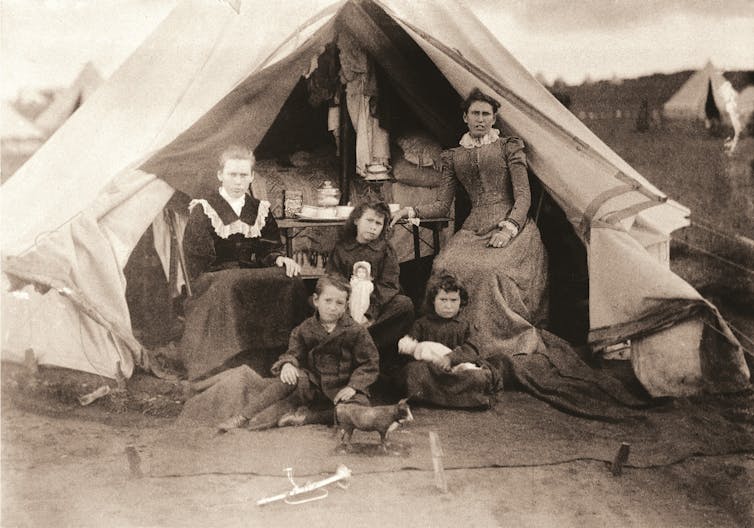
Inside one of the British concentration camps.
Photographical Collection Anglo-Boer War Museum, Bloemfontein SA

The death rate for Boer civilians in the concentration camps in South Africa exceeded this by a factor of 10. It’s well established that 28 000 white people and 20 000 black people died in various camps in South Africa. Between July 1901 and February 1902 the rate was, on average, 247 per 1000 per annum in the white camps. It reached a high of 344 per 1000 per annum in October 1901 and a low of 69 per 1000 per annum in February 1902.

The figures would have been even higher had it not been for the fact that British welfare campaigner Emily Hobhouse exposed the deplorable conditions in the camps. A subsequent report by the Government’s Ladies Commission prompted the British Government to improve conditions. Another factor that reduced the fatality rate was that Lord Milner, High Commissioner for South Africa and Governor of the Cape Colony, took over administration of the camps from the military from November 1901.

Rees-Mogg also revealed his total lack of understanding of why the British military authorities established the concentration camps in statements such as:

Where else were people going to live when … (the Boers were fighting the war)?

People were put in camps for their protection.

They were interned for their safety.

They were being taken there so that they could be fed because the farmers were away fighting the Boer War.

The reality was very different.

The origins of the camps

After Lord Roberts, chief commander of the British forces, occupied the Free State capital, Bloemfontein, on 13 March 1900, he issued a proclamation inviting the Boers to lay down their arms and sign an oath of neutrality. They would then be free to return to their farms on the understanding that they would no longer participate in the war.

Eventually, about 20 000 Boers – about a third – made use of this offer. They were called the “protected burghers”. Roberts had banked on this policy to end the war. But after the British occupation of the Transvaal capital, Pretoria, on 5 June 1900, there was no end in site. On the contrary, the Boers had started a guerrilla war, which included attacks on railway lines.

In reaction Roberts issued a proclamation on 16 June 1900, stating that, for every attack on a railway line the closest homestead would be burnt down. This was the start of the scorched earth policy. When this didn’t work, Roberts issued another proclamation in September stating that all homesteads would be burnt in a radius of 16 km of any attack, and that all livestock would be killed or taken away and all crops destroyed.

This policy was intensified dramatically when Lord Kitchener took over from Roberts as commander in November 1900. Homesteads and whole towns were burnt down even if there was no attack on any railway. In this way, almost all Boer homesteads – about 30 000 in all – were razed to the ground and thousands of livestock killed. The two republics were entirely devastated.

Meanwhile, the Boer leaders were reorganising their commandos after some major setbacks. One action was to remobilise the Boers who had laid down their arms.

Roberts felt he should protect his oath takers and gather them in refugee camps. The first two were established in Bloemfontein and Pretoria in September 1900.

But the scorched earth policy had led to more and more Boer women and children being left homeless. Roberts decided to bring them into the camps too. They were called the “undesirables” – families of Boers who were still on commando or already prisoners of war. They were given fewer rations than others in the camps.

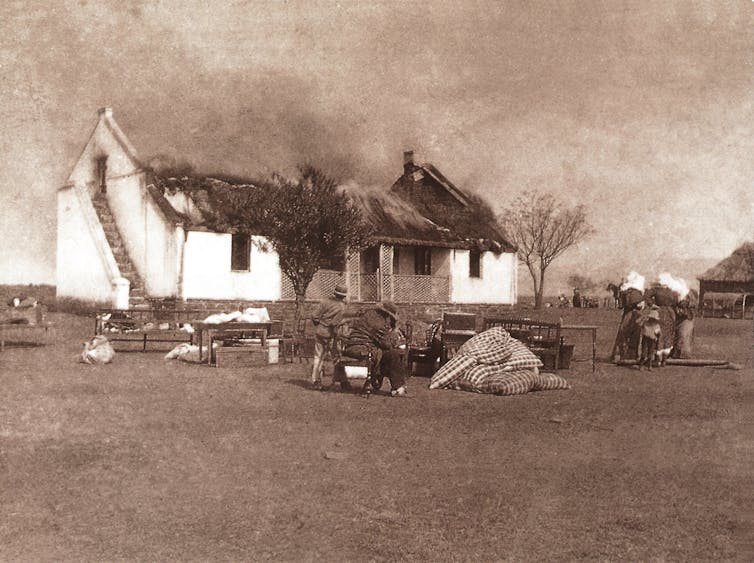
A Boer family looks on at their house that was set alight by the British forces during the South African War.
Photographic Collection Anglo-Boer War Museum, Bloemfontein SA

These families eventually outnumbered the protected burghers and their families by 7:3.

These families were taken against their will. They were forcibly put on ox wagons and open railway trucks and taken to the camps. They were not, as Rees-Mogg claimed, moved for their protection and safety. Nor were they moved to the camps to be fed. Rather, their internship had everything to do with ending the resistance of Boers still fighting the British.

The administration of the camps was appalling. Food was of a very poor quality, sanitation deplorable, tents were overcrowded and medical assistance shocking. Little was known at the time about how to handle epidemics of measles and typhoid.

This isn’t all. Rees-Mogg is also obviously unaware of the action that the British commanders took against black South Africans. A total of 66 black concentration camps were set up across the Transvaal and Free State where conditions were just as bad and the death rates similar.

These camps were set up to get black people off the land so that the Boers couldn’t get supplies from them. In addition, forcing black farmers also enabled the British to use black men as labourers on gold mines.

Rees-Mogg was right on one point: the concentration camps didn’t have the same aims as Adolf Hitler’s extermination camps during the Second World War. The aim in South Africa wasn’t systematic murder.

But this shouldn’t detract from his numerous other falsehoods.The Conversation

Fransjohan Pretorius, Emeritus Professor of History, University of Pretoria

This article is republished from The Conversation under a Creative Commons license. Read the original article.

Like this article? Subscribe for free to ZA Confidential to receive our newsletters: Click here
 

Does Caster merit special treatment?

This is what I wrote for The Messenger last year.


Caster Semenya is a brave, determined, admirable athlete. It is irritating and humiliating that her hormonal balance is the subject of so much international scrutiny. Is it wrong, though?

Nobody can take away from her an extraordinary array of achievements, nor her excellence as an athlete.

So, what do we make of the International Association of Athletics Federation (IAAF)? This regulatory body seems to believe that the South African athlete has a hormonal structure which gives her an unfair advantage in races against other female athletes.

The ruling of the IAAF is that female athletes including Semenya, will have to reduce and then maintain their testosterone levels to a certain ceiling if they want to compete in events ranging from 400m to a mile.

Were Caster an accountant, a lawyer, a farmer or (God help her) a journalist, her hormonal structure would be totally irrelevant.

But when you have someone in the fiercely competitive, fraction-of-a-second, watched-by-millions, world of athletics excellence, should the same rules apply?

Let us look at this another way. If you had a Paralympic event which was won by an able-bodied athlete, you would condemn this as cheating.

So how is it different if the other female competitors in a race face a disadvantage because an unusual hormonal mix – caused by nature, not drugs – gives Caster that extra edge?

It is a tricky one, and there is a case to be made for both sides of this argument.

This is not about her appearance, nor her voice, nor her character.    This is about science, not emotion.

It has been reported that MPs have joined the chorus of condemnation against these rules, describing them as “unjust, sexist, dehumanising”.

These rules, however, have not been drawn up with regulating MPs in mind, nor to deal with workplace disputes. They apply only to the athletics track.

Of course, we all bask in the glow of national pride every time any one of our athletes wins a race, wins a medal, breaks a record.

Does this mean we can ignore the concerns inside some sectors of the world of athletics that any female competitor with unusually high levels of certain hormones, has an unusual advantage? Do you ignore this, or do you regulate?

Caster is not being asked to stop competing, but for certain races, she will need to take medical measures to adjust her hormone levels –  if she wishes to enter.

Annoying?  Certainly.   But unjust?  Sexist?

The Australian cricketers were, quite rightly, condemned over the recent ball-tampering incident.

It just wasn’t cricket.  It was unfair.   It was cheating.

The way in which Caster is being treated is harsh, humiliating, hurtful.

When looked at emotionally, it seems so unfair.

But is it?

RIP DVD – a major con on the consumer

By John Fraser

All good things come to an end, and my faithful Blu-ray player needed replacement.   I sought advice from a contact at Makro, who told me Samsung is no longer importing them into South Africa.

A trip to a couple of retail outlets revealed a couple of display units still on offer, along with some really expensive units.   A trip to the Takealot website showed a few units, but no direct replacement for my dying one.

So I suspect the writing is on the wall.    Just like VHS players (of which I could find none on the Takealot website) DVD, Blu Ray, CD players are slowly on the way out.

I did manage to find a suitable Blu-ray rayplacement, purchasing it from Amazon in the US.  It was expensive to ship, the import duties were harsh, and it had the wrong plug.

But it was soon up and running, working well, and it plays my Blu-rays, CDS, DVDs, while having an excellent streaming facility which gives me access to Netflix and YouTube.

But what do I do if this one lasts less long than I do?  I have a good collection of CDs and DVDs, many of which replaced now-discarded VHS and audio cassettes and vinyl (I did not expect the vinyl revival).

My assertion is that the people who sold me all of these discs of one sort or another should have some responsibility for keeping them valid.  Either by getting their associated electronics businesses to continue churning out the players, or by starting their own production.

When I asked someone in the industry about my fears of the death of DVD, he responded: “Have you tried streaming?”

I have, yes.  But I still want to return to the favoured drama, comedy and music for which I have already paid.    Streaming is not cost-free.   If you don’t have uncapped data, it can be cripplingly expensive.  And not everything is readily available online.

So, it worries me that as technology evolves, some of the hardware to drive your home entertainment is facing extinction.

I would like to think the entertainment industry shares my concern, but there is a nagging doubt that it will recklessly continue to offer new products, new systems, so it can cash-in afresh, again and again.

And bugger the consumer. Like this article? Subscribe for free to ZA Confidential to receive our newsletters: Click here


SA’s red tape is keeping away vital skills

By John Fraser

party glass architecture windows
Photo by Negative Space on Pexels.com

Top global talent is willing to help close SA’s chronic skills gap, but is it often impossible for international executives to move and work here.

This is the claim of Debbie Goodman-Bhyat, CEO of Jack Hammer, Africa’s largest independent executive search firm.

“Internationally-based executives and entrepreneurs continue to inquire about career opportunities in South Africa, despite the challenges facing the country, including political uncertainty and crime,” she stated.

“South Africa remains a very attractive destination for global talent

“But even though these high-level leaders are in a position to drive growth and job creation locally, the current policy environment makes it almost impossible for them to do so.”

Goodman-Bhyat said that since the expansion of her operations into the US, they have been approached by highly-qualified and experienced executives and entrepreneurs about a potential move or expansion into South Africa.

“Unfortunately, they come back to earth really quickly when we share the realities of attempting such a move, because even once they have gone through the arduous process of applying for a work permit, the chances of them securing one are minuscule,” she warned.

jack Hammers says that in 2016, the Department of Home Affairs noted that “South Africa has not yet put in place adequate policies, strategies, institutions and capacity for attracting, recruiting and retaining international migrants with the necessary skills and resources”.

However, it fears that the situation remains the same today, with a recent report from the Human Sciences Research Council (HSRC, June 2018), noting that South Africa is unable to find the critical skills which are desperately needed.

“Note here that we are talking specifically about people who bring scarce skills, resources and capital, who will, in fact, grow the economy, create jobs, and contribute to the fiscus by way of taxes,” said Goodman-Bhyat.

“These are people who are motivated to invest their resources in the country, and have the potential to balance the impact of the brain drain, that continues to flow offshore.”

Goodman-Bhyat noted that top talent is global – meaning that the best talent is very mobile – and that the most competitive companies will secure this talent, from wherever they may be in the world.

“The ability of companies to do this is, however, completely dependent on whether the relevant policies are enabling or dis-enabling. In the case of South Africa, attracting global talent is a very long, steep, uphill battle.”

The recent enquiries from abroad are further evidence that South Africa is losing out on high-quality talent.

“Despite our challenges, the grass is still pretty green this side. Our cost of living, quality and cost of education, access to some of the best lifestyle-related assets in the world – these are very attractive factors to some of the best intellectual capital out there. If you had to compare all of this to working and living in San Francisco, for example, it’s an absolute no-brainer to want to work in SA.,” Goodman-Bhyat argued.

“We have to start looking at the big picture. Addressing transformation and employment equity can happen alongside a willingness to be open-minded and attract great talent – the two are not mutually exclusive. Yet at the moment, we are ignoring – even actively shunning – the intellectual capital that can contribute to the growth of the country.

“South Africa must realise that it is losing out to other countries seeking to attract critical skills, and understand the impact of doing so. Yes, the country finds itself at a difficult junction right now, and this might not seem like the most pressing issue.

“But if stabilising the economy, and ensuring future economic growth and job creation really is a priority, then getting the brightest brains to join the project will be a help, not a hindrance.”

President Cyril Ramaphosa has routinely said that SA wants to make it easier to do business in this country.  However, the government’s actions have yet to match the rhetoric.

Like this article? Subscribe for free to ZA Confidential to receive our newsletters: Click here
Pravin: Human error or sabotage accounts for half of Eskom’s plant breakdowns

Gordhan

Public Enterprises Minister Pravin Gordhan

By John Fraser

The systemic and ruthless destruction of state utility Eskom on Jacob Zuma’s watch was laid bare this week by Public Enterprises Minister Pravin Gordhan, who claims as many as half of all breakdowns are related to human failures, and therefore not to mechanical factors.

He was addressing a business forum in Johannesburg, organised by Business Unity South Africa (BUSA).

Gordhan told a panel discussion that the crisis at Eskom means that it needs funding of R420bn.

“SOEs (State-Owned Enterprises) are in difficulty, particularly those at heart of state capture.  They became operationally weak,” he noted, referring back to Jacob Zuma’s kleptocratic reign.

“Incompetent people were put in place, for example at Eskom power stations,” Gordhan stated.

He said he has been told 40% of Eskom breakdowns are a result of the human factor. “I believe it is 50%,” he warned.   And he speculated that some of the actions may be deliberate.

He said of the state-owned enterprises that in SA, following the Zuma years we “are left with a bit of a disaster.  We need governance, the right management.  We might need outsiders to give us the technical input we require.”

“We need to get them generating more revenue, to make them more viable.”

He confirmed a major restructuring of Eskom is underway, and the question of whether Eskom is unbundled into three is being discussed.

“We need very fast movement.”

In a later BUSA conference session, President Cyril Ramaphosa hit out at Zuma.

“Our SOEs are not behaving as they should be.  We are in a messy situation,” he stated.

“We have a mechanism which is ferreting (corruption) out.  After that, there has to be real, serious action.”

Without naming Zuma, he said: “there is a notion there are people who will fight back, as they will.  They are going to resist.  And so must we.

“We should not be defined by acts of corruption which have gone out of kilter with our values.

“Transparency International says (in a recent report) we are one of the most corrupt countries in the world.    This is the last time.”

He said of the Zuma years that “unfortunately in the last 9 years or so, policy was almost done on the hoof.  This led to policy uncertainty and inconsistency.

“The state has been denuded of good people, who gave it all up and left.  Some have been hounded out.  The state has been weakened severely.

“That is why we need to cooperate between business and the state.  We need to put all hands of South Africans on deck.”

It was reported, Wednesday, that Zuma had hit back at Ramaphosa, which confirms the mammoth task facing the new-broom regime which is now attempting to turn around the economy.

Ramaphosa also met business leaders in a separate engagement, and there was agreement on a sector-by-sector approach to reviving economic growth.

“Business people and ministers are beginning to imagine a South Africa which will have a 5% and a 7% growth,” the President cheered.

“They are looking at sectors, which for me is the holy grail we should all aspire to touch.  That is where we want to be.

“They tell me: we want the government to deal with the inhibitors.  I found that enormously uplifting.

“This is a no-brainer.  We must remove the inhibitors for growth.  South Africa must go and grasp that high growth.  South Africa is on the runway.  Let’s take off. ”

Like this article? Subscribe for free to ZA Confidential to receive our newsletters: Click here