Does South Africa have a microplastics problem? Our research says: yes

File 20180913 177938 18yyfch.jpg?ixlib=rb 1.1
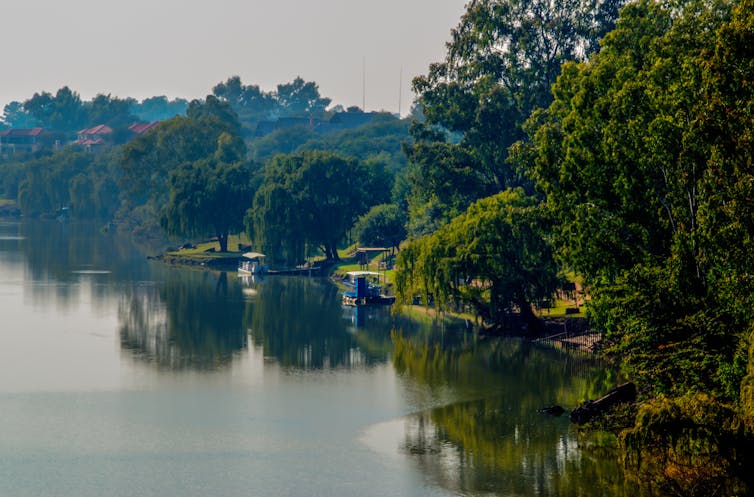
Surface water from the Vaal River is highly polluted with fragments of microplastics.
Flickr/Paul Saad

Henk Bouwman, North-West University

The dangers of plastics, and more specifically microplastics, is increasingly grabbing the world’s attention. A growing body of research shows that plastics and microplastics in the marine environment are having a devastating effect on life in the sea. The impact has been tracked particularly closely in laboratory setups where conditions can be managed and effects monitored.

At any size, plastics pose a threat to living organisms. In the sea they can block whales’ digestive tracts, entangle sea turtles and affect the photosynthesis of algae. They’re also a problem in rivers and fresh water lakes.

Microplastics are generally understood to be pieces, particles, or fibres less than 5 mm long. They have three major sources. The first is when large bits of plastic break down into tiny pieces not clear to the eye. The second is when fibres are shed from fabrics during use and washing. And the third is microbeads. These are also tiny and are manufactured to be used in products ranging from tooth paste to facial scrubs, and sandblasting.

The use of plastics has become ubiquitous over the past 50 years. Most consist of stable polymers that have lots of useful properties. They are light in weight, strong, pliable and can be made into many different forms. And by combining plastics with a range of additives, products can be dramatically changed. This extends from colour to hardness and pliability.

This means that they can be used in a host of innovative ways including affordable food protection and packaging, piping, ropes and netting, construction materials and windows. But, in most cases, products made out of plastic have a long durability and often outlasting their utility. They eventually become waste and enter the environment.

A great deal of research has been done on the effect of microplastics on marine life as well as fresh water in developed countries. But the knowledge gaps in developing countries such as South Africa are huge.

At the request of South Africa’s Water Research Commission – South Africa’s premier water knowledge hub – we recently undertook a scoping study of microplastics in freshwaters in the country’s economic powerhouse Gauteng and an area to the south of the region.

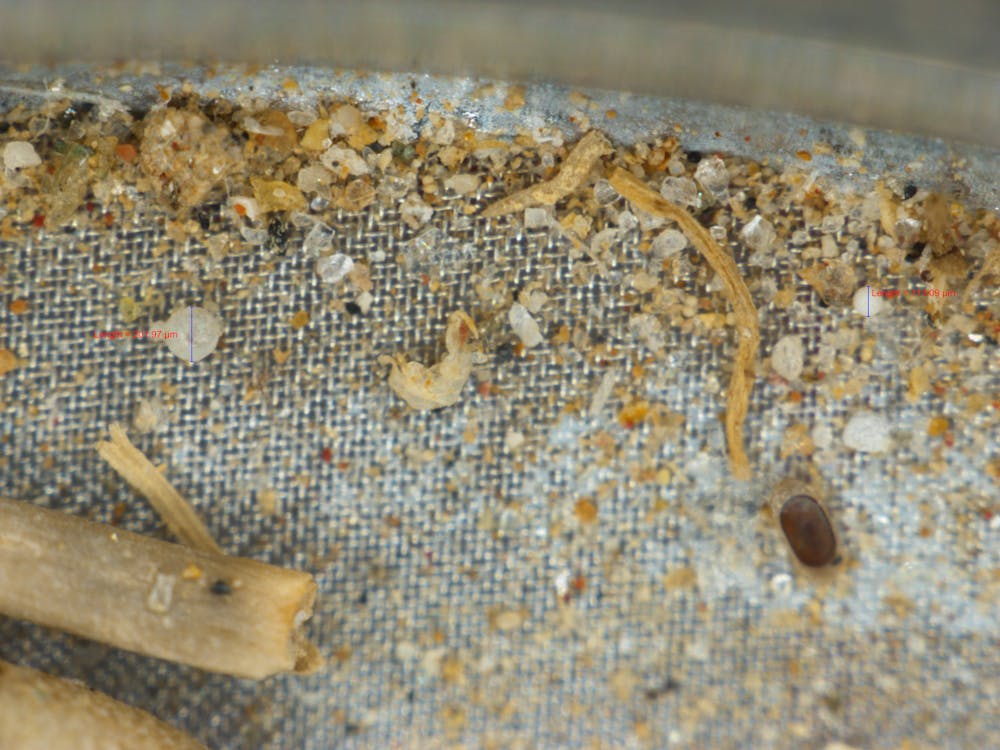
We found that surface water from the Vaal River – the largest tributary of the South Africa’s longest river, the Orange River – was highly polluted with fragments. This is most likely due to water draining into the river from industries in the area. We also found that fibres were more abundant in rural rivers, possibly due to untreated laundry water entering these rivers.

The problem

Because plastics are relatively new in the environment, many organisms can’t discriminate between food and non-food and ingest plastics as part of their diet.

Humans and animals are adapted to handle natural particles in water, air, and food. But the way the new addition of synthetic polymer particles in our environment is dealt with is less well known.

Microbeads found in the water.
Author supplied

The indications are that some organisms don’t handle microplastics well, while others seem to be able to discriminate better between food and non-food items.

Very small particles are now also known to be able to cross the plasma membranes of animals, entering cells. What the effects of these may be on molecular, cellular, organ, and organismic levels are not well understood. But they may be significant.

The research

Our study focused on surface water from various rivers draining into the Crocodile, Olifants and Vaal River drainage basins. For scoping purposes, municipal water samples from Tshwane and Johannesburg were taken as well as ground water samples from the Potchefstroom area in the North West province.

We found that there were indeed high levels of microplastics in the water. But our findings are only the beginning of what should be a much more intense research endeavour.

For example, we still don’t understand a wide range of factors that affect the release, transformation and transportation of microplastics. We also don’t know enough about their composition. And there’s also a great deal to learn about the leaching of chemicals from plastics under South African conditions, including high temperatures, dry periods, and ultra violet.

In addition, we need to establish whether or not airborne microplastics contribute to the microplastic load in South African water systems. Recent international studies also show atmospheric fallout as a source of microplastic contamination.

What now?

Experience in other countries shows that one of the most effective actions that can be taken is the immediate ban on microbeads, and products containing microbeads.

We also suggest a review of laws and regulations elsewhere to provide a guide on how South Africa can strengthen its responses to plastic pollution. In particular, the country needs to develop laws around plastic packaging which seems to be the most obvious and visible component of inland plastics pollution.

The plastics issue in South Africa – and the world – can only be addressed with a concerted effort by producers, retailers, designers, consumers, scientists, conservationists, government, and society. Although laudable, recycling isn’t the complete solution. More is needed.

Given market forces and few regulations, meaningful voluntary reduction of the plastic components of packaging, or promoting the use of recyclable or re-usable plastic products (which are more expensive), seems remote. But even remote opportunities should be pursued and opportunities investigated.

South Africa could take a leaf out of the European Union’s book. It recently released a strategy that aims to transform the design of plastics, how it is produced, used, and recycled for a more resilient plastics industry. A similar approach could be followed in South Africa, although the country’s circumstances, such as the high number of jobs provided by the plastics industry, must be given serious consideration.

Carina Verster, a post-graduate student, was the co-author on this article.The Conversation

Henk Bouwman, Research Professor Ecotoxicology , North-West University

This article is republished from The Conversation under a Creative Commons license. Read the original article.

Like this article? Subscribe for free to ZA Confidential to receive our newsletters: zaconfidential@gmail.com.
 

Twenty-five years after the Oslo Accords, the prospect of peace in the Middle East remains bleak

File 20180917 96155 1jfhqz3.jpg?ixlib=rb 1.1
US President Bill Clinton, Israeli Prime Minister Yitzhak Rabin and Palestinian leader Yasser Arafat sign the historic Oslo accord at the White House in September 1993.
Wikicommons/Vince Musi

Tony Walker, La Trobe University

Looking back on events 25 years ago, when the Oslo Accords were struck on the White House lawn, it is hard to avoid a painful memory.

I was watching from a sickbed in Jerusalem when Bill Clinton stood between Israel’s Prime Minister Yitzhak Rabin and Palestinian leader Yasser Arafat for that famous handshake on the White House lawn.

At that moment, I was recovering from plastic surgery carried out by a skilled Israeli surgeon and necessitated by a bullet wound inflicted by the Israeli Defence Forces. (I had been caught in crossfire while covering a demonstration in the West Bank by stone-throwing Palestinian youths.)

That scar – like a tattoo – is a reminder of a time when it seemed just possible Arabs and Jews, Israelis and Palestinians could bring themselves to reach an historic compromise.

All these years later, prospects of real progress towards peace, or as American president Donald Trump puts it, the “deal of the century”, seems further away than ever.


Read more:
Russia expands in the Middle East as America’s ‘honest broker’ role fades


As a correspondent in the Middle East for a decade (1984-1993) and as co-author of a biography of Arafat, I had an understandable interest in the outcome of the Oslo process.

In hours of conversations with members of the Palestine Liberation Organisation’s historical leadership, I had tracked the PLO’s faltering progression from outright rejection of Israel’s right to exist to acceptance implicit in the Oslo Accords.

Throughout that process of interviewing and cross-referencing with Israeli sources, I had hoped an honourable divorce could be achieved between decades-long adversaries. Like many, I was disappointed.

In 1993, the so-called Oslo Accords, negotiated in secret outside the Norwegian capital, resulted in mutual recognition of Israel and the PLO. This enabled the beginning of face-to-face peace negotiations.

A devastating event

Two years after the historic events at the White House, and by then correspondent in Beijing, I witnessed another episode of lasting and, as it turned out, tragic consequences for the Middle East.

On November 4, 1995, Rabin was assassinated while attending a political rally in Tel Aviv by a Jewish fanatic opposed to compromise with the Palestinians.

That devastating moment brought to power for the first time the current Israeli Prime Minister Benjamin Netanyahu. He has distinguished himself by his unwillingness to engage meaningfully with the Palestinians through four US administrations: those of Bill Clinton, George W Bush, Barack Obama, and now Trump.

Some argue the Palestinians and their enfeebled leadership bear significant responsibility for peace process paralysis. That viewpoint is valid, up to a point. But it is also the case that Netanyahu’s replacement of Rabin stifled momentum.

Under Trump, Netanyahu finds himself under no pressure to concede ground in negotiations, or even negotiate at all. Indeed, the administration seems intent on further marginalising a Palestinian national movement, even as settlement construction in the occupied areas continues apace.

US President Donald Trump, here with Israeli Prime Minister Benjamin Netanyahu, has promised the ‘deal of the century’ in the Middle East, but the details have not yet been made clear.
AAP/ Olivier Douliery/pool

On the eve of the accords, there were 110,000 Jewish settlers in the West Bank and Gaza Strip. That number has grown to 430,000 today. In 2017, those numbers grew by 20% more than the average for previous years.

The Trump administration’s decision to move the American embassy to Jerusalem without making a distinction between Jewish West or Arab East Jerusalem could hardly have been more antagonistic.

By taking this action, and not making it clear that East Jerusalem as a future capital of a putative Palestinian state would not be compromised, the administration has thumbed its nose at legitimate Palestinian aspirations.

The administration’s follow-up moves to strip funding for the United Nations Works and Relief Agency (UNWRA) and assistance to Palestinian hospitals in East Jerusalem have further soured the atmosphere.

UNWRA is responsible for the livelihoods of thousands of Palestinian refugees in camps in the West Bank, Gaza, Jordan, Lebanon and Syria. These are the ongoing casualties of Israel’s 1948 War of Independence against the Arabs.

In this context, it is interesting to note that Jared Kushner, Trump’s son-in-law and Middle East envoy, has urged that refugee status be denied Palestinians and their offspring displaced by the war of 1948.

In that year, two-thirds, or about 750,000 residents of what had been Palestine under a British mandate became refugees.

Against this background and years of conflict between Israel and the Palestinians, including two major wars – the Six-Day War of 1967 and Yom Kippur War of 1973 – the two sides had in 1993 reached what was then described as an historic compromise.

Hopes dashed

What needs to be understood about Oslo is that its two documents, signed by Rabin and Arafat, did not go further than mutual recognition of Israel and the PLO in the first, and, in the second, a declaration of principles laying down an agenda for the negotiation of Palestinian self-government in the occupied territories.

What Oslo did not do was provide a detailed road-map for final status negotiations, which were to be completed within five years. This would deal with the vexed issues of refugees, Jerusalem, demilitarisation of the Palestinian areas in the event of a two-state settlement, and anything but an implied acknowledgement of territorial compromise, including land swaps, that would be needed to bring about a lasting agreement.

Writing in the Journal of Palestine Studies in 1994, Oxford professor Avi Shlaim described the White House handshake as:

one of the most momentous events in the 20th-century history of the Middle East. In one stunning move, the two leaders redrew the geopolitical map of the entire region.

Now emeritus professor, Shlaim’s own hopes, along with those of many others, that genuine compromise was possible, have been dashed.

Referring to the recent passage through the Knesset of a “basic law” that declares Israel to be “the nation-state of the Jewish people”, Shlaim recently observed:

This law stands in complete contradiction to the 1948 declaration of independence, which recognizes the full equality of all the state’s citizens ‘without distinction of religion, race or sex’… Netanyahu has radically reconfigured Israel as the nation-state of the Jewish people, rather than a Jewish and a democratic state. As long as the government that introduced this law stays in power, any voluntary agreement between Israel and the Palestinians will remain largely a pipe dream.

Martin Indyk, now en route to the Council on Foreign Relations from the Brookings Institution, shared Shlaim’s hopes of an “historic turning point’’ in the annals of the Arab-Israeli conflict.

As Clinton’s National Security Council adviser on the Middle East, Indyk was responsible for the 1993 arrangements on the White House South Lawn. He writes:

The handshake was meant to signify the moment when Israeli and Palestinian leaders decided to begin the process of ending their bloody conflict and resolving their differences at the negotiating table.

Two decades later, in 2014, the funeral rites were pronounced on the Oslo Process after then Secretary of State John Kerry had done all he could to revive it against Netanyahu’s obduracy. Oslo had, in any case, been on life support since Rabin’s assassination.


Read more:
Fifty years on from the Six Day War, the prospects for Middle East peace remain dim


“Then,” in Indyk’s words, “along came Trump with “the Deal of the Century”. Indyk writes:

His plan has yet to be revealed but its purpose appears clear – to legitimize the status quo and call it peace. Trump has already attempted to arbitrate every one of the final status issues in Israel’s favor: no capital in East Jerusalem for the Palestinians; no ‘right of return’ for Palestinian refugees; no evacuation of outlying settlements; no ’67 lines; no end of occupation; and no Palestinian state…
Over 25 years, in shifting roles from witness to midwife, to arbiter, the United States has sadly failed to help Israelis and Palestinians make peace, leaving them for the time being in what has essentially been a frozen conflict.

However, as history shows, “frozen conflicts” don’t remain frozen forever. They tend to erupt when least expected.

Twenty-five years ago, I shared a bloody hospital casualty station – not unlike a scene from M.A.S.H. – with more than a dozen wounded Palestinians. Some of them would not recover from terrible wounds inflicted by live ammunition.

I asked myself then, as I do now: what’s the point of it all?The Conversation

Tony Walker, Adjunct Professor, School of Communications, La Trobe University

This article is republished from The Conversation under a Creative Commons license. Read the original article.

Like this article? Subscribe for free to ZA Confidential to receive our newsletters: zaconfidential@gmail.com.


CON COURT CANNABIS JUDGMENT: WHAT WAS THE REASONING AND WHAT DOES IT MEAN?

FD8861C6-58FB-4ECA-83D9-FACB1B48E1BF

Pierre de Vos

On Tuesday the Constitutional Court decriminalised the possession and cultivation of cannabis in private by adults for personal private consumption. The court relied on the right to privacy to reach this result. Although the order was suspended until Parliament can fix the defect in the law, the court provided interim relief that will make it unlawful for the Police to arrest adults who privately cultivate, possess or use relatively small amounts of cannabis.

Several years ago, Gareth Prince (one of my former students) approached the Constitutional Court, arguing that legislation prohibiting Rastafarians from possessing and using cannabis (widely known as “dagga” in South Africa) unjustifiably limited the right of Rastafarians to religious freedom as guaranteed by section 15 of the Bill of Rights. In that case (decided in 2002), the Constitutional Court voted 5 votes to 4 to dismiss Mr Prince’s application, but as we say in Afrikaans “aanhouer wen” (he who perseveres, triumphs), and this week the Constitutional Court in a unanimous judgment came to a different conclusion.

As Deputy Chief Justice Raymond Zondo pointed out in his judgment in Minister of Justice and Constitutional Development and Others v Princethe situation has changed since the Constitutional Court ruled against Mr Prince in 2002. There are now 33 jurisdictions across the world in which the use and possession of cannabis have been decriminalised or legalised.

This case also differs from the original 2002 case in that it was not based on the right to freedom of religion and did not require the legislature to provide for a special exemption for Rastafarians only. Instead, the argument before the court was that the criminal prohibition of the private cultivation and possession of cannabis for private consumption unjustifiably limited the right to privacy guaranteed by section 14 of the Bill of Rights.

The right to privacy can be understood as a right to live one’s own life with a minimum of interference by the state and by other private institutions or persons. The right can be imagined as a multi-layered onion, with protection being more intense at its core, and less intense as one peels away the layers and reaches to the outer layers of the onion. As the Court explained

A very high level of protection is given to the individual’s intimate personal sphere of life and the maintenance of its basic preconditions and there is a final untouchable sphere of human freedom that is beyond interference from any public authority. So much so that, in regard to this most intimate core of privacy, no justifiable limitation thereof can take place…  This inviolable core is left behind once an individual enters into relationships with persons outside this closest intimate sphere; the individual’s activities then acquire a social dimension and the right of privacy in this context becomes subject to limitation.

Given this definition of the right to privacy, the Court had no difficulty in finding that the prohibition of the mere possession, use or cultivation of cannabis by an adult in private for his or her personal consumption in private is inconsistent with the right to privacy provided for in section 14 of the Constitution. The only question in the case was therefore whether such a drastic infringement on the right to privacy was justifiable in terms of the limitation clause contained in section 36 of the Constitution.

The court raised several compelling arguments to justify its conclusion that this limitation of the right to privacy was not justifiable in terms of the limitation clause.

First, it quoted with approval from the High Court judgment which noted that much of the history of cannabis use in this country “is replete with racism”, and noted that there is a long history of the use of cannabis by indigenous South Africans.

The Court did not note that the use and possession of cannabis was outlawed by the colonial authorities in South Africa partly to prevent interracial socialisation and sexual activity which some legislators at the time thought would be encouraged by the widespread use of dagga. Neither did it comment on the argument that the criminal law often imposes more severe penalties on those convicted of the possession of drugs mostly used by poor people and by black people than on the possession of drugs mostly used by rich people and white people.

However, the Court did make the following comment about the long history of cannabis use by black South Africans:

[W]e do not, of course, intend to minimise the fact that the use of dagga is a great social evil in South Africa. Nevertheless, the long-standing indulgence in the use of the substance by a group of which an accused person belongs may well constitute a circumstance to be taken into account in mitigation at any rate where he has been convicted of the use or possession of a small quantity.

Second, while the infringement on the right to privacy by the criminal law was severe, the purpose of the prohibition (protecting individuals from drug addiction and the harms associated with drugs) was not as pressing as previously thought because the harm of cannabis use was not as severe as previously argued by government “experts”. The court relied on findings by the World Health Organisation and others about the relative harm of cannabis compared to other widely available substances like alcohol and tabacco.

Relying on these findings, the court pointed out that the adverse health and social consequences of cannabis use reported by cannabis users who seek treatment for dependence appear to be less severe than those reported by persons dependent on alcohol or opioid. The court also noted that the harmful effects caused by cannabis are incomparable to those caused by tobacco. Although the court did not spell this out, the logical consequence of this is that it makes little sense to criminalise the use and possession of cannabis but to allow the use and possession of alcohol and tobacco.

Lastly, as noted above, attitudes in other open and democratic societies towards cannabis use have changed drastically over the past ten years, providing another reason why the severe limitation on the right to privacy could not be justified.

The court thus declared invalid the relevant sections of the Drugs and Drug Trafficking Act and read words into these sections to ensure that the judgment would have immediate effect – although it also ruled that Parliament could pass its own amendments within the next 24 months to manage the regulation of the private possession, cultivation and use of cannabis – as long as such legislation did not infringe on the right to privacy of individuals.

The effect of the reading-in is that an adult person may use or be in possession of cannabis in private for his or her personal consumption in private. One would be able to use cannabis in private even when this private place is not ones home or dwelling. Moreover, the cultivation of cannabis by an adult in a private place for his or her personal consumption in private is no longer a criminal offence. As the court explained:

An example of cultivation of cannabis in a private place is the garden of one’s residence. It may or may not be that it can also be grown inside an enclosure or a room under certain circumstances. It may also be that one may cultivate it in a place other than in one’s garden if that place can be said to be a private place.

This ruling does not extend to the use, including smoking, of cannabis in public or in the presence of children or in the presence of non-consenting adult persons. Furthermore, the use or possession of cannabis in private other than by an adult for his or her personal consumption is not permitted.

The ruling also does not extend to the cultivation or possession of cannabis with the intention of selling it. This means that it is still a criminal offence to grow dagga commercially or to deal in dagga.

Dealing in cannabis is a serious problem in this country and the prohibition of dealing in cannabis is a justifiable limitation of the right to privacy.

The judgment is somewhat vague about how a court will decide when you cultivate or possess cannabis for private use and when you intend to sell that cannabis to others. The court did not impose specific limits on the quantities that you are allowed to possess before it will be assumed that you are dealing in dagga and are no longer merely possessing it for private use. However, judge Zondo provided the following guidelines:

In determining whether or not a person is in possession of cannabis for a purpose other than for personal consumption, an important factor to be taken into account will be the amount of cannabis found in his or her possession. The greater the amount of cannabis of which a person is in possession, the greater the possibility is that it is possessed for a purpose other than for personal consumption. Where a person is charged with possession of cannabis, the State will bear the onus to prove beyond a reasonable doubt that the purpose of the possession was not personal consumption.

This means that if a police officer finds a person in possession of cannabis, he or she may only arrest the person if, having regard to all the relevant circumstances, including the quantity of cannabis found in that person’s possession, it can be said that there is a reasonable suspicion that a person has committed an offence in terms of the Act.

This leaves some discretion to the Police to arrest individuals who are found in possession of cannabis. However, the judgment minimises the possibility that this power will be abused by an overzealous Police officer by making clear that when in doubt, the Police officer should not arrest an individual found in possession of cannabis.  Zondo explains the practical effect of this as follows:

It is true that there will be cases where it will be clear from all the circumstances that the possession of cannabis by a person is for personal use or consumption. There will also be cases where it will be clear from all the circumstances that the possession of cannabis by a person is not or cannot be for personal consumption or use. Then, there will be cases where it will be difficult to tell whether the possession is for personal consumption or not.  In the latter scenario a police officer should not arrest the person because in such a case it would be difficult to show beyond reasonable doubt later in court that that person’s possession of cannabis was not for personal consumption I will, therefore, not confirm that part of the order of the High Court because we have no intention of decriminalising dealing in cannabis.

Parliament may of course pass legislation to provide different guidelines to Police officers, but Parliament it is now constitutionally prohibited from passing legislation that would criminalise the private cultivation, possession, and consumption of cannabis. While Parliament can tweak the laws to ensure the effective enforcement of laws to criminalise the commercial manufacture and dealing in cannabis, any such law would have to respect the rights of an adult to cultivate, possess and consume cannabis in private.

This is from Constitutionally Speaking by Prof Pierre de Vos

Like this article? Subscribe for free to ZA Confidential to receive our newsletters: zaconfidential@gmail.com.

Naspers to cast off Pay-TV arm

By Chris Gilmour

Naspers has announced its intention to list its video entertainment business separately on the JSE and simultaneously to unbundle its shares in this business to its shareholders.

The new company will be named Multichoice Group and will include Multichoice South Africa, Multichoice Africa, Showmax Africa and Irdeto.

Multichoice is unquestionably the leading operator in its field on the African continent, but in recent times there have been signs that it is taking increasing pressure from internet services such as Netflix, which provides stiff competition to Multichoice’s products at very competitive prices.

The conclusion to be drawn from this action is that Naspers is exiting what is rapidly becoming a far less attractive proposition.

When Multichoice’s predecessor (MNET) began life in the late 1980s, the only competition was the state broadcaster, the SABC/SAUK, which was the propaganda arm of the apartheid government. In those days, it was illegal for private individuals to access satellite television – and those who tried, with massive dishes that managed to get a small amount of “spillage” from international broadcasters like CNN, very soon had their equipment rendered inoperative by the authorities.

By the mid-1990s, Multichoice’s DStv began offering satellite TV to individuals, and this was like a breath of fresh air. All of a sudden it was possible to access international broadcasters like CNN, CNBC, BBC and Sky TV, as well as Discovery Channel and many others.

At the time, it was transformative. Multichoice/DStv was very clever insofar as it managed to offer top quality content – and frankly, the few competitors that tried to compete failed dismally, as they were unable to access that world-class content.

But their monopolistic behaviour began sowing the seeds of a longer-term malaise.

Until very recently, South Africans had only limited access to reasonably fast broadband, and that access was very very expensive. But all that changed with the arrival of Fibre Broadband to The Home (FTTH), spearheaded by operators like Vumatel.

In a remarkably short space of time, hundreds and then thousands of suburbs all over the country were able to access fast, reliable broadband without having to use Telkom, and at significantly lower prices.

FTTH offered South Africans the ability to access global entertainment at a fraction of the cost that DStv was charging.

It took a little while before many people cottoned-on to the fact that they could access hitherto undreamt of entertainment, sport and cinema online – but when they did, the effect was shattering.

Netflix offered a South African version of their global offering at R100/month.

To put this in perspective, to access the full bouquet of DStv products, it is necessary to have their Explora PVR decoder and pay an access fee for using the decoder’s facilities for around R900 per month.

First, you need to buy the decoder itself, which with installation and a new dish can cost just under R2 000.

Netflix is a streaming product and doesn’t require any extra hardware.

The effect of Netflix and other streaming products on DStv has been noticeable.

In the year to March 2018, Multichoice lost over 40 000 subscribers, due mainly to those subscribers switching from DStv to Netflix and other internet services.

At this point, it is worth doing a few calculations to illustrate just how expensive DStv/Multichoice is, both in local and international terms.

Take Britain’s Sky TV as a base of comparison. The basic Sky setup costs GBP20/month and then it is left up to the individual to decide which extras he or she wants.

For this 20 pounds, you get the basic Sky entertainment features such as Sky Atlantic, Sky One, National Geographic and many others. Sky Cinema – the equivalent of a Netflix – will cost another ten pounds. The complete Sky Sports package costs another 20 pounds. So in total, a relatively full Sky subscription will cost approximately the same as a Premium DStv subscription – but the difference is in the much higher degree of versatility offered.

For example, Sky Cinema offers up-to

-date movies that in a DStv context one would each have to pay R35 for, via their Box Office option.

And on the Sky Sports front, one can opt not to buy a monthly package at 20 pounds but instead just go for a daily or weekly pass at a significantly reduced rate and without having to be on any form of contract, via Sky’s subsidiary, the internet-based Now TV.

And of course, all of the free-to-air channels like BBC, ITV, Channel 5 etc are available for no cost.

So, DStv is expensive compared to Sky TV, especially when one considers the choice and versatility offered by Sky.

South African viewers can access the UK’s free-to-air channels by utilizing what is known as a Virtual Private Network (VPN).

These free-to-air channels are only available in the UK but by using a VPN, South African viewers effectively change their location to the extent that these channels think that they are being viewed in the UK.

A typical VPN subscription costs about 8 pounds per month. South African viewers can access Now TV and enjoy Sky Cinema, Sky Entertainment and Sky Sports via a VPN, once they paid for their subscriptions.

The bottom line is that the competition to Multichoice is likely only to intensify in future.

As FTTH becomes more widely available and more and more people understand what is available, they will carry on deserting DStv in favour of more versatile offerings such as Amazon Prime, Netflix and their own VPNs.

It is not clear how Multichoice intends countering this threat, other than by attempting to get the South African regulatory authorities onboard and forcing Netflix to pay tax in SA.

By being more innovative – by offering more versatile and appealing packages – oh, yes, and by drastically reducing their prices – they could easily counter this threat.

But somehow I don’t think they will.

It will be interesting to see how successful or otherwise this new listing will be.

I, for one, will not be buying shares in this new company.

Chris Gilmour is an investment analyst, writer and commentator

Like this article? Subscribe for free to ZA Confidential to receive our newsletters: zaconfidential@gmail.com.

South Africans come off second best as politicians play havoc with coalitions

File 20180913 177947 pqhb86.jpg?ixlib=rb 1.1
EPA-EFE/Nic Bothma

Joleen Steyn Kotze, University of the Free State

For the past two years political party coalitions have become the “new normal” in South African politics. They became a key feature in 2016 after the main opposition party, the Democratic Alliance (DA), wrested power from the governing African National Congress (ANC) by forming coalitions in three key metropolitan – Nelson Mandela Bay, Tshwane and Johannesburg.

But the coalitions have proven to be volatile and unstable, most notably in Nelson Mandela Bay. The metropolitan municipality council has found it difficult to pass budgets, approve and agree on a long-term strategic development plan for the city.

After a series of crises, the coalition which had been cobbled together between the DA and three smaller parties finally collapsed in August. Another motion of no confidence – the fifth in two years – was tabled against the DA’s executive mayor Athol Trollip. A slim majority of councillors voted in favour and he was ousted. Trollip has challenged the decision in court. For now the city has a mayor from the United Democratic Movement which has 2% of the vote in the council.

The coalition in South Africa’s second largest city Tshwane is also on shaky ground. The executive mayor Solly Msimanga, also from the DA, faced a motion of no confidence a mere three days after Trollip was ousted. But Msimanga survived to fight another day due to a technical glitch in the voting procedures.

The coalition in Johannesburg seems to be holding – for now.

But the troubles in Nelson Mandela Bay and Tshwane are raising real concerns that the political chess games are affecting accountability, governance stability and service delivery in the cities.

This is a serious state of affairs. If political parties can’t work together, passing resolutions and agreeing on developmental priorities becomes difficult. Once governance stagnates, a municipality cannot function effectively. This in turn affects its ability to provide services. When councils become political theatres, ordinary citizens suffer. This much has been evident in Nelson Mandela Bay.

Political expediency

Coalitions are usually formed on the basis of political expediency. The political marriages of convenience come about when political parties can’t get an outright majority. To secure power, parties scramble to find partners, at times without considering ideological, policy, or historical differences. As African political and governance scholar W. O. Oyugi cited by African human rights expert Dr Japheth Biegnon has noted:

coalitions are a necessary evil – an evil in the sense that normally no party ever coalesces except in circumstances in which not to do so would deprive it of a chance to exercise power

This certainly holds true for the coalitions formed in South Africa since 2016. The cooperation forged among opposition parties was designed solely to get the ANC out of power.

What emerged were uncomfortable coalition governments led by the DA. It promised to root out corruption and improve the delivery of basic services, such as water and electricity, to communities. But it lacked the required majority to govern on its own so turned to building coalitions.

It partnered with a number of smaller parties. One of them, the Economic Freedom Fighters (EFF), helped the DA take over governments in Nelson Mandela Bay, Tshwane and Johannesburg.

The EFF, acutely aware of the power it wields in all these arrangements, has used the fragile political situation at local government level for its own political agenda. This has included promoting its radical stance on land expropriation and nationalisation with an eye on improving its performance in next year’s elections.

The EFF declined to formally join any coalition government, but effectively holds the position of political kingmaker, especially in hung councils.

Both the DA and the ANC realise that, potentially, they might need to work with the EFF in future. It is therefore not surprising that following the Tshwane motion of no confidence, Msimanga announced he would “reach out” to the EFF.

Lessons for the future

There are two key lessons that political parties should take away from the current political turmoil if they want to bring about a semblance of bureaucratic stability.

Firstly, using local coalition politics to advance political agendas can severely hamper service delivery. Secondly, this undermines public trust in local government, creating fertile ground for political unrest.

Political parties will need to heed these lessons to ensure effective governance and political stability in the country. This is particularly important in view of the 2019 national and provincial elections, which are expected to result in even more coalition governments.

If they don’t, ordinary citizens will suffer while politicians engage in a game of chess to secure power. As it is, South Africans are increasingly dissatisfied with democracy. This is due to a number of factors, including poor service delivery and a lack of societal trust in government.

Ultimately, coalitions need to work for the citizenry, and not politicians.

The author’s has just published a new book, Delivering an Elusive Dream of Democracy: Lessons from Nelson Mandela Bay

Like this article? Subscribe for free to ZA Confidential to receive our newsletters: zaconfidential@gmail.com.

Lessons from Nelson Mandela Bay.The Conversation

Joleen Steyn Kotze, Senior Research Specialist in Democracy, Governance and Service Delivery at the Human Science Research Council and a Research Fellow Centre for African Studies, University of the Free State

This article is republished from The Conversation under a Creative Commons license. Read the original article.


Working long and hard? It may do more harm than good

File 20180905 45151 1s5ndu7.jpg?ixlib=rb 1.1
Shutterstock

Argyro Avgoustaki, ESCP Europe and Hans TW Frankort, City, University of London

Nearly half of people in the EU work in their free time to meet work demands, and a third often or always work at high speed, according to recent estimates. If you are one of them, have you ever wondered whether all the effort is really worth it?

Employees who invest more effort in their work report higher levels of stress and fatigue, along with lower job satisfaction. But they also report receiving less recognition and fewer growth opportunities. And they experience less job security. So increased work effort not only predicts reduced well-being, it even predicts inferior career-related outcomes.

These are some of the results of our recent study forthcoming in the Industrial and Labor Relations Review. We examined data on almost 52,000 employees representing the European workforce in 2010 and 2015, with the objective of comparing the well-being and career-related implications of their work effort. The data set is not perfect (the ideal data may not exist), but it facilitated a systematic approach to a question far too urgent to postpone.

The finding that excessive work effort predicts unfavourable well-being and career-related outcomes held true after accounting for a wide range of differences across employees, including their gender, age, occupation, education, and level of authority. It even held true in employees with discretion over when and how to perform their work. In other words, excessive work effort broadly predicts unfavourable outcomes.

Why does more effort not pay?

If you were aware that overtime is more common among higher-income occupations, then our results might surprise you. However, just because overtime is more common among high-income occupations, does not automatically mean that there are career benefits to expending more effort than your peers. And because your boss will compare you to your peers, we honed in on exactly this, comparing people within rather than between occupations.

So why does more effort not pay? Overtime reduces day-to-day recovery, while work intensity (the amount of effort you put in during the time you spend at work) reduces opportunities for recovery during the working day. This lack of recovery accumulates and ultimately decreases your ability to perform at adequate levels and deliver quality work.

Working long and hard takes its toll on your physical and mental health.
Shutterstock

Examples abound linking excessive effort with bad outcomes. Investment bankers and similar professionals, notorious for working long hours under intense pressure, are often believed to suffer disproportionally from symptoms of stress and depression.

Of course, these might be extremes. The point is that sustained excessive effort rapidly reduces employee well-being. By implication, it also reduces the ability to function adequately.

Work intensity is worse

We found that overtime and work intensity do not relate to poor outcomes in equal measure. Increased work intensity is a much stronger predictor both of reduced well-being and of inferior career-related outcomes. Work intensity typically comes from a persistent exposure to tight deadlines, which is often accompanied by constant work at high speed.

To us, this finding stands out. Employers and policymakers are commonly aware of the limits of overtime and long hours. For example, the Boston Consulting Group, a top consultancy firm, experimented with ensuring staff had planned, uninterrupted time off. In the US, the Accreditation Council for Graduate Medical Education mandated a reduction in resident work hours. And France offered its citizens a legal right to disconnect from work.

In sharp contrast, concerns over work intensity seldom seem to make the news. We believe that they should.

Costs vs benefits

People can benefit from greater awareness of the potential harm from excessive work effort, and particularly work intensity. On average, it is just not clear that the benefits offset the well-being costs of excessive effort. Even in environments where hard work is the norm and people constantly brag about it – Wall Street comes to mind – our research suggests that pushing yourself to work harder than the norm is not wise.

Our results also show that employers can offer discretion over how and when work should be done. This wouldn’t fully resolve the harm done by excessive effort. But it can sometimes attenuate such effects, which might be particularly beneficial in jobs with unpredictable tasks or schedules, in which overtime is more common.

Plus, employers and governments also can benefit from greater awareness, which is important in order to stimulate productive and sustainable effort in the workforce. Beyond the existing initiatives to limit the duration of work, we emphasise that strategies to reduce the harms of intensive work merit greater consideration.

In 2017, Uber reportedly changed its internal mantra from “work smarter, harder, and longer” to “work smarter” and “harder”. Could such a mantra perhaps productively evolve into something as crisp as just “work smarter”?The Conversation

Argyro Avgoustaki, Assistant Professor of Management, ESCP Europe and Hans TW Frankort, Senior Lecturer in Strategy, City, University of London

This article is republished from The Conversation under a Creative Commons license. Read the original article.

Like this article? Subscribe for free to ZA Confidential to receive our newsletters: zaconfidential@gmail.com.

Taking the knife to crap carveries

A decent carvery can be wonderful

John Fraser

It is dry. It is brown. It is nasty. And you find it at mass-catering events almost everywhere.

I am not talking about dog poo, although my current complaint is about something which almost as unappetising.

I am talking about carvery cremations.

Recently, I have noshed at a few large-scale events, the most recent being a disorganised energy conference at the Cape Town International Convention Centre.

Lunch break on Day 1 came after a horribly-tiresome morning and an insultingly late start. After sprinting from the hall, we were told the grub could not be served until some unknown God of the buffet table had given the all-clear.

This is an immensely irritating trend which one sees at several conferences.

Presumably, it is the view of the organisers that if there is a choice between almost-digestible food and horrid, tedious, morale-sapping speeches, the delegates will vote with their stomachs and head early for the nosh. So no food is allowed until there is confirmation that the food for thought is halted.

Q: Please Sir? I want my lunch.

A: Fxxx off

So what of the carvery itself? Well, after a frustrating wait, we were given permission to eat. There were rolls. There were relishes. And then there was the meat. Dry, chewy, way, way, way, way overcooked. Such a waste. Horrid.

In contrast, the curry was good. So they can cook. If they try.

I have been to great carveries. To magnificent ones. Not recently though. If done well, a roast of beef or lamb will retain some pink shading, some moisture, some taste. Will belong on a plate, not in an urn.

It could be the incompetence or inattention of the chefs at so many SA events; it cannot be that people actually want to eat this shit.

So a plea, please? Learn the cooking times for meat. If you are working in a professional kitchen and can’t cook a joint of beef or lamb or pork properly, then you should go back to catering school. Or be thrust into an oven and yourself be charred to a blistered, inedible mess.

Of course, the catering industry does not just get away with murder; sometimes it gets away with genocide.

Many great cuisines of the world involve delicious stuff on sticks – the succulent satays of Malaysia and its neighbours, the oregano-flavoured kebabs of the Mediterranean, the assortment of braai delights on sticks which you will find at all good butcher’s shops in SA.

But I recently endured the horrid, tasteless, gristle-infused, burnt offerings at the AVI analysts’ presentation at the JSE. I honestly think that the sticks on which the once-meat had been brutalised would have been nicer and more digestible than the meat, if it deserves that description.

And this occurred at a (booze-free) buffet hosted by one of SA’s largest food industry companies. How could they let this happen? Yet they did.

Why was the chef not summoned to be hung, drawn and quartered in front of the much-abused guests?

In my case, I spat out the crap on the kebab, phoned for a huff and left in it.

Sadly, this sort of gastronomic horror happens time after time after time after time. I remember a Tiger Brands’ presentation at the same venue where they were showcasing some of their sliced breads.

Had I done the catering, I would have ensured that the fillings of the sandwiches were 1) tasty and 2) identifiable. The best thing on sliced bread, so to speak.

They were neither tasty nor identifiable. A marketing mishmash of shameful proportions. The worst thing Tiger did before dozens of its customers were poisoned in the recent listeriosis scare.

So one bit of advice to hosts everywhere. Instead of delegating the supervision of the catering to the least-experienced, sensory-deprived intern, the one who does not know nuffin, instead take some pride, some care. Put a proper chef or experienced organiser in charge.

And if you dare to risk staging a carvery, ensure they cook the stuff properly, and not for too long. In a nation of meat lovers, we should expect nothing less.

Like this article? Subscribe for free to ZA Confidential to receive our newsletters: zaconfidential@gmail.com.

CT hopes to ease water restrictions. At last.

STATEMENT BY THE CITY’S EXECUTIVE DEPUTY MAYOR, ALDERMAN IAN NEILSON

During a meeting with the National Department of Water and Sanitation on Friday, 24 August 2018, the City of Cape Town proposed that there should be a gradual relaxation of restrictions

The City has advocated for a conservative relaxation of the restriction levels, which would pave the way for the associated relaxation of the restriction tariffs

Dam levels have again improved over the past week, rising by 1,9% to 62% of storage capacity

The average water consumption for the past week was 513 million litres per day, down from the previous week’s 527 million litres per day

As dam levels have now exceeded 60% the City, on a risk-based analysis, has proposed to the National Department of Water and Sanitation (DWS) that the water restriction levels should be conservatively and marginally relaxed.

This proposal was made during a meeting with the DWS and other users within the Western Cape Water Supply System on Friday 24 August 2018 to review the current status of water in the dam system.

The City’s proposal is that the urban restriction be relaxed from 45% to 40% and the agricultural restriction be relaxed from 60% to 50%.

These restriction levels were imposed by the DWS as part of the response to the severe drought in order to preserve the water in the dams supplying Cape Town, the Western Cape and the agricultural sector.

This means, for instance, that Cape Town is required to reduce usage by 45% of what it would normally be allocated. This is also how the City’s target of reaching 450 million litres of water per day, or 50 litres per person per day, was calculated.

The City has been advocating a risk-based and conservative adjustment of restriction levels for some time now.

This proposal was supported by the other municipalities in the system. Agriculture representatives motivated for a greater relaxation for agriculture.

The DWS undertook to give a response by Friday 31 August 2018.

As the water supply situation has improved adequately, it is essential that an appropriate relaxation of restrictions takes place as soon as possible, not only so that economic activity can be improved, but also so that water tariffs can be relaxed from the current high levels to give the necessary tariff relief to households and businesses.

The City thanks its water users for continuing to use as little water as possible in an effort to preserve the water in our dams. This effort is helping to build a buffer against the summer months ahead. As always, we are grateful to our water users for all of the effort and sacrifices that have been made to get us all through this extreme phenomenon.

The City continues all programmes and initiatives to ensure that water usage remains as low as possible.

Like this article? Subscribe for free to ZA Confidential to receive our newsletters: zaconfidential@gmail.com.
Michael Jordaan on wine innovation

254F63E1-2FFF-4727-9983-4F7136A082E2

Michael Jordaan is one of the most impressive people in the SA wine scene, so it seemed apt to feature the speech he recently made to the Nederburg Auction:

It will come as no surprise to anyone here that South Africa’s wine-producing regions are, without exception, presented as beautiful, lush, fertile and prosperous. Wine and the landscapes that produce them have a timeless aura about them that only the most hardened cynic can resist.

But scratch a little below the surface, and you’ll find a grim reality.

Only 14% of South African wine producers are sustainably profitable. Half struggle by with very low or no profit, at the mercy of every shock in the weather, the vines or the market. Almost four in ten wine producers run at an outright loss.

Against prices that have been declining in real terms, wine production costs have soared relentlessly, and there appears to be no end in sight.

The area of land under wine grape vineyards in South Africa has declined by 7% over the last ten years, and that decline has accelerated since 2015.

South Africa has lost almost a quarter of its primary grape producers, and the number of cellars has also been trending downwards.

Because of the severe drought in the Western Cape, there was a sharp decline in South Africa’s production for 2018. According to VinPro, production was down 15% year-on-year.

And globally, wine production is also at its lowest ebb this century.

So far, the state of the wine industry, both in South Africa and overseas, looks pretty dismal.

On the upside, however, worldwide wine consumption has remained stable, and South African consumption has been on a steep rise.

We drank 21.6% more wine last year than we did five years ago. Don’t tell (Health Minister) Aaron Motsoaledi, but sin taxes don’t work. In fact, they just encourage us.

While drought has slashed production, it has also increased grape quality, which makes for less, but better, wine.

According to Nicolò Pudel of Port2Port, almost all the future growth in the South African wine industry will come from the premium segment. That is, wines that retail above R65 a bottle.

Although about 60% of South Africa’s exports still consist of bulk wine, the quality of the country’s wines has risen steadily since 1994. The premium wine segment is ripe for exploitation by local winemakers.

Wine is a complicated thing. And to be fair, I’m just an ordinary wine enthusiast so this is a very daunting audience for me. You are far better qualified in all aspects of wine from production to taste to marketing.

When I sniff a glass of wine, I’m likely to say, “Mmm, do I detect a hint of grapes?”

Show me a wine stopper, and I think, “Why would you want to stop the wine?”

But not only are you better qualified than I am, you also all have strong and widely varying views on wine and what should be happening in the SA wine industry.

To give you just a few examples of the advice offered to me by a few wine fundis who’ve crossed my path in the last few days:

Jan-Boland Coetzee from Vriesenhof told me that optimal wine production is all about understanding the light intensity on every block of the vineyard. The idea is to plant the right varietals according to sunshine and then treating blocks, and even vines, in each vineyard individually.

Amanda Barnes, a leading wine journalist, told me that South African reds are still harvested too early and we should not worry about higher alcohol levels, but rather get the slight green taste to go away.

Johan Olivier from Beau Constantia says the problem with our wines is the same problem that most people have: namely that they are trying to hard to be someone else. We should stop trying to be like, say, the French wines and produce our own style of wine.

My wife Rosemary – from Bartinney – tells me many things all the time: mostly to do more stuff at home. But she too has strong views on everything from women in wine to making gin out of wine grapes infused with seasonal fynbos.

Nicolò Pudel makes the point that the future is all about data and that wine producers have very little data about who exactly bought their wine, what did they pay, how it is stored, when and where it was drunk, whether it was paired with food , and which food, and how consumers felt about the wine.

I respect all these opinions, as well as those that I am likely to hear later today. I think this diversity of viewpoints is exactly what makes us strong, together. And I know better than to take you on.

So instead of talking about wine directly, I’m going to talk about innovation. Innovation is all about challenging the status quo, sometimes disruptively so, in order to achieve not only high revenue growth, but, more importantly, profit growth. This is an area that I know a bit better than wine on its own.

There are complex ways in which innovation interacts with tradition, and that is especially true in a grand old industry like viniculture.

Innovation is easy to do, in principle. Just change something. Anything. Come up with ideas, even if they look ridiculous at first.

The computer pioneer Howard Aiken used to say, “Don’t worry about people stealing your ideas. If your ideas are any good, you’ll have to ram them down people’s throats.”

Some people would say if you understand it, it isn’t innovation. It’s very fashionable to say if you’re not failing, and failing often, you’re not innovating.

Innovation has become a necessity for good business, but it has also become a bit of a cult, even spawning gurus that claim to be able to teach you how to innovate, just like maharishis will teach you how to meditate.

But there is plenty of innovation that isn’t worth a damn, because the innovator did not understand what they were doing, or why they were doing it. My background is in banking. In my business, innovation that goes wrong can literally break the bank.

The same is true for the wine industry. Innovation for the sake of innovation can be a bigger risk to the business than not innovating at all.

Digital disruption is happening in many industries.

The world’s largest taxi company owns no taxis.

The world’s largest accommodation provider owns no real estate.

The world’s largest phone companies own no telecommunications networks.

The world’s most valuable retailer owns no inventory.

The world’s largest media company creates no media.

The world’s largest movie house owns no cinemas.

The world’s largest software vendors don’t write the apps.

According to Tim Atkins, the master wine critic from the UK, a similar thing is already happening in South African winemaking. In the current depressed economic circumstances, barriers to entry for new winemakers are very low, and some of South Africa’s best winemaking talents, such as Duncan Savage, Donovan Rall, David & Nadia Sadie, Ginny Povall, Hannes and Ernst Storm, Pieter Walser and Stompie Meyer, don’t own any vineyards at all.

So, let’s consider some innovations that do and don’t make sense in this environment. As a wine consumer, I see an awful lot of fads pop up. Most disappear overnight. A lot of effort goes into marketing to a younger, poorer sort of customer. Most of these ideas are gimmicks, at best, and some are quite off-putting to the more sophisticated and more traditional wine consumer.

In 2013, William Fèvre released a Limited Edition Hipster Chablis, which lit up under ultra-violet light. Aimed at the clubbing market, it came complete with a QR code that would launch a 360° animation, and a level indicator to monitor how much of the wine had been drunk.

This is straight out of the book of trying too hard. Most millennials look upon hipsters with disdain, and would only use the term ironically to describe themselves. When you’re clubbing, you don’t exactly need 360° animations of anything. And who needs a level indicator to tell them how much wine is left in a bottle?

The McCann advertising agency in Lithuania thought it might be a cool idea to package wine in a paint tin. On the back, it had a colour swatch showing how stained your teeth would get, depending on how many glasses of wine you drink.

Because that’s why people drink red wine. To stain their teeth.

According to Forbes, it has become a bit of a thing, in highly fashionable circles on both sides of the Atlantic, to pair wines with insects such as mealworms and fried scorpions. Apparently, hosting a bug and wine pairing is perfect for team building, sustainability programmes, classrooms, wellness centres, foodies and promotions.

Except, of course, it isn’t perfect for these events at all. You try to feed your staff insects. I can assure you, you’ll quickly become a very unattractive employer, which will be a problem, because most of your staff won’t come back to work.

Then there’s this wine. The label comes off, and serves as a paper cup. Let’s be generous and assume that (using) a paper cup is better than swigging straight from the bottle, as debatable as that might be.

Would you really want a tiny paper cup that you cannot even put down? This idea won a design competition. I’ll bet none of the judges were wine drinkers.

Here’s another one from the “I didn’t know I needed that. Wait, I really don’t,” department.

And before you say USB sticks are great for putting promotional material on, they aren’t. People who get USB sticks delete the marketing junk as soon as they get them. And then they’re going to want to use the USB stick. Ever tried to squeeze an entire cork into the space available for USB sticks on your computer?

From the crazy-rich neighbourhoods of Los Angeles comes the idea of yoga-and-wine retreats. The New York Times even ran an article about it. Write this up as an appeal to people who take neither yoga nor wine seriously. A few of the yogis the New York Times spoke to said, “well, whatever floats your boat”. But most were appalled that people would do yoga drunk, because alcohol totally messes with the vibrations of your astral being.

Shock labels were pioneered 20 years ago by French winemaker Thierry Boudinaud and British wine importer Guy Anderson. The concept was a roaring marketing success, and has been widely copied. Traditional labels almost seem a rarity, these days.

Even in the early days, however, they caused controversy. Advertising leaflets for Fat Bastard were banned in Iceland, because they were considered inappropriate for children. The brand was banned in Texas, because despite their boastful talk about liberty, they’re actually quite narrow-minded under their ten-gallon hats.

Of course, if you want to continue to shock, you have to keep pushing the envelope. And soon, instead of growing your potential market, you risk offending it.

Until you get to ideas that seemed funny at the time, perhaps because you sampled a little too much of your own tipple. This label drew so much public outrage that it had to be withdrawn from the market altogether.

This is not the sort of innovation that will help South Africa’s wine industry. Innovation is not about creating the most ridiculous new fad. In fact, in wine, innovation often means going back to traditional roots, while solving modern problems with innovative production methods, new distribution channels, and marketing that targets broad audiences instead of niche markets. And there’s little point to innovation if it cannot find ways to address the economic challenges of operating in the wine industry.

The challenges for the South African industry include a lack of profitability, a global perception as a value-priced bulk wine exporter, and an over-complicated supply chain that largely fails to create a connection between consumers and wineries.

An innovator would look at what would seem like relentless bad news, such as the critical production shortage caused by the weather in 2018, or the fact that the rand is circling the proverbial drain, and consider how they might present opportunities.

With lower volumes and a weaker rand, winemakers now have an excuse to focus on higher-quality wine, and to raise their wholesale prices. Even as the quality of South African wine continues to improve, they are still inexpensive by global standards, and the weak rand will mitigate higher prices in export markets. And even a small increase in prices can make a large difference in income at the farm gate.

After years of stagnant prices, VinPro is now anticipating sustained price increases. These projections were made before taking into account the production shortage of 2018, so the future might well be even brighter.

South Africa was a pioneer in producing sustainable wines. Two decades ago, the industry established the Integrated Production of Wine scheme, a world first, administered by the Wine and Spirit Board.

IPW certification complies with international sustainability standards, and builds on the older Wine of Origin certification process. Almost all South African producers are IPW certified.

Local winemakers have also been pro-active in developing fair labour practices and obtaining certification for doing so. According to VinPro, 66% of wine by volume in 2017 was accredited by organisations such as Fair Trade or the Wine and Agricultural Ethical Trade Association. This is up from only 20% in 2015, which deserves congratulations. At this rate, the target of 100% ethical wine will be achieved long before the target date of 2025.

But at the high end, sustainability and ethical labour practices aren’t enough anymore. Premium wine consumers are increasingly attracted by organic and biodynamic wines. Just in the last three years, the number of organic and biodynamic wines entered into the Concours Mondial de Bruxelles has grown by 80%.

Organic wines are produced without any synthetic chemicals, fertilisers or additives. Biodynamic wines are often organic, but go further, by considering the vineyard as a complete ecosystem, and farming within that ecosystem’s physical and natural limits.

Producing organic wine is difficult, as this leaves grapes more vulnerable to the vagaries of the weather, and wine quality can be hit and miss. You have to be a good winemaker to produce decent organic wine.

Only the best winemakers are able to pull off the production of biodynamic wines. The restrictions these disciplines impose on the winemaking process are daunting, and can dramatically influence quality and consistency.

Only a small number of South African wine producers have taken the bold and innovative step into organic or biodynamic winemaking. There are only 17 certified organic producers in South Africa, and a mere two certified biodynamic producers.

So this is an unexploited potential growth area in which to create and market higher-value products for both the domestic and international market.

Another area in which innovative thinking is required is transformation. Although there has been a little growth in the last few years, the number of hectares of vineyard under at least 25% black ownership is a measly 2.5% of the industry total. The tonnage produced by farms with at least 25% black ownership is only 1.9% of the total tonnage.

There is huge political pressure on land ownership, right now, with outright expropriation looming very large on the horizon. Finding ways to introduce black partners into both viticulture and viniculture, not just as owners but as active participants, is a crucial matter of self-preservation for the wine industry.

The wine distribution chain, especially for export wines, is largely old-fashioned and opaque. Winemakers cannot see their customers. They don’t know what their customers like, which wines are being recommended to them, what food it is being paired with, on what occasions it is being drunk, and even at what price the wine is being sold.

Conversely, consumers are often presented with a wall of labels and brands, without getting much of a feel for who the winemaker is, what goes into a particular wine, or why they should select one brand over another, even if the price is higher.

Companies like Port2Port use technology to try to bridge this gap. It enables wineries to market directly to consumers, enables consumers to buy directly from wineries, and delegates shipping and logistics to dedicated courier companies.

It provides a single, integrated online platform that brings together premium wineries, importers, retailers, restaurants and private buyers, facilitating not only physical trade, but also online sales.

The rise of the internet has caused disintermediation in many industries, and it is happening in the wine industry too. Innovators won’t fight this trend. Innovative business models will take advantage of the power of technology to carve unnecessary cost overheads out of the supply chain and enhance the winemaker’s relationship with customers.

Our changing climate also brings about a need for innovation in wine. South Africa’s wine growing regions are perilously close to the 20°C line, above which few, if any, wine grape varietals grow. For the foreseeable future, it is likely that the climate of the Western Cape will get a little warmer, and possibly a little drier.

One of the standout success stories of the South African wine industry has been the development of the Swartland and the region around the Olifants River even further north. Innovative winemakers like Charles Back, Eben Sadie, Donovan Rall, Adi Badenhorst, Andrea and Chris Mullineux, Callie Louw, David Sadie and Marc Kent have turned the region from a producer of rough, rustic wines suitable only for blending, to a producer of some of the most exciting new wines the country has seen.

The Swartland can be as much as 5°C warmer than Paarl or Stellenbosh, and it is also much drier, yet the region’s innovative winemakers are producing wines that critics describe as complex, flavourful and elegant.

According to the famous US wine critic Stephen Tanzer, Swartland vintners replaced most of the traditional stock with varieties from the south of France and the Mediterranean that were better suited to the climate.

Many of these winemakers are also pioneers in naturally produced wines, as members of the Swartland Independent Producers association. They also host events around the country to market the unique wines of the region, along with other local products and food pairings.

This is the kind of innovation that promises to lift South African wine to internationally competitive quality, while being resistant to the vagaries of both the climate and the economy that await us.

Innovation is not just about the latest marketing fad. True innovation is aimed at long-term success. It builds on economic realities, scientific knowledge, traditional values, and new market trends.

Innovation doesn’t just create a product that is briefly trendy. It meets market needs that are far broader than taste and price, to embrace ecological, social and economic sustainability. It creates a closer relationship between winemakers and customers, makes objectively better wines, and supports profitability for years to come.

That’s why innovation will decide who the winners are, even in the most traditional of arts.

Like this article? Subscribe for free to ZA Confidential to receive our newsletters: zaconfidential@gmail.com.

Thousands of mental health professionals agree with Woodward and the New York Times op-ed author: Trump is dangerous

trumpy

President Donald Trump, August 30, 2018. Reuters/Kevin Lamarque

Bandy X. Lee, Yale University

Bob Woodward’s new book, “Fear,” describes a “nervous breakdown of Trump’s presidency.” Earlier this year, Michael Wolff’s “Fire and Fury” offered a similar portrayal.

Now, an op-ed in The New York Times by an anonymous “senior White House official” describes how deeply the troubles in this administration run and what effort is required to protect the nation.

None of this is a surprise to those of us who, 18 months ago, put together our own public service book, “The Dangerous Case of Donald Trump: 27 Psychiatrists and Mental Health Experts Assess a President.”

My focus as the volume’s editor was on Trump’s dangerousness because of my area of expertise in violence prevention. Approaching violence as a public health issue, I have consulted with governments and international organizations, in addition to 20 years of engaging in the individual assessment and treatment of violent offenders.

The book proceeded from an ethics conference I held at Yale, my home institution. At that meeting, my psychiatrist colleagues and I discussed balancing two essential duties of our profession. First is the duty to speak responsibly about public officials, especially as outlined in “the Goldwater rule,” which requires that we refrain from diagnosing without a personal examination and without authorization. Second is our responsibility to protect public health and safety, or our “duty to warn” in cases of danger, which usually supersedes other rules.

Our conclusion was overwhelmingly that our responsibility to society and its safety, as outlined in our ethical guidelines, overrode any etiquette owed to a public figure. That decision led to the collection of essays in the book, which includes some of the most prominent thinkers of the field including Robert J. Lifton, Judith Herman, Philip Zimbardo and two dozen others. That decision was controversial among some members of our field.

We already know a great deal about Trump’s mental state based on the voluminous information he has given through his tweets and his responses to real situations in real time. Now, this week’s credible reports support the concerns we articulated in the book beyond any doubt.

Author Bob Woodward’s new book on Trump.
AP/Mark Lennihan

The psychology behind the chaos

The author of the New York Times op-ed makes clear that the conflict in the White House is not about Trump’s ideology.

The problem, the author sees, is the lack of “any discernible first principles that guide his decision making … his impulsiveness [that] results in half-baked, ill-informed and occasionally reckless decisions that have to be walked back, and there being literally no telling whether he might change his mind from one minute to the next.”

These are obviously psychological symptoms reflective of emotional compulsion, impulsivity, poor concentration, narcissism and recklessness. They are identical to those that Woodward describes in numerous examples, which he writes were met with the “stealthy machinations used by those in Trump’s inner sanctum to try to control his impulses and prevent disasters.”

They are also consistent with the course we foresaw early in Trump’s presidency, which concerned us enough to outline it in our book. We tried to warn that his condition was worse than it appeared, would grow worse over time and would eventually become uncontainable.

What we observed were signs of mental instability – signs that would eventually play out not only in the White House, as these accounts report, but in domestic situations and in the geopolitical sphere.

There is a strong connection between immediate dangerousness – the likelihood of waging a war or launching nuclear weapons – and extended societal dangerousness – policies that force separation of children from families or the restructuring of global relations in a way that would destabilize the world.

Getting worse

My current concern is that we are already witnessing a further unraveling of the president’s mental state, especially as the frequency of his lying increases and the fervor of his rallies intensifies.

I am concerned that his mental challenges could cause him to take unpredictable and potentially extreme and dangerous measures to distract from his legal problems.

Mental health professionals have standard procedures for evaluating dangerousness. More than a personal interview, violence potential is best assessed through past history and a structured checklist of a person’s characteristics.

These characteristics include a history of cruelty to animals or other people, risk taking, behavior suggesting loss of control or impulsivity, narcissistic personality and current mental instability. Also of concern are noncompliance or unwillingness to undergo tests or treatment, access to weapons, poor relationship with significant other or spouse, seeing oneself as a victim, lack of compassion or empathy, and lack of concern over consequences of harmful acts.

The Woodward book and the New York Times op-ed confirm many of these characteristics. The rest have been evident in Trump’s behavior outside the White House and prior to his tenure.

That the president has met not just some but all these criteria should be reason for alarm.

Other ways in which a president could be dangerous are through cognitive symptoms or lapses, since functions such as reasoning, memory, attention, language and learning are critical to the duties of a president. He has exhibited signs of decline here, too.

Furthermore, when someone displays a propensity for large-scale violence, such as by advocating violence against protesters or immigrant families, calling perpetrators of violence such as white supremacists “very fine people” or showing oneself vulnerable to manipulation by hostile foreign powers, then these things can promote a much more widespread culture of violence.

The president has already shown an alarming escalation of irrational behavior during times of distress. Others have observed him to be “unstable,” “losing a step” and “unraveling.” He is likely to enter such a state again.

Violent acts are not random events. They are end products of a long process that follow recognizable patterns. As mental health experts, we make predictions in terms of unacceptable levels of probability rather than on the basis of what is certain to happen.

Trump’s impairment is a familiar pattern to a violence expert such as myself, but given his level of severity, one does not need to be a specialist to know that he is dangerous.

What next?

I believe Woodward’s book and the revelations in the New York Times op-ed have placed great pressure on the president. We are now entering a period when the stresses of the presidency could accelerate because of the advancing special counsel’s investigations.

The degree of Trump’s denial and resistance to the unfolding revelations, as expressed in a recent Fox interview, are telling of his fragility.

From my observations of the president over extended time via his public presentations, direct thoughts through tweets and accounts of his close associates, I believe that the question is not whether he will look for distractions, but how soon and to what degree.

At least several thousands of mental health professionals who are members of the National Coalition of Concerned Mental Health Experts share the view that the nuclear launch codes should not be in the hands of someone who exhibits such levels of mental instability.

Just as suspicion of crime should lead to an investigation, the severity of impairment that we see should lead to an evaluation, preferably with the president’s consent.

Mental impairment should be evaluated independently from criminal investigations, using medical criteria and standardized measures. A sitting president may be immune to indictments, but he is subject to the law, which is strict about public safety and the right to treatment when an individual poses a danger to the public because of mental instability. In the case of danger, the patient does not have the right to refuse, nor does the physician have the right not to take the person as a patient.

This evaluation may have been delayed, but it is still not too late. And mental health professionals have extensive experience assessing, restraining and treating individuals much like Trump – it is almost routine.The Conversation

Bandy X. Lee, Assistant Clinical Professor, Yale School of Medicine, Yale University

This article is republished from The Conversation under a Creative Commons license. Read the original article.

Like this article? Subscribe for free to ZA Confidential to receive our newsletters: zaconfidential@gmail.com.