Food and Wine Guru Michael Olivier goes ape over Ayama’s Baboon’s Back Shiraz.
John Fraser is joined in the Johannesburg studio by tasters Gumtree’s Jeff Osborne, branding expert Jeremy Sampson and Tersos’ Malcolm MacDonald.
Business, politics and lifestyle.
Food and Wine Guru Michael Olivier goes ape over Ayama’s Baboon’s Back Shiraz.
John Fraser is joined in the Johannesburg studio by tasters Gumtree’s Jeff Osborne, branding expert Jeremy Sampson and Tersos’ Malcolm MacDonald.
Food and wine Guru Michael Olivier introduces three still wines from Boplaas – a Cape producer better know for its ports.
John Fraser is joined in the Johannesburg studio for this trio tasting by a trio of tasters: branding executive Jeremy Sampson, Jeff Osborne from Gumtree and Tersos’ Malcolm MacDonald.
The three wines tasted are the Cape Portuguese White Blend 2014, the Tinta Barocca 2013 and the Touriga Nacional 2013.
Michael Olivier introduces the podcast panel to one of the last ZA Ports to be allowed legally to call itself a Port.
John Fraser is joined in the Johannesburg studio by PR executive Leo Kok and by restaurateur Dino Fagas of Prosopa and Al Dente.
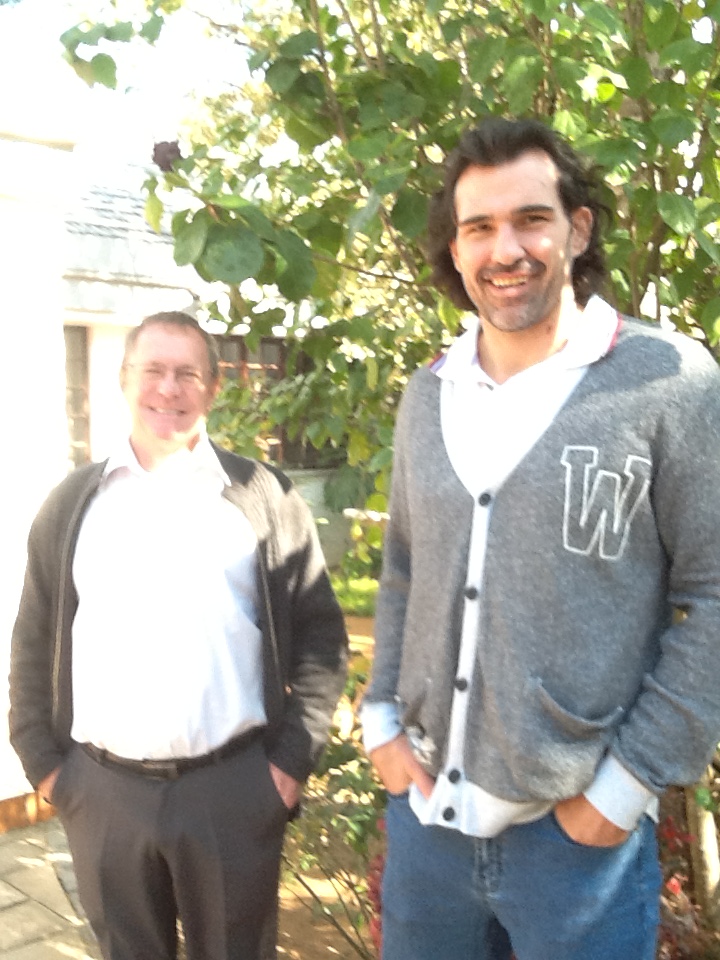 The Efficient Group’s Dawie Roodt has recruited Springbok rugby player Victor Matfield as a Brand Ambassador, to help educate people about investment products, and to help boost the group’s image and business. To find out how this works, and how things have gone in the first year, ZA Confidential caught up with Dawie and Victor.
ZAC: Why a Brand Ambassador, and why Victor?
Dawie: The obvious reason to approach Victor was because of his profile as the most recognizable SA sportsman, at the prime of his career. We want to be a bit different. As a sportsman of his calibre, he is a great representative of what South Africa has become. He is a new South African. I think the majority of South Africans cannot retire financially independent, as a lot of people are not that well versed and do not plan for retirement. We have approached Victor to see how he manages his own affairs, and he is not too different to other South Africans. We aim to make him financially more literate – to get advice, have a proper budget, and choose the right products. He is a guinea pig who has achieved something amazing in his own field.
ZAC: You seem to suggest he was the obvious choice?
Dawie: We discussed who we wanted and we all agreed Victor was the best choice. It was easier to put the deal together than I had expected.
ZAC: What are the challenges facing rugby players, whose careers tend to be shorter than the normal working lifetime?\
Victor. As we get older in rugby, we talk about more than just girls and rugby. The biggest problem is how we manage the money we earn. We earn well at an early stage, and spend money on anything. But in the later stage of our careers, a lot of people come to us with ventures – and a lot of players lose their money. If young players can come to a company like the Efficient Group, a lot more rugby players will be able to retire and look after themselves and their families. If you can get players to have a house and two cars and no debt when they retire, they are in a good space. A lot of players get used to a certain type of lifestyle, and at 32 or 34 that kind of income is difficult to match. Eighty percent of rugby players are not where they should be when they retire.
ZAC: Dawie, how do you and Victor work together in promoting the Efficient Group and its products?
Dawie: To be a successful financial service company you need far more than an economist. You need a professional team behind you. Victor is a very strong leader and when we do presentations I talk about the economy and he talks about a team. I was surprised to see how these two concepts fit together in a good way. He has taught us a lot about leadership and team play. Initially it was an agreement which was to run for two years and we are now talking about extending it.
ZAC: Victor, do you expect this to be more than just a limited relationship? And how do you find the time for this?
Victor: When we started I said I don’t just want to do this for two years but want to learn more from the company. Hopefully after the first two years there can be a longer relationship. It takes some of my time, but it is all about time management. So far we have been able to manage it.
ZAC: What are you teaching Victor about the world of finance?
Dawie: He has had a few classes in economics and he will end up in asset management.
ZAC: And how much of a draw card is Victor?
Dawie: We have been to a couple of places. If you walk with Victor anywhere, you don’t stop because a queue forms. He is always so nice with everybody. Everybody know him, and clearly we made the right decision. I have done presentations with him and he is an excellent speaker and a great motivational speaker.
ZAC: You are a well-known Afrikaner and so is Victor. Is there a danger you might squeeze out other sections of South African society?
Dawie: If I look at how many journalist call me for comment, I get far more calls from English speakers. I get invited to address all sorts of fora. It is simply not the case we at the Efficient Group just have Afrikaans clients. But it is not easy to get qualified individuals from all parts of society. Victor does not represent Afrikaans or rugby; he represents South Africa.
ZAC: Do you agree, Victor?
Victor: Yes. I am Afrikaans speaking, but I take more photos and am approached by more black people than white people. Some people don’t understand the pull rugby has in the black and coloured community, especially the Springboks. I am not here as an Afrikaner, but here as a South African.
ZAC: Finally, Victor, how has this relationship made a difference to you?
Victor: A lot of our presentations suggest a dream or goal on how you want to end up financially. You have to have discipline, and then you can achieve your goals. Some people have different goals. Some people want to drive a Ferrari at 35. Other want to retire at 50. I am very impressed with the Efficient Group. I have moved all my things (investments) here.
Conclusion:
This appears to be a win-win situation for both parties, and Victor and Dawie clearly get on well together and work well together. We see so much awful advertising and marketing in South Africa that it is a pleasure when you see two smart and talented people who seem to have have found the right formula.
Tweet of the Day:
Mark Twain (@MarkTwainQuote): Sometimes too much to drink is barely enough.
Funny Tweets (@Funny_TweetsQ): I’m great in bed… I can sleep for hours.
Reginald Braithwaite (@raganwald): “Don’t worry about people stealing your ideas. If your ideas are any good, you’ll have to ram them down people’s throats.”—Howard Aiken
ZA Confidential is a subscription newsletter. For subscription details or any other communication, please contact: zaconfidential@gmail.com Follow us on twitter: @zaconfidential
Trade and Industry Minister Rob Davies has been speaking on the forthcoming BRICS summit, and revealed that ZA is still lobbying for the new BRICS Development Bank to be located in Johannesburg.
He also confirmed that the substantive negotiations on a new trade deal between SA and its regional partners with the EU are over. Signing should be soon, and then it would be ratified – assuming all involved can agree to what has now been decided. (Some technical talks are still continuing). One notable victory is that the EU will recognise the uniquely South African nature of roobos tea, which some overseas players have tried to poach.
BRICS:
Davies said BRICS leaders will take the final decisions on the BRICS New Development Bank, as he called it. The Heads of State will take the decision on its location. SA has put forward ourselves as a potential domicile for the Bank. The Bank will not just provide financial support for projects in BRICS countries, but in other developing countries. Africa has a significant funding gap and we are looking to the BRICS bank to play a part. The mandate of the Bank will not be limited to the BRICS countries themselves. In the framework of the integration of the African continent, we are going for free trade areas, and going for a continental FTA. We must address the infrastructure inadequacy, which is one of the barriers to regional trade. SA has indicated our willingness and desire to offer Johannesburg as a host domicile. We have a robust and significant financial sector in ZA, which is also involved in the African continent. For the functioning of the institution and some of its key roles, being located in SA would be a huge advantage from the point of view of the efficacy of bank to fulfil that role. One of the focuses will be on Africa and locating it in Johannesburg would be a huge advantage. Our prime motivation and argument is the ability to play that role in an optimal manner.
Davies said work needs to be done to alter the pattern of SA trade with the other BRICS, which has seen massive increases. China is SA’s number one trading partner, India is in the top 10 and Brazil and Russia have risen in the league. The nature of that trade is largely that we supply unprocessed and unbeneficiated mineral products, and we import from the other BRICS value-added products. That has to change. There is a structural imbalance. That imbalance is that we import value added products and don’t export value added products. We want more Chinese buying missions and to encourage active investment. Just yesterday we saw a new Chinese automotive investment in Coega, to manufacture medium and heavy commercial vehicles. That is what we have been seeking. The BRICS Business Council is discussing the aircraft industry.
EU Negotiations on a new trading partnership:
Davies said both sides have accepted there is nothing more to be achieved by further technical engagements, except for a few tiny technical matters to be sorted out. The sealing of the negotiation process is on the cards. Together with other SACU states, we will say whether the decision is yes or no, without changes. It will mean the EU will be able to initiate its own processes, to avoid trade disruption (for some of South Africa’s neighbours). SA will have secured extra access for sugar, wine, ethanol and some fruit products – not total duty free access. We have to recognize EU geographic indicators in return, on wine, alcohol, cheeses, and some meat products. Europe, in turn, will recognise a number of ZA wine names, as well as rooibos, honey bush tea and Karoo lamb. Davies said of the negotiations that you come to a stage when you say: we have gone as far as we can. A few technical matters have to be solved but we agree we have gone as far as we can in substantive process. It is now a yes or no decision. In or out? The process of initialling, to seal the negotiation – we are moving into that now.
Hospitality:
Davies was speaking in Parliament, on a link to the Government’s Communications Centre in Hatfield, Pretoria. Journalists in Pretoria were not even offered a glass of water, and no coffee or tea. ZA Confidential does not advocate the squandering of taxpayers’ money, but the lack of hospitality by these bureaucrats defies belief.
ZA Confidential is a subscription newsletter. For subscription details or any other communication, please contact: zaconfidential@gmail.com Follow us on twitter: @zaconfidential
For our second poll of top economists, ZA Confidential asked whether the Monetary Policy Committee of the Reserve Bank will hike interest rates next week. And opinion was divided. Eight are predicting a rise, while seven expect no change. We did offer our respondents the chance to say it is too close to call, but no one opted for this third choice.
Here are the results:
Yes
Peter Attard Montalto of Nomura
Russell Lamberti of ETM
Dawie Roodt of the Efficient Group
John Loos from FNB
Theo Vorster from Galileo Capital
Ettienne Le Roux from RMB
Goolam Ballim of Stamdard Bank
Mike Schussler from economists.co.za
No
Annabel Bishop of Investec
Professor Eltie Links
Sake Economist of the Year Ulrich Joubert
Professor Raymond Parsons of NW University
Ian Cruickshanks of the SAIRR
Johannes Jordaan of EMS
Azar Jammine from Econometrix
Conclusion:
It will be a very close call. Savers would welcome a rise in interest rates, but for many millions of South Africans it would make tough times even tougher.
Tweets of the Day:
Ellen DeGeneres (@TheEllenShow): Did you see the guy who took the airline to trial for misplacing his luggage? They lost the case. #ClassicJokeWednesday
Steve Stifler (@SteveStfler): When a cop pulls you over and asks,”do you know why I pulled you over,” you might not want to say “because my tires look like donuts”
Ellen DeGeneres (@TheEllenShow): Did you hear about the kid who used a paintball gun on his art test? He passed with flying colors. #ClassicJokeWednesday
Political Humor (@PoliticalLaughs): Politicians should serve two terms. One in office, one in prison.
LifeOnTheLinks (@LifeOnTheLinks): My golf swing is like a box of chocolates: half are good and half make me want to vomit.
ZA Confidential is a subscription newsletter. For subscription details or any other communication, please contact: zaconfidential@gmail.com Follow us on twitter: @zaconfidential
It looks as if the leaders of the five BRICS (Brazil, Russia, India, China and SA) nations will give the go-ahead at their Summit next week in Brazil to the new BRICS Development Bank. This may be an important step, as it will give substance to a bloc which until now has been more of a talking shop than anything else. What do our experts make of it?
Glenn Silverman, Chief Investment Officer at Investment Solutions, and co-author of a forthcoming book on the BRICS:
The BRICS bloc has been, first and foremost, a political alliance. It has now moved to the next stage, which is arguably the more important one, with the creation of the BRICS Business Council and the BRICS Development Bank. The latter has been mooted for some time, but details are still to emerge. It’s being positioned as a major event, but that remains to be seen. It faces two key challenges at the outset regarding its relevance and its positioning against the existing Western equivalents – the IMF, World Bank and so on – and then its positioning, structure and rules within the five BRICS member countries themselves. Both provide challenges, but with that, opportunities too. We await details and then will be able to comment further. It should be newsworthy and interesting either way.
Dr Martyn Davies, CEO of Frontier Advisory:
The major project of the BRICS grouping is the proposed BRICS Development Bank (BDB). If it materialises, the new organisation is likely to be used for increased state-driven infrastructure spend around prioritised regional corridors in Africa. The South African Government seeks to draw in its BRICS partners into its foreign policy design for the region. In the same way as China and Brazil’s development banks have served as tools of foreign commercial policy, so will South Africa’s, albeit with a regional focus. Will it be a potential game changer in developmental finance in Africa’s economies? This may be premature but the new institution will undoubtedly be giving the World Bank something to think about. It is a pity, however, that the BRICS do not place much priority on discussing intra-BRICS trade liberalization. This would undoubtedly give the stalled Doha Round some impetus in the face of rising protectionism. As the BRICS becomes more increasingly institutionalised, it will begin to challenge the economic architecture set out by the Bretton Woods institutions – regarded by many policy-makers within the BRICS as obsolete and biased toward the developing world. The underlying motivation within the BRICS is to assert their own collective, but hard to define, interests against established Western ones.
John Mare, an independent consultant on public affairs, SA Director for the UK-based Business Council for Africa (BCA) and a Special Adviser in Fipra International:
Any new developmental financial institution would be welcomed but to be meaningful it should have a clear mandate and should coordinate not duplicate or inadvertently undermine other institutions or processes. Meaningfully targeted support which benefits the country concerned, and if possible its broader context, is especially relevant for Africa. Improved infrastructure is hopefully one of the targets for BRICS’ support and is critically important for African growth and stronger regionally-integrated economies, relevant on a national and intraregional basis as well as regards international relations. While sub-Saharan Africa should be a key focus for any BRICS bank, inter alia given that South Africa’s position in the group is supposedly as a bridgehead between the BRIC countries and Africa, the needs of other developing economies could also benefit – and it is hoped that the BRICS bank will not focus on the BRICS themselves to the exclusion of others. Similarly, one hopes that a BRICS bank utilises and helps build local inputs rather than only those from the BRICS.
Sandile Zungu, Member of the BRICS Business Council:
The BRICS Development Bank should make a huge difference in a world of development funding which is dominated by austerity-inspired conditionalities. Africa, in particular, will welcome the new BRICS Bank, because infrastructure rollout should happen despite the political risks that have tended to deter the IMF and The World Bank.
Peter Draper, Founder and Director of Tutwa Consulting.
In line with its foreign policy thrust on the Africa Agenda, South Africa will, no doubt, lobby for recognition of Africa as an important geography to benefit from infrastructure development funds to be made available via the BRICS Development Bank. This will be critical for South Africa, which has played the role of champion to the Programme for Infrastructure Development in Africa (PIDA), and chair of the north–south corridor connecting South Africa to the Democratic Republic of the Congo and Tanzania. This will be more so since it lost the bid to play host to the BRICS Development Bank.
Elizabeth Sidiropoulos from the SAIIA:
The Bank’s establishment will add to the growing pool of new or emerging development finance institutions, such as the Asian Infrastructure Investment Bank and the Asia-Africa Development Fund, the geopolitical dimensions of which should not be underestimated. China is playing a leading role in all of these. In size (USD 50 billion) the BRICS Bank will be some way behind the leading regional development banks, such as the Asian Development Bank (with $136 billion) and African Development Bank (with $98 billion). The World Bank is still well ahead, with $223.2 billion in subscribed capital. However, the Bank can play an important role in augmenting existing finance mechanisms, given the gap between development financing resources and developmental needs in both emerging and other developing economies.
Conclusion:
The new BRICS Development Bank should, over time, make a difference to the developing world, notably to African countries. But maybe its true significance is that it give a new institutional underpin to the BRICS club, in a way that the BRICS Business Council has to date seemingly failed to offer. However, given the track records of nepotism and corruption within the BRICS nations, it is vital that the highest standards of governance and scrutiny are implemented from Day 1. One has to worry about these things at any gathering at which Zuma and Putin are present.
Tweet of the Day:
Denis Leary (@denisleary): Fat guy who fell asleep during Boston/Yankees game sues ESPN for calling him Fat Guy Who Fell Asleep During Boston/Yankees Game. USA! USA!
ZA Confidential is a subscription newsletter. For subscription details or any other communication, please contact: zaconfidential@gmail.com Follow us on twitter: @zaconfidential
The automotive sector gives a pretty good insight into what is happening in the wider economy, so it is always useful to get a perspective from vehicle finance house WesBank. Their Q2 Vehicle Sales Confidence Indicator was presented this morning by Cyril Zhungu, General Manager of WesBank’s Motoring Division. Here are a few highlights:
– Negative factors affecting the environment include low GDP growth, high fuel prices, rising inflation and interest rates.
– There was a slight drop in confidence in the latest quarter, of 5.5%, Q on Q, or 12.7% year on year. Despite this, there is some positive sentiment in the market.
– There is a move to buy used cars from new ones, as consumers continue to look at price and value.
– Labour disruptions remain a big concern. BMW and General Motors plants are already affected by the latest strike.
– Applications for finance have been artificially boosted by the credit amnesty in April.
– Customers are taking steps to stay in the market and still purchase vehicles – by structuring transactions to maximise the repayment period, but the average contract period is stabilising around 68 months.
– People hold on to cars for longer. Around 36 months on average.
– Manufacturers are stimulating the market with incentives.
– A lot of people seek so-called balloon payments, where there is still a sum owing at the end of the contract time, to make vehicles more affordable. At around 18% of transactions.
– Cost of motoring continues to rise. The cost of fuel is the big factor putting customers under strain – affecting confidence levels.
– Any big hike in interest rates will have a huge impact on the economy.
– A fall of 3% to 5% in vehicle sales is predicted for this year.
– If there is protracted industrial action, it will have a significant impact in the second half of this year.
– Repossessions have ticked up, together with arrears. The rise for WesBank hasn’t been as significant as in previous downturns, as it has become more prudent about its lending.
Conclusion:
People continue to buy cars, and to finance them, but it is tough out there, with motorists under strain and the economy limping along. We must keep an eye on this sector for continued information on the real impact of rising fuel prices, higher interest rates, e-Tolls and other horrors.
Hospitality:
On what must be the coldest day so far this year, a cold breakfast buffet was on offer. To add to the discomfort it was served outside in an open area with a canvas roof. WesBank may know a lot about cars, but if you are ever invited to breakfast by them, be advised to eat before you get there.
ZA Confidential is a subscription newsletter. For subscription details or any other communication, please contact: zaconfidential@gmail.com Follow us on twitter: @zaconfidential
There are few strategies more important than making adequate provision for your golden years. A bad retirement strategy, or lack of one, can lead to misery and poverty. Proper provision can ensure comfort and dignity in old age. There has recently been discussion in Australia of moving the retirement age beyond the current 65, to give people a few more years to provide for their retirement. We discussed this, and a few other issues around retirement planning, with Craig Aitchison, GM of Corporate Member Solutions at Old Mutual Corporate:
ZAC: What are the benefits to the individual of a later retirement age, moving, say, from 65 to 70?
CA: For an individual who is saving for their own retirement, it gives them a double benefit. First, they have a few more years to grow and even contribute to their retirement savings. Second, they need a little less savings because they have shortened the time they might spend in retirement. This all translates to being able to afford a higher income in retirement.
ZAC: What are the benefits to the state/the economy?
CA: For a nation like Australia or the UK, where they want to increase the age at which their state pension is paid, it helps reduce the burden to the state of the state pension. The state pension is becoming unaffordable in these countries. The state pension is usually paid for by the tax payers, and with people living longer and longer, there are now far more pensioners for tax payers to support. Extending the retirement age helps manage this impact.
ZAC: Is such a move to a later mandatory retirement age likely in ZA?
CA: It is unlikely in the foreseeable future. South Africa has actually gone the other way, decreasing the age at which the State Old Age Grant (SOAG) is available, down to age 60.
ZAC: If there is no change, can you suggest a few other ways in which people can better prepare or provide for their retirement?
CA: The best advice I heard was:
1. Start saving as early as you can
2. Never cash in those savings until retirement – especially when you change jobs
3. Save as much as you can
4. Save a regular, budgeted amount every month.
ZAC: Do you think employers and the financial sector could do more to advise people of the possibilities and pitfalls surrounding retirement planning?
CA: According to our research, employees would like assistance from their employers, in particular in the form of information and literature, financial planning workshops and access to face-to-face advice.
ZAC: Many people move from job to job during their working lives. What are the dangers of this, in terms of securing and growing their retirement savings?
CA: Currently our retirement system allows employees to receive cash for all their retirement savings that they have built up with their employer. This is very popular option which most people take, with the result that the money is used for something else. The impact of this on the amount of savings we have at retirement is massive, and one of the main reasons why on average retiring employees face a 70% drop in income.
ZAC: Do you think the tax system in ZA could be more supportive of those who do save for their retirement? If so what might be done?
CA: I think the tax support is reasonably good in South Africa. In fact, changes announced to the tax system which will come into effect in March 2015 have actually increased tax deductions for most employees who make retirement savings contributions. Part of the challenge in South Africa is to help people moderate their use of debt, and to make saving a part of our monthly budget, so that we do so in a regular, planned way.
Conclusion:
Retirement provision is a bit like birth control. If you don’t get it right in advance, there isn’t much you can do once you are in trouble.
Tweets of the Day:
Steve Stifler (@SteveStfler): Was drinking at the bar, so I took a bus home. That may not be a big deal to you, but I’ve never driven a bus before.
Zen Moments (@Zen_Moments): Give a man a fish and he has food for a day; teach him how to fish and you can get rid of him for the entire weekend. ~ Zenna Schaffer
ZA Confidential is a subscription newsletter. For subscription details or any other communication, please contact: zaconfidential@gmail.com Follow us on twitter: @zaconfidential
For this week’s podcast wine tasting, we return to the vineyards of Ayama to taste their 2012 Pinotage. Michael Olivier introduces the wine to studio guests Dino Fagas from Prosopa and Al Dente restaurants in Pretoria, and to Malcolm MacDonald from Tersos:
 ZA Confidential