A black Bond? It’s an apparently unproblematic and straightforward question, right? Well, not quite. When suggested quite quizzically by a colleague, it sparked a series of reactionary positions in the staff room, especially from the 007 traditionalists.
In fact, whispers that the very suave – and yet indisputably black – actor Idris Elba could potentially play Bond have ignited social commentaries about race, filmic representation and literary integrity around the world.
The issue was shaken and stirred (sorry, I couldn’t help myself) by a recent report in the Daily Star, in which director Antoine Fuqua recalled a discussion with Bond producer Barbara Broccoli, who allegedly said “it is time” for a black actor to star as 007 and that she is confident “it will happen eventually”.
Interestingly, this little nugget sat at the top of a story about Fuqua launching his latest business venture – an app that allows people to listen to movies online with surround sound. But reporters know how to sell stories to their editors and so the headline, main picture and the first half dozen paragraphs were devoted to Elba’s Bond prospects.
Despite the fact that Fuqua’s management subsequently insisted that the conversation was “made-up stuff”, the question of Elba as the new Bond dominated the comments below the story, which included one reader asking: “What would be the outcry if Martin Luther King was played by a white bloke?” What indeed?
Elba’s no mug. He knows how to fan the flames of speculation. And I’m unashamedly going to fall into his trap. So is it time for a black James Bond? What the heck – why not?
Tall, dark and handsome
Is it beyond fictionalisation – or the limitations of our individual and cultural imagination – to comprehend a reality in which there’s a devilishly handsome and sophisticated black Englishman with an MI6-approved licence to kill. It gives new – or should I say restores (in my humble opinion) the original – meaning to “tall, dark and handsome”, right? Everything that Bond is supposed to be.
Wouldn’t it be more surprising, and perhaps unsettling, if such an imagining, even in fiction, couldn’t withstand the assumed fragility of our liberal mindedness? Especially when we are supposed to live in a post-racial society where – ironically – inequalities, discrimination and oppression are nonexistent. If they are nonexistent in the material world, it seems they are alive and well in the figments of our imagination.
Cast your mind back to the media’s preoccupation with Prince Harry and Meghan Markle’s “racially progressive” interracial union, or France’s international posturing as a bastion of ethno-racial equality, with its “colourblind” government prohibition on referencing the race and ethnicity of its citizens. Is that enough to convince you that we live in a multicoloured land of bliss where all is possible?
Rallying against this romanticism are traditionalists – or Bond literalists – who, in all their intransigent preoccupation with conserving the historically white purity and scriptural heritage of the Bond franchise, are irked at a blackened prospect.
They offer a plethora of counter arguments, not least that in 1953 Casino Royale, the first in Ian Fleming’s 12-book Bond series, the secret agent is described as a white Englishman of part Scottish and Swiss heritage who was educated at Fettes College.
To which I submit: we aren’t in the 1950s. The films are no longer time-warped in black-and-white – they have changed and adapted to reflect the cultural zeitgeist of cinematic and contemporary public consciousness.
It’s interesting to note that these purists are not all white – disproportionally so, yes – but not all. Some non-white Bond enthusiasts have also put in their own two cents’ worth, asking producers to “stick to the script” and insisting that being white is integral to Bond’s character. But can we racialise character?
Others, meanwhile, have called for their own black, Walther PPK-wielding agent, in the manner of 007, to not only tell their own new or complimentary stories but also avoid falling prey to potential accusations of tokenism in film.
Colourblind casting
Meanwhile, JK Rowling decried critics of the casting of black actress Noma Dumezweni as the fictional Harry Potter character Hermione Granger, as “a bunch of racists” and that “white skin was never specified”, challenging normative assumptions that fictional characters are white, by default.
Supporters of Bond’s racial metamorphosis urge for better ethnic minority filmic representation in the spy genre and stress that fiction is not exempt from transformation even in the context of race. It’s a sentiment I share.
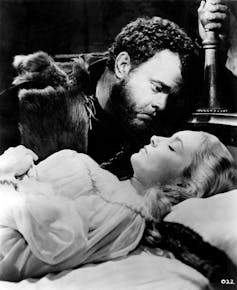
Colourblind casting? Orson Welles as Othello. United Artists via Wikimedia Commons
I realise that my openmindedness unlatches a Pandora’s Box of “Whatabout-me-isms”. What about a polyamorous, gender-nonconforming, effeminate, anti-misogynist Gujarati Indian as Othello? Or, can I, as a Liverpudlian-accented, shaven-headed, transgendered lesbian, play Sherlock Holmes? Then again, what about a white Shaft? But wait wouldn’t that be “Whitesploitation”? Let’s not go there.
Would Elba make a fine Bond? Absolutely. Having seen 007 in all his white iterations, I’m all for a representational shift towards a salt-and-peppered Afro-textured, mahoganied urbanite. Too far fetched? Surely not.
Africa’s wild lion population is estimated to be between 20 000 and 30 000. Researchers have good reason to believe that the real number is closer to 20 000. This puts lions in the “vulnerable” category of threatened species.
The categorisation masks important realities. The only growing populations are those in fenced reserves with small wild managed populations. This is not only a species crisis. It’s also an ecological and economic crisis. Lions are apex predators, which means that entire food chains and ecological systems depend on healthy populations. Lions are also a significant tourism drawcard, and tourism is a significant employer.
South Africa, uniquely, also allows the breeding of lions in captivity, most of which have no conservation value. It has an estimated 7000 to 8000 lions in captivity across roughly 300 facilities. These lions are predominantly bred for canned hunting and the Asian predator bone market.
But, following a global campaign, the demand for canned hunting has plummeted in the last few years. Environmental lobby groups argue that lions are now increasingly being killed for the bone trade.
A report prepared by by EMS, an activist charity, and the lobby group Ban Animal Trading, shows that lion bones are sold on the black market as tiger bones. The bones are dropped into rice wine vats and sold as tiger bone wine which is promoted in Asian markets as a treatment for rheumatism and impotence. The bones are also used to produce tiger bone cakes, an exotic small bar of melted bones mixed with additives like turtle shell.
Captive breeding is perfectly legal, if distasteful. But there are limits on the trade of lion bones. In 2016 the 17th CITES Conference of the Parties decided that no bone exports should be allowed from wild lions. But the conference also agreed that South Africa should establish a quota for skeleton exports from captive-bred lions. Captive breeding only occurs at scale in South Africa, so no other country is permitted to export lion bones.
A year later the Department of Environmental Affairs set an annual lion skeleton export quota at 800. It raised this to 1500 in July 2018. It did so without public consultation or the support of research. Even an interim report prepared for the department by the South African National Biodiversity Institute did not specify grounds on which to establish, or expand, a quota.
On top of this, there’s poor regulation of lion breeding facilities. The department doesn’t have a working database, so doesn’t know how many facilities there are, or what the total number of captive-bred predators is.
How it works
In my new report, I discuss how breeding facilities are linked to the trade in lion bones.
The facilities arrange hunts that cost in the region of $22 000 for a male and female combination. Wildlife researcher, Karl Amman, describes how trophy taxidermists then sell the lion skeletons (without the skull) on to buyers. These are usually in Asian countries. A skeleton can fetch $1500.
The importer then sells the bones on for between $700 and $800 per kg. A 100kg lion yields about 18kgs of bone, worth roughly $15 000 at this point in the supply chain. The bones are then imported into Vietnam, boiled down in large pots to yield 100g bars of cake which are sold for roughly $1000.
Conservationists are concerned that South Africa’s quota provides an incentive to breed lions not only for the bullet, but also for the bone trade.
The 2017 quota was fully subscribed within weeks while a newly released report prepared for CITES suggests that 3469 skeletons were exported that year, nearly double the allocated number.
This rise in the trade of lion bones shouldn’t come as a surprise. In 2016 the US banned the import of captive-origin lion trophies from South Africa. Breeding facilities began looking for alternative markets. Selling lion carcasses was an obvious option given that a lioness skeleton fetches roughly R30 000, and a male skeleton about R50 000, when sold to a trader.
The predator breeding industry in South Africa argues that captive lion populations serve as a buffer against wild lion poaching because it can satisfy the demand for bones.
But those who oppose the trade in lion bones cite evidence that suggests the opposite is true. If anything, the quota could fuel the demand for lion products and provide a laundering channel for illegally-sourced wild lion parts. This may imperil already vulnerable wild lion populations elsewhere in Africa. It also makes law enforcement extremely challenging: officials cannot be expected to distinguish between legal and illegally sourced bone stock.
What is being done about it?
The public outcry over an apparently arbitrary quota has been notable. The backlash against canned hunting and the bone trade has been similarly vocal.
The arguments against the trade have been put on the table at a two-day colloquium in South Africa’s parliament. The question being asked is: does the captive lion breeding industry harm, or promote, South Africa’s conservation image?
Ultimately, it is parliament’s job to hold the government to account. The colloquium may go some way towards doing so. It may even end the brutality of captive predator breeding.
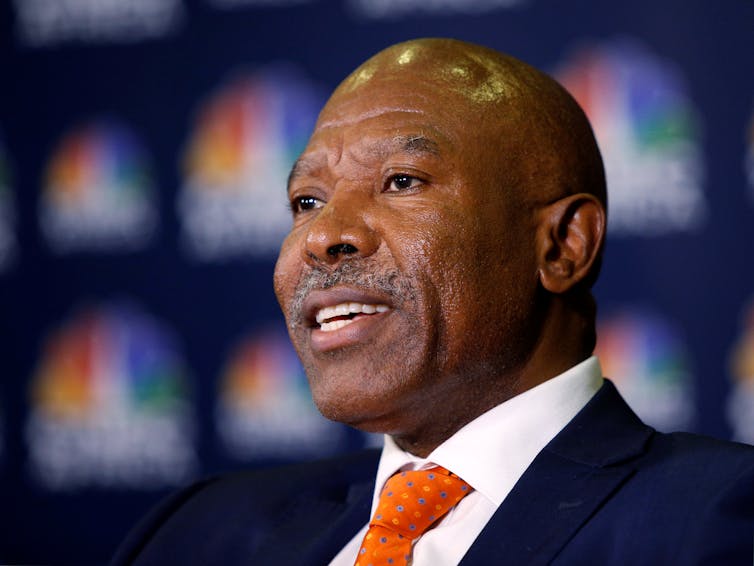
Central banks everywhere play a critical role in shaping the direction of a country’s economy. The South African Reserve Bank is the central bank of South Africa. Its main mandates are to ensure financial and economic stability and to regulate the banking sector. It achieves the first thorough monetary policy which involves targeting inflation to prevent borrowing costs from rising and competitiveness of the economy from deteriorating. But the bank has been criticised for focusing too much on curbing inflation – it keeps inflation within a target range of 3% to 6% – at the expense of economic growth. And the banking regulation arm is also facing a barrage of questions. The Conversation Africa organised three economic scholars to pose questions to the Reserve Bank Governor Lesetja Kganyago.
Nimisha Naik, Wits University – How should the Reserve Bank respond to the country’s recent credit rating downgrade? What approaches can it take to limit the potential decrease in investments to South Africa?
Lesetja Kganyago: A rating downgrade implies higher risk for investing in a
country. As such (everything else being equal) a higher return is required to attract the same amount of foreign capital necessary to finance South Africa’s current account deficit.
As markets shift to reflect the higher return needed, the country’s currency might weaken. This adjustment may be compounded by foreign funds having to divest from South Africa as their investment mandates prevent them from holding non-investment grade assets.
But a credit rating downgrade need not trigger a reaction from the Reserve Bank, unless its impact on capital flows and the exchange rate jeopardises price stability.
Raising the repo rate – the rate at which the central bank lends to commercial banks – by itself would do little to attract new investments. This is because only a small part of capital flows into the country consist of short-term money market investments. Most are made up of purchases of longer-term bonds and equities.
But failure to deal with the inflationary consequences of currency depreciation, which pushes up import prices and potentially all prices, would also push up both short and long term borrowing costs. This could eventually endanger the policy framework we have in place. As the commitment to low inflation weakens, investors will push up their expectations of future inflation, which further increases borrowing costs. This would, in turn, exacerbate capital outflows and push the currency down and prompt stronger inflation, in a vicious cycle.
The Reserve Bank has tended to think that, over time, such a negative outcome from a downgrade has become less likely. Market expectations of higher borrowing costs had already reached levels similar to those of lower-rated, non-investment grade countries even before the 3 April Standard and Poor’s rating event. This implies that the market had mostly “priced-in” the downgrade.
Also, at the moment the global context is unusually supportive of emerging markets. Interest in riskier assets is being sustained by higher commodity prices and better global growth prospects. These factors in turn suggest that short-term selling of rand-denominated assets may be relatively muted.
Nonetheless, further downgrades, in particular to “local currency” ratings, would again lower prices of assets and raise the cost of financing in the economy. This would be clearly negative for South African borrowers, domestic financial institutions and economic growth more generally.
Professor Alan Hirsch, University of Cape Town – The recent budget showed that the National Treasury is tightening fiscal policy. Does this provide scope for monetary policy loosening?
Lesetja Kganyago: There are two major channels through which fiscal policy tightening can interact with the monetary policy stance. Firstly, curbing private and public-sector spending growth normally dampens demand-driven price pressures. These are pressures caused when demand for goods and services cannot be easily met by increased production of those goods and services, resulting in higher prices for them. Secondly, reassuring investors about the medium-term sustainability of debt levels limits the risk of capital outflows – and therefore downward pressure on the rand.
The moderate tightening in South Africa’s fiscal stance over the past three to four years has gradually lowered the amount of annual borrowing from around 4% to about 3% of GDP. This is expected to continue over the next two years.
Some of this fiscal restraint has occurred through tax increases. Expressed as a share of pre-tax disposable income, direct household taxes increased by 1.5 percentage points between 2012 and 2016.
Another part of the fiscal consolidation has happened through a nominal spending ceiling which is an absolute rand value for spending in a given year.
A sustainable fiscal trajectory for deficits and borrowing is an important influence on the cost of capital in the economy generally. Greater borrowing by the public authorities can put upward pressure on interest rates.
While government spending has contributed to South Africa’s recovery from the global recession of the 2009-2010 period, the impact of the higher cost of borrowing weighs more heavily on economic activity as borrowing continues year after year. This appears to be where the country is now. Spending contributes less than it did earlier to sustained economic growth, in part because the cost is higher.
As a contribution to short-term economic growth, government and private debt has probably become a constraint. Fiscal space is being re-opened as government debt levels stabilise and the economy’s growth rate strengthens. Household debt levels have also come down in recent years, especially in 2016. This also creates space for stronger consumption growth over the longer-term.
As the fiscal consolidation progresses and deficits work down, both inflation and interest rates should moderate. This is helpful to monetary policy. It has, and should, continue to facilitate the Reserve Bank’s gradual and flexible approach to getting inflation sustainably down towards the middle of the target band of 3% to 6%.
Professor Alan Hirsch – As global interest rates rise this year, will the Reserve Bank be able to delay reciprocal increases in order not to stifle South Africa’s meagre growth. And to allow its currency to continue to favour exporters?
Lesetja Kganyago: The rise in global interest rates will tend to depreciate other currencies, except those of economies that will get a strong and direct growth benefit from more robust growth in the US. But domestic conditions are critically important. The inflation targeting framework provides room for flexibility, allowing the Monetary Policy Committee to choose what weight to place on external and internal factors in deciding policy.
Policy is not bound to follow interest rate decisions of major central banks. This is unlike countries that use the exchange rate targeting framework for achieving low inflation. As the Monetary Policy Committee has noted, domestic economic growth has been weak and this requires policy settings that are supportive. For these reasons, “de-coupling” of interest rates is a common feature of growth and policy cycles.
This implies that some currency depreciation has been expected in recent years. And indeed this has happened. In this context it’s been important for policy to focus on whether depreciation will generate future inflation. Up to now we have been fortunate this “pass-through” into domestic prices has been less than would normally be expected.
This may, in part, be because of lower commodity prices and terms of trade and the more generally weak economy. The upshot is that we have gained competitiveness as the nominal exchange rate has depreciated, without much stronger growth in domestic inflation. This has helped to keep interest rates at near historically low levels since 2010. This has supported the recovery in the economy, while still keeping expectations of future inflation just within the target band.
Professor Jannie Rossouw, Wits University. – Does the existing structure of private shareholders still serve the best interest of the Reserve Bank and South Africa?
Lesetja Kganyago: The Reserve Bank’s shareholding structure is unusual, yet not unique in the world of central banking. At present, eight central banks in the world have a degree of private ownership. These include the US Federal Reserve, the Bank of Japan and the Swiss National Bank.
Historically, most central banks were privately-owned. This pattern changed drastically after the Great Depression of the 1930s. Back then, many governments felt that the conflict between private shareholders’ interests and the public policy mandate of these institutions had in some cases prevented appropriate policy responses.
But several safeguards ensure that the Reserve Bank’s shareholding structure does not pose such risks in South Africa. In fact, the Reserve Bank’s private shareholders have no influence on the Reserve Bank’s key mandates of price and financial stability.
The Governor and his or her deputies are appointed by the president of the country. And the SA Reserve Bank Act can only be amended by Parliament. The Reserve Bank’s functional independence is enshrined in the Constitution. Equally, as per the spirit of the constitution, the inflation targeting framework has been determined through a consultative process between National Treasury and the Reserve Bank.
Provisions of the Act further stipulate that no individual shareholder, including his or her associates, can hold more than 10,000 of the existing 2 million shares. It also caps the dividend at 10c/share. These prevent any attempt by shareholders at extracting significant profits from the institution, for instance through the sale of its assets.
Overall, the role of the Reserve Bank’s private shareholders remains one of oversight and can improve governance. This happens, for example, through the tabling of an annual report and financial statements at the annual general meeting of shareholders.
While international experience does not suggest that the shareholding structure of a central bank meaningfully affects its performance, there is equally no obvious case for changing such a structure in South Africa at present.
Professor Jannie Rossouw – What needs to happen before there can be a debate about a lower inflation target, say 3% – 5%?
Lesetja Kganyago: South Africa’s inflation target range is both relatively wide and high by international standards, including among emerging countries. At the time the 3%-6% target was adopted in the early 2000s, South Africa remained an economy in transition, having recently faced renewed exposure to global economic volatility.
The economy was thus exposed to shocks, and it was felt that a relatively wide and high target would be more credible in such a vulnerable environment. The strategy seems to have borne fruit: compliance with the target has improved over time despite greater currency volatility. Inflation, as well as inflation expectations and wage growth, display lesser volatility than in the early years of the targeting regime. And the policy appears to have gained growing acceptance, over the years, from respective stakeholders.
But a relatively wide target can create uncertainty as to the actual objectives of monetary policy. In the South African case, this lack of clarity has resulted in an anchoring of inflation expectations at the upper end of the target range, which now restrains the margin of policy manoeuvre in the event of exogenous shocks.
In addition, the persistence of higher inflation in South Africa relative to its major trading partners introduces a medium-term depreciation bias to the currency, which will raise the risk premium on domestic interest rates. Achieving a lower inflation rate would help ease these constraints on the economy. Whether a more efficient target (using a point, a lower target, or being more explicit about where in the band is the best inflation rate) could help achieve such an outcome is an open question for economists to consider.
The target was revised to 3%-5% in 2001 but after the currency depreciation that same year the range was revised back to 3%-6% with the proviso that once inflation is back within the target then the 3%-5% target range will be reinstated. This has not happened yet.
Professor Alan Hirsch – What has the Reserve Bank learned from the Barclays/ABSA saga? Will it be more circumspect in allowing foreign investors to buy thriving South African banks in the future?
Lesetja Kganyago: The Barclays Plc separation from Barclays Africa Group (trading in South Africa as Absa Bank) has renewed the policy debate on foreign ownership of the large South African banks at the Reserve Bank. The debate is also back because of the regulatory reforms imposed by the Basel Committee and the Financial Stability Board on global systemically important banks following the global financial crisis.
These reforms imposed various additional requirements on global systemically important banks. This has filtered down to their significant subsidiaries operating in different jurisdictions, including emerging markets. These subsidiaries then need to compete with other local banks that don’t need to meet those global systemically important banks requirements, contributing to an uneven playing field.
The Reserve Bank is supportive of and welcomes foreign ownership of South Africa’s large banks. But it remains cautious against controlling ownership by a global systemically important bank, as this could result in onerous regulatory requirements being imposed on the local operation.
The actual separation is also closely monitored as the local banking operations have become closely aligned and integrated on IT systems, infrastructure and processes with their parents. As such any separation needs to ensure that the local subsidiary remains operationally stable during and after the separation.
When the Banking Registrar assesses new investors applying to acquire a stake in any bank, its office conducts a fit-and-proper assessment. This is to establish the strategic intent of these investors. It’s to see whether the investment is expected to be long-term in nature, how the investment will be funded and how the investors plan to fulfil their fiduciary duties, including in terms of governance.
Don’t get me wrong. I am no food snob. One of the most delightful treats for me is to find that uninspiring-looking Indian shop which makes brilliant Samosas, a downtrodden Portuguese joint with perfect prawns, a greasy burger joint which offers a brilliant bite.
So I am always happy to nosh in a place which is more a caff than a restaurant. With the single proviso…that it must be good.
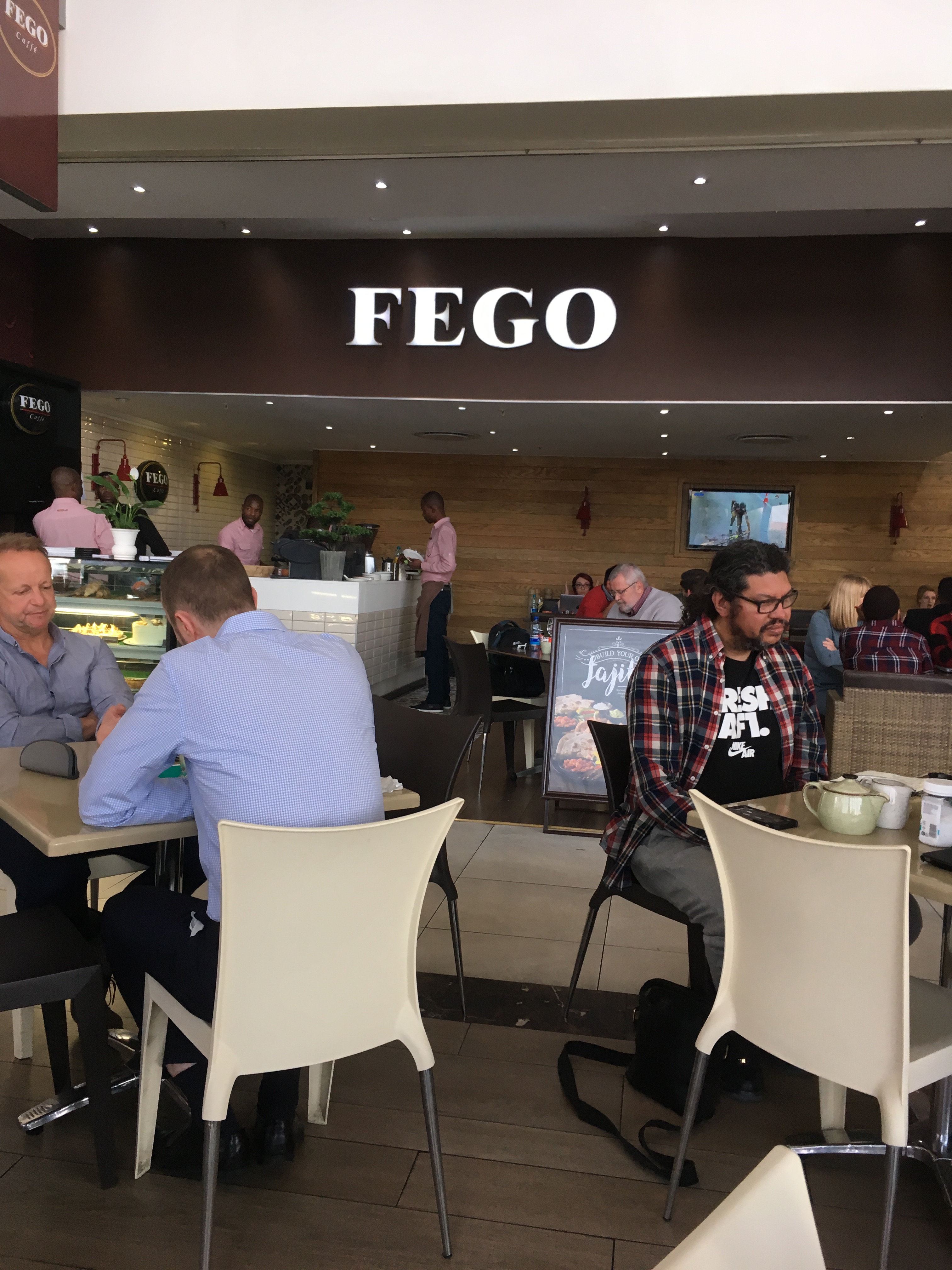
I was happy to meet up recently for lunch with my biker mate Jeff at the Fego caff in the Nicolway mall.
The menu, I think, had a choice of four wines. We went for the red. A Durbanville Hills Merlot. Enjoyable.
However, this is the land of great wines. Even a few specials would have been appreciated. If you have a license to serve booze, why not do so with imagination?
He ordered a chicken in lemon, served on couscous. A generous portion. Should have been called couscouscous.
I went for the special, which turned out to be anything but – the Chicken Fajita.
The tortilla was so dry and tasteless that I suspect I would have had more fun had I piled the filling on the menu.
It came with guacamole (tasteless) sour cream (tasteless). A few other unattractive blobs of stuff, and shrivelled little chunks of very-dry chicken. Awful and tasteless.
When asked whether I was enjoying my meal, I asked why they had a special which was so awful, and was promised a free pudding in compensation for my torment.
We each had a slice of carrot cake, which was nice and moist, tasty, but so large that it was off-putting. Less would have been more. Much less.
The carrot cake (which we had been offered, remember) was nonetheless slapped on the bill. An indication of the feeble level of service, customer care, and attention to detail.
Will I be back to Fego? Feget it!
Rating: I give it a 2*
Key to the Ratings….
1* Dog food is nicer
2*. Cat food is nicer
3*. Not bad if Woolworths is sold out of ready meals.
4*. I like it
5*. I love it. Not to be missed.
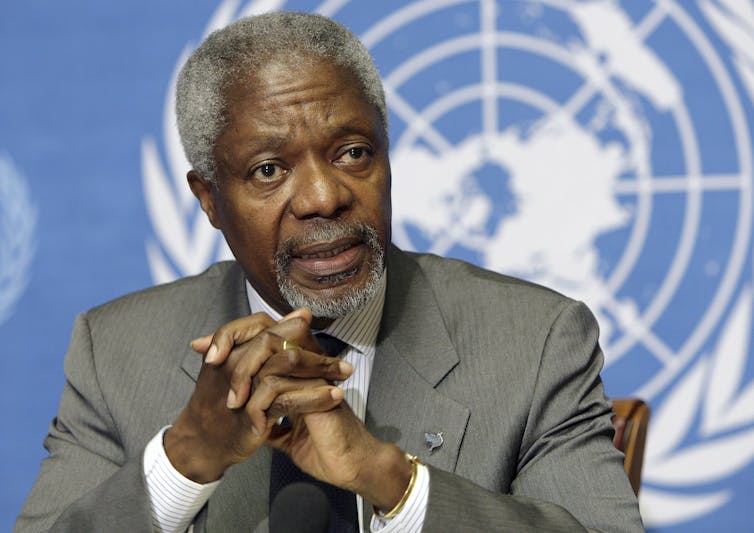
Kofi Annan (80) was an important historical figure who played a critical role in many key events of the 1990s and 2000s. His death is therefore an opportunity to both celebrate his life and to begin honestly assessing his contributions to the world.
The Ghanaian diplomat’s legacy is complicated. He served as both head of the United Nations peacekeeping and as Secretary General of the UN. His tenure in these high offices – from 1992 to 2006 – were marked by great human tragedies as well as episodes of progress. His role in these events raises difficult questions about individual responsibility and the role of international organisations and their leaders in creating a more peaceful and just world.
On the plus side, his contributions were impressive. He was an effective diplomat, a shrewd negotiator and an intelligent strategist. He was such a successful bureaucratic operator that he was the first UN employee to rise to the position of Secretary General.
When he took over the organisation it was facing numerous challenges. They included a tense and often hostile relationship with its most powerful member state, the US, a difficult budgetary situation and what appeared to be an inability to fulfil its core peacekeeping, human rights and development functions.
By the end of his term, things looked very different. Relations with key member countries had been restored, the UN had a sound fiscal position and both he and the organisation had won the Nobel Peace Prize.
In addition, the organisation had launched some important new initiatives. It had adopted the Millenium Development Goals, which contributed to significant gains in health, education and human welfare in many countries around the world. The initiative was so successful that it was succeeded by the even more ambitious Sustainable Development Goals.
He had also initiated the process of getting corporations to recognise and accept their responsibility for the environmental, social and human rights consequences of their activities. This process moved slowly. But his efforts ultimately led to the UN Human Rights Council unanimously endorsing the Guiding Principles on Business and Human Rights in 2011. These have now been incorporated into the human rights policies of many companies and have led to a number of countries adopting national action plans on the human rights responsibilities of business.
After he left the UN, Annan continued to do good work with both the Elders, a group of global leaders working for peace and human rights, and his own foundation. In these capacities he had some notable achievements. He helped resolve the post-election violence in Kenya, helped ensure peaceful elections in Nigeria and a number of other countries, and helped promote more productive and sustainable agriculture and good governance across Africa. He also tried, albeit unsuccessfully, to end the civil war in Syria and the campaign against the Rohingyas in Myanmar.
But there’s also a darker side to Annan’s record.
The tragedies
Annan was the head of UN Peacekeeping operations in the 1990s when two of the biggest failures in UN history happened. Under his watch both the Rwandan genocide and the massacres in Srebrenica took place.
In both cases his commanders on the ground requested authority to take stronger action to limit the risk of tragedy to those under their protection. In both cases he declined their request –with tragic results.
In addition, under his leadership UN peacekeepers in a range of countries, including Liberia, Sierra Leone and the Democratic Republic of Congo, were found to be sexually exploiting those they were charged to protect. The UN failed to respond promptly to these actions and they continued into the 2000s.
In most organisations, a leader who is responsible for such profound failures would be held accountable. If not fired, or forced to resign, they would at the very least be moved to a position of lesser authority. But this didn’t happen because the UN has poor mechanisms and a weak culture of accountability. In fact, the UN and its member states, decided to promote Annan, selecting him to replace the first African Secretary General, Boutros Boutros Ghali, who was deemed to be too independent minded by the US.
Annan continued relying on the UN’s lack of accountability once he was in office. His son was implicated in the infamously corrupt food-for-oil programme that was initiated to help the Iraqi population during the period of sanctions against Saddam Hussein.
Eventually, under pressure, he appointed the independent Volcker Commission to investigate the programme. It concluded that, although Annan himself was not guilty of any wrong doing, his actions in response to the abuses were inadequate, including that he had failed to refer the matter to the UN’s independent watchdog agency.
He also tolerated sexual harassment within the UN Secretariat, protecting the former head of the UN refugee agency when he was accused of sexual harassment, penalising his accuser and then relying on the UN’s legal immunity to avoid having to respond to her efforts to seek justice. The adverse publicity eventually forced the guilty official to resign.
Lessons to be drawn
There is no doubt that running a complex international institution like the UN is difficult, and requires leaders who are willing to compromise. Given the Secretary General’s weak position, it may also be inevitable that its leaders will have to turn a blind eye to some acts and omissions that have tragic and possibly evil consequences in order to advance higher priorities.
Annan showed throughout his career that he was a master at playing this game. As a result, his record includes both some impressive achievements and some profound failures. It will be up to history to decide if he made the right choices and struck the correct balance between doing good and tolerating evil.
In the meanwhile, we should all draw lessons from the life of this important historical figure about the importance of holding leaders and the institutions that govern our world accountable for their actions and decisions.
The South African Ministry of Energy is to release an updated electricity plan this month. Analysts will be hoping it will launch the country’s power sector into a modern sustainable, clean power future, and that outdated and financially unfeasible facets of previous plans will be laid to rest.
The Integrated Resource Plan projects the country’s long-term electricity needs and defines the infrastructure developments needed to meet power production. Government uses it to work out the number and type of power stations to construct, as well as the time frames for their commissioning and the occasional retirement of old plants.
The intention was to update the plan every two years. But the last plan, adopted in 2011, is already seven years old. It envisaged a substantial increase in electricity demand from 39GW in 2010 to 68GW in 2030. The extra capacity was to come from an additional 9.6GW of nuclear power, 17.6GW from solar and wind renewable technologies (which were quite new at the time) and 6.3GW from new coal plants.
Draft revisions were prepared in 2013 and 2016. They lowered the long-term forecast for electricity consumption, expanded the proportion of renewable energy in the mix and postponed the construction of new nuclear plants, even suggesting that these might not be needed at all. The less steep electricity consumption growth rates are a consequence of technological improvements allowing better energy efficiency and the sluggishness of the mining sector.
Government never ratified the updates. There was speculation that this was because they undermined the strategy favoured by the administration of Jacob Zuma, President of South Africa until February 2018, to expand nuclear power production rapidly.
Electricity consumption projections are a lot lower now than the 2011 plan expected them to be. Even the 2016 draft projected that long-term electricity demand would be about 30% lower than estimated five years earlier.
Ten years ago, power cuts were common in South Africa. Now, with lower demand, there is a substantial surplus of electricity. South Africa has also been affected by better energy efficiency strategies that have led to energy consumption remaining steady – or even falling – in some of the world’s most developed nations.
While electricity demand in the country will still increase due to population growth, the total electricity needed will be lower than previously expected. Does the new energy plan foresee even lower electricity demand growth rates in future?
Closing the coal power plants?
The new one will provide greater clarity on the future importance of coal in the energy mix.
As a signatory of the Paris Agreement on climate change, South Africa has committed to reducing carbon emissions. This implies it will gradually close most of the existing ageing coal plants. Trade unions are gearing up for a fight against potential job losses should this happen.
One would expect the new plan to show when all major coal plants will close, except for the new Medupi and Kusile plants, which aren’t even completed yet. Closing plants rapidly would signal a serious effort to meet Paris Agreement emission targets. Longer lifespans would signify a concession to the labour sector.
It will also be interesting to see if there are any indications that Medupi and Kusile may not be developed to full capacity. That’s an option for saving costs.
Nuclear or nuke-free?
In contrast to the stridently pro-nuclear executive under Zuma, the administration of President Cyril Ramaphosa has ruled out nuclear developments in the current economic climate. As economists are not forecasting major sustained growth any time soon, this effectively rules out any major nuclear development in the coming decade.
Nuclear plants provide near constant electricity and emit almost no greenhouse gases. Despite those advantages, future nuclear development in South Africa is extremely unlikely.
The first reason is that a 9.6GW new nuclear build would be hugely expensive. In addition, recent nuclear builds elsewhere in the world have been plagued by serious delays and cost overruns.
Secondly, the South African public doesn’t trust new nuclear developments. That’s because of the irrational way in which Zuma tried to push the nuclear project ahead.
It will be interesting to see whether the plan makes provision for more nuclear plants to come online in about 2040, or whether nuclear is taken out of the mix altogether.
Will renewables become dominant?
The falling cost of renewable energy has changed the energy sector globally. Solar and wind power generation is steadily expanding in most countries, and may dominate global electricity production within the next generation.
The chief argument against wind and solar technologies is no longer cost, but rather their dependence on weather and the day-night cycle. Even that argument is weakened by better energy storage and the fact that it’s now easier to predict the weather.
It’s now possible – in theory – that a country could get all its power from renewable energy. Costa Rica may become the first to do so.
It’s unlikely that South Africa’s new energy plan will commit to 100% renewable power in the foreseeable future, but energy analysts will be keen to see the target for 2050.
Another point to look out for is cost projections for renewable power. The 2016 plan failed to base its projections on a steady downward cost trend. The new energy plan is expected to rectify this shortcoming, boosting the prospects for renewable energy.
Advances in energy efficiency and storage technologies will also steadily decrease the demand for electricity from an external supplier. Massive power plants and extensive high-voltage electricity grids will become less critical than they are now.
South Africa will be looking for a new energy plan that leads the way into the new global energy landscape.
A recent Daily Mail article announced that: “Beer is officially good for you”. The article claimed that beer “reduces heart risk” and “improves brain health”. Even if “heart risk” sounds a bit vague, the news sounds good.
But let’s take a closer look at the evidence. The Daily Mail cites the source of the research as The American Journal of the Medical Sciences. The journalist even provides a quote from the study, which was published in 2000:
The antioxidant content of beer is equivalent to that of wine, but the specific antioxidants are different because the barley and hops used in the production of beer contain flavonoids different from those in the grapes used in the production of wine.
The Daily Mail article goes on to say that beer can help to reduce the risk of developing diabetes and heart disease, it can protect cognitive function and it can boost levels of high-density lipoprotein (so-called good cholesterol) – although it’s not clear if the journalist is citing the study at this point or a nutritionist.
Before we look at whether or not beer is good for your health, we first need to look at what’s in beer.
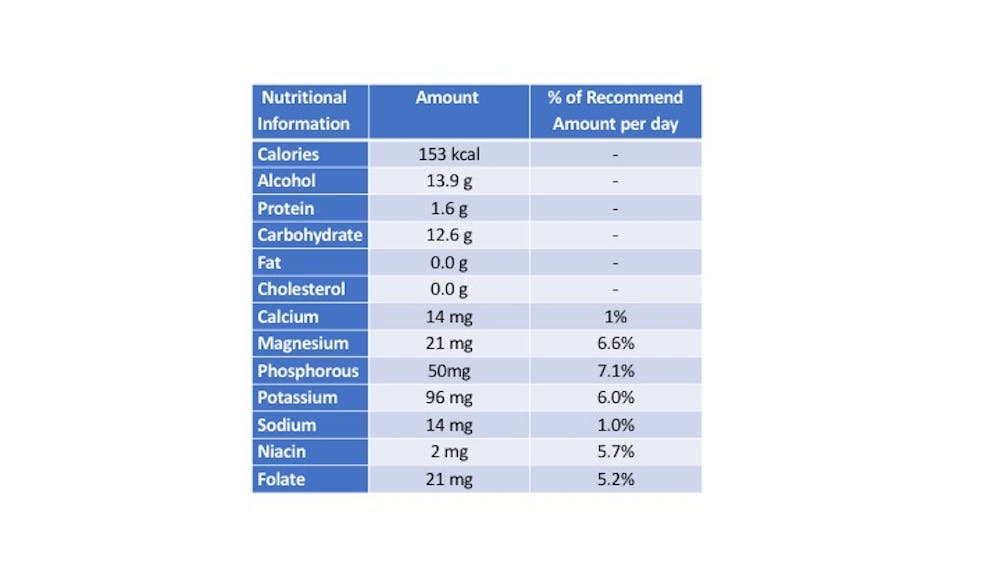
Beer is made from four primary ingredients: grain (mainly barley, but it could be other grains), hops, yeast and water. Table 1 provides a summary of the nutrients found in a 330ml serving of beer.
Table 1: The nutrition information of beer. Mayur Ranchordas, Author provided
Beer also contains micronutrients called polyphenols. Some of these polyphenols, such as flavanoids, flavanols and phenolic acids, have known health benefits, although a lot of the research has focused on wine, not beer.
But what about the specific health claims made in the article? Does beer really reduce “heart risk”? Most studies on beer suggest that low to moderate consumption could reduce the risk of heart disease. The reported effects are similar to those found in wine.
The Daily Mail article also claims that beer can “boost brain health”, although the evidence for this is somewhat shaky. A recent study that tracked 550 men and women over the course of 30 years, concluded that alcohol consumption, even at moderate levels, is associated with negative changes in the brain.
Alcohol and mortality
Previous alcohol studies showed a J-shaped relationship between alcohol consumption and mortality, suggesting slightly higher mortality for teetotallers, slightly reduced mortality for light and moderate drinkers, then an increase in mortality for heavy drinkers. However, the latest research, using more complete data, suggests that the relationship between alcohol and mortality is actually linear – the more alcohol you drink, the more likely you are to die prematurely. The only age group for whom moderate alcohol consumption still seems to be associated with reduced mortality are women over the age of 65.
It should be noted that the UK guideline for alcohol intake is 14 units for men and women, which equals about five pints of a 5% alcohol beer per week.
Ultimately, the healthy properties found in beer such as flavanoids, flavanols and phenolic acids can also be obtained from non-alcoholic plant-based food and drinks. So don’t be fooled by the eye-catching headlines; beer may have some health benefits, but that doesn’t mean it’s the healthiest way to obtain those benefits.
It should also be noted that the study quoted by the Daily Mail concluded: “There is no evidence to support endorsement of one type of alcoholic beverage over another.”




 It should also be noted that the study quoted by the Daily Mail concluded: “There is no evidence to support endorsement of one type of alcoholic beverage over another.”
 ZA Confidential