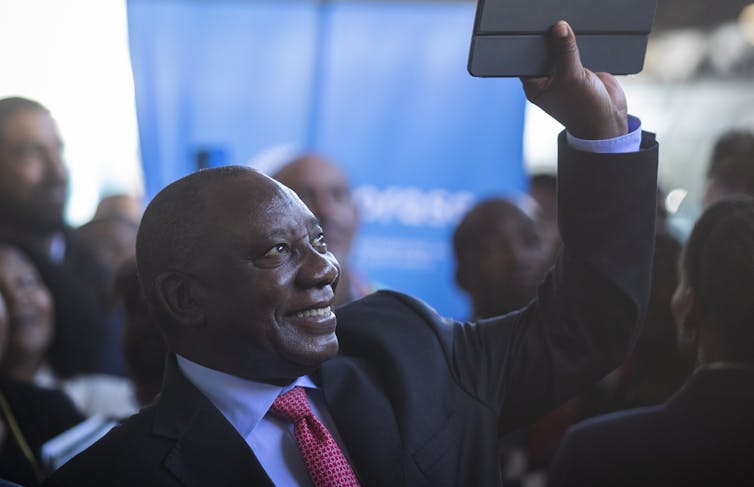
Ramaphosa’s presidency is drawing voters back to the ANC: new study

File 20190410 2912 mrfp2l.jpg?ixlib=rb 1.1
Cyril Ramaphosa, president of South Africa and of the ruling African National Congress. EPA/Nick Bothma

Leila Patel, University of Johannesburg

The latest research into the voting preferences of South Africans finds that trust in the country’s president is the single most important predictor of the potential party choices at the ballot. If voting behaviour follows suit this could be the key to understanding the success of the African National Congress (ANC) on election day – May 8.

These findings come from the second nationally representative study conducted by the Centre for Social Development in Africa at the University of Johannesburg. The survey was completed in the fourth quarter of 2018. The first study was done in the fourth quarter of 2017.

The findings suggest that recent leadership changes in the governing party and government have bolstered trust in the presidency of Cyril Ramaphosa compared with his predecessor Jacob Zuma. The research suggests that this factor is expected to be a significant predictor of voter behaviour.

To understand what the influence of Ramaphosa’s presidency is likely to be in the upcoming elections, researchers from the Centre for Social Development in Africa compared the most recent survey results with those of an earlier survey conducted during Zuma’s presidency. Trust in the presidency under Zuma was at 26%. This time around that number had gone up to 55% – 29 percentage points higher than under Zuma.

Two models for control

The study was done based on a nationally representative sample of 3 431 respondents. This is considered reliably representative of over 38 million potential voters. It’s the second of a three-part study to understand the links between socioeconomic rights and what drives voter choices in the coming elections.

To understand the shift in support for the ANC versus the opposition parties the researchers constructed two models for analysis of the most recent survey results. This was to control for the change in leadership.

When Ramaphosa was removed from the equation, governance or trust in institutions such as parliament and the courts was no longer a predictor of voter preference. But when inserted as a factor on its own and independent of trust in institutions, trust in the presidency emerged as the single most important predictor of voter preference for the governing party in the upcoming elections.

These findings echo other recently released studies and polls which predict that the ANC is likely to win the upcoming general election.

Differences between the first and the second survey

Our first survey in 2017 was conducted at the height of the leadership contest in the ANC. At that time party loyalty wasn’t found to be a predictor of voter choice. But it emerged as a predictor in the 2018 survey.

Given this, it appears that trust in President Ramaphosa may have rekindled loyalty to the party that brought freedom and democracy to South Africa.

The findings seem counter-intuitive or contrary to what one might expect given the social, economic and political instability in the country. For example, how does one account for the changes in voter preferences at a time of growing economic insecurity, near-daily exposure of corruption in high places, loss of trust in institutions, and poor government performance in service delivery?

The answer is that voters make decisions based on a complex set of variables.

The reasons for voter choices in this election appear to be more nuanced and complex than usual as citizens are struggling to make difficult choices. On the one hand, trust in the presidency is a predictor of preference for the ANC; on the other hand, it’s clear that factors such as corruption also hold sway for voters. Over 70% of all respondents in the recent survey thought that corruption had increased in the past year.

Given this, it’s likely that trust in Ramaphosa’s leadership may be based on the respondents’ favourable perceptions of his personal attributes as a leader such as his personal integrity, his knowledge and skills and experience. Other factors that might have worked in his favour include the establishment of commissions of enquiry to investigate corruption. For some voters, these factors will trump their concerns about corruption.

The data also shows that women voters (who in the first survey were more likely to vote for the opposition) have shifted their support back to the ANC. A highly significant factor in voter choices is the fear that they would lose their social grants if another party came to power. This clearly speaks to securing personal, family and material well-being.

High expectations

The survey results present a nuanced picture of the complicated decision-making at play where potential voters are weighing up the issues and making conscious choices of who to vote for based on these judgements.

In spite of the numerous constraints that the Ramaphosa presidency faces, the shifts in voter choices reflected in the study suggest a degree of hope that the ANC under new leadership can still lead the country towards better days.

Should the president and the ANC win the election, the natural next question will be: can Ramaphosa meet these expectations and rebuild public trust and confidence in government, the economy and democracy?

Considering the structural constraints that he faces, as well as those imposed on him by his own party, it will be a tough task.

Like this article? Subscribe for free to ZA Confidential to receive our newsletters: Click here
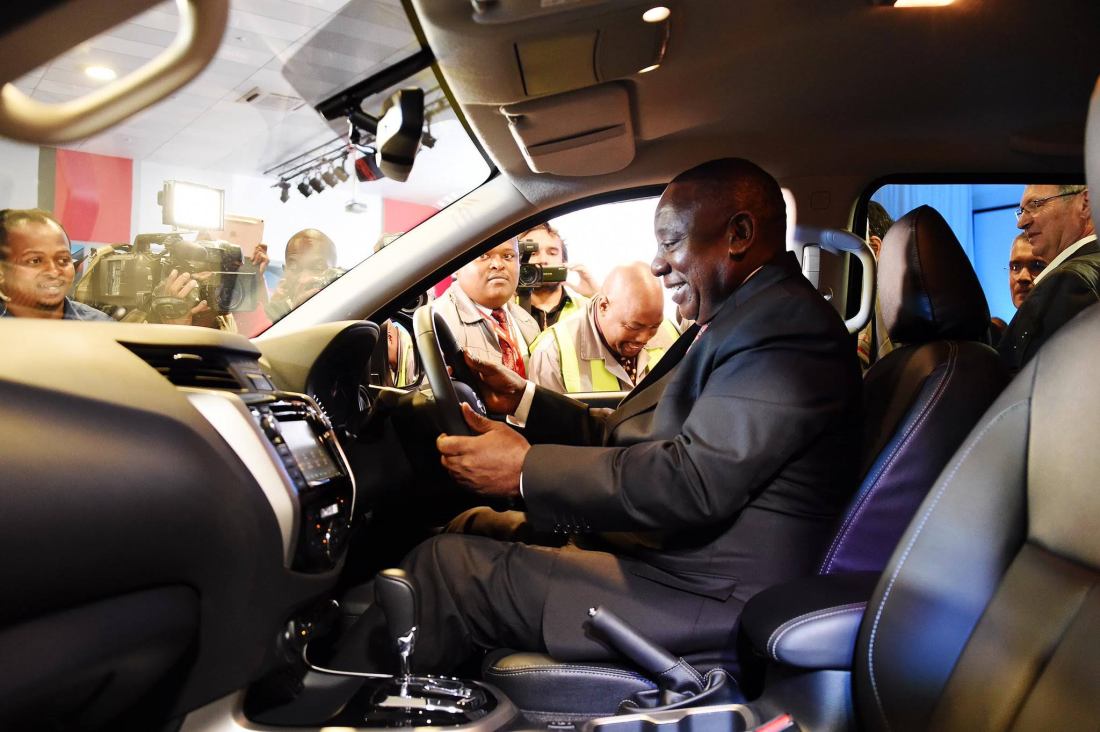
Nissan R3bn investment a bonus for Cyril

42511d5d-a532-45c3-a6ac-fd7c811218bc

Cyril:  “Now how do I reverse over Malema?”  

By John Fraser

If I had Cyril Ramaphosa’s dosh, I would be taking it easy.  Instead, our President is rushing around the country almost as fast as his ANC comrades appear to messing-up his election prospects.   

Burning rubber, and not books, our President yesterday took a ride in some new (hopefully fireproof) Prasa trains, followed by an engagement with the farmers of Stellenbosch.

Today he was at Nissan’s Rosslyn factory near Pretoria to welcome a new R3bn investment, before zooming off to a gathering of religious leaders. All of this before lunchtime.

President Cyril Ramaphosa is demonstrably on the election trail, with numerous public appearances, speeches, rallies, and his government promising that it will fix what – arguably – it has messed up due to incompetence and corruption, most notably the supply of water and electricity.

In this environment, it is easy to see his relish at the R3bn Nissan investment in the local production of new Navara pickups.

With this investment, there will be new jobs, training, exports, all sort of good stuff.  Let us just hope that as the vehicles roll off the production line, pampered politicians and officials will be forced to procure and use these proudly-local vehicles.

Nissan bosses say their plant is now much more efficient than before, on a global scale, which helped it to secure this production deal – and the auto giant is ready to welcome to its plant the production of vehicles by sister brands Renault and Mitsubishi.

Local content, a key requirement for maximising state investment incentives, is to be boosted, with a target of 60%.  To reach this, there will be mentoring, incubation, all sort of support for small black component producers, with the aim of making them larger and larger entities.

All good stuff, although the actual new direct jobs from these billions in investment will be in the hundreds, which won’t even send a ripple across the ocean of unemployed.

Speaking to officials behind the scenes, it was clear that this was not an easy investment to secure.  This country has so many challenges.

However, as we move ever-closer to the election, it is reassuring that one of the pledges made at the President’s glitzy Investment Summit last year has translated into bricks and mortar, wheels and tires, engines and windscreens.

Nice one Cyril.  Keep ’em coming.

Like this article? Subscribe for free to ZA Confidential to receive our newsletters: Click here

Do we really own our digital possessions?

File 20190405 180052 1xszr3j.jpg?ixlib=rb 1.1
tommaso79/Shutterstock

Rebecca Mardon, Cardiff University

Microsoft has announced that it will close the books category of its digital store. While other software and apps will still be available via the virtual shop front, and on purchasers’ consoles and devices, the closure of the eBook store takes with it customers’ eBook libraries. Any digital books bought through the service – even those bought many years ago – will no longer be readable after July 2019. While the company has promised to provide a full refund for all eBook purchases, this decision raises important questions of ownership.

Digital products such as eBooks and digital music are often seen to liberate consumers from the burdens of ownership. Some academics have heralded the “age of access”, where ownership is no longer important to consumers and will soon become irrelevant.

Recent years have seen the emergence of an array of access-based models in the digital realm. For Spotify and Netflix users, owning films and music has become unimportant as these subscription-based services provide greater convenience and increased choice. But while these platforms present themselves clearly as services, with the consumer under no illusion of ownership, for many digital goods this is not the case. So to what extent do we own the digital possessions that we “buy”?

Fragmented ownership rights

The popularity of access-based consumption has obscured the rise of a range of fragmented ownership configurations in the digital realm. These provide the customer with an illusion of ownership while restricting their ownership rights. Companies such as Microsoft and Apple present consumers with the option to “buy” digital products such as eBooks. Consumers often make the understandable assumption that they will have full ownership rights over the products that they pay for, just as they have full ownership rights over the physical books that they buy from their local bookstore.

We buy eBooks just as we do paperbacks, and yet the former is subject to very different terms of ownership.
Oleksiy Mark/Shutterstock

However, many of these products are subject to end-user licence agreements which set out a more complex distribution of ownership rights. These long legal agreements are rarely read by consumers when it comes to products and services online. And even if they do read them, they are unlikely to fully understand the terms.

When purchasing eBooks, the consumer often actually purchases a non-transferable licence to consume the eBook in restricted ways. For instance, they may not be permitted to pass the eBook on to a friend once they have finished reading, as they might do with a physical book. In addition, as we have seen in the case of Microsoft, the company retains the right to revoke access at a later date. These restrictions on consumer ownership are often encoded into digital goods themselves as automated forms of enforcement, meaning that access can be easily withdrawn or modified by the company.

This is not a one-off occurrence. There have been many similar instances that raise questions of ownership. Just last month, social media site MySpace admitted to losing all content uploaded before 2016. Blaming a faulty server migration, the loss includes many years’ worth of music, photos, and videos created by consumers.

Last year, after customers complained of films disappearing from Apple iTunes, the company revealed that the only way to guarantee continued access was to download a local copy – which, some opined, goes against the convenience of streaming. Amazon hit the headlines way back in 2009 for remotely erasing “illegally uploaded” copies of George Orwell’s 1984 from consumers’ Kindle e-reading devices, much to consumers’ dismay and anger.

Illusions of ownership

Once you purchase a physical book, you own it entirely.
LStockStudio/Shutterstock

My research has found that many consumers do not consider these possibilities, because they make sense of their digital possessions based on their previous experiences of possessing tangible, physical objects. If our local bookstore closed down, the owner wouldn’t knock on our door demanding to remove previously purchased books from our shelves. So we do not anticipate this scenario in the context of our eBooks. Yet the digital realm presents new threats to ownership that our physical possessions haven’t prepared us for.

Consumers need to become more sensitised to the restrictions on digital ownership. They must be made aware that the “full ownership” they have experienced over most of their physical possessions cannot be taken for granted when purchasing digital products. However, companies also have a responsibility to make these fragmented ownership forms more transparent.

Often there is a logical business reason for such restrictions. For instance, since digital objects are infinitely reproducible – they can be duplicated quickly and easily at negligible costs – restrictions on sharing are a means to protect the profits of both distribution companies (Microsoft or Apple, for example) and media producers (including the authors and publishers of an eBook). However, these restrictions must be stated clearly and in simple terms at the point of purchase, rather than hidden away in the complex legal jargon of end-user licence agreements, obscured by the familiar terminology of “buying”.The Conversation

Rebecca Mardon, Lecturer in Marketing, Cardiff University

This article is republished from The Conversation under a Creative Commons license. Read the original article.

Like this article? Subscribe for free to ZA Confidential to receive our newsletters: Click here

 

What Cape Town’s drought can teach other cities about climate adaptation

File 20190401 177175 1m17hjo.jpg?ixlib=rb 1.1
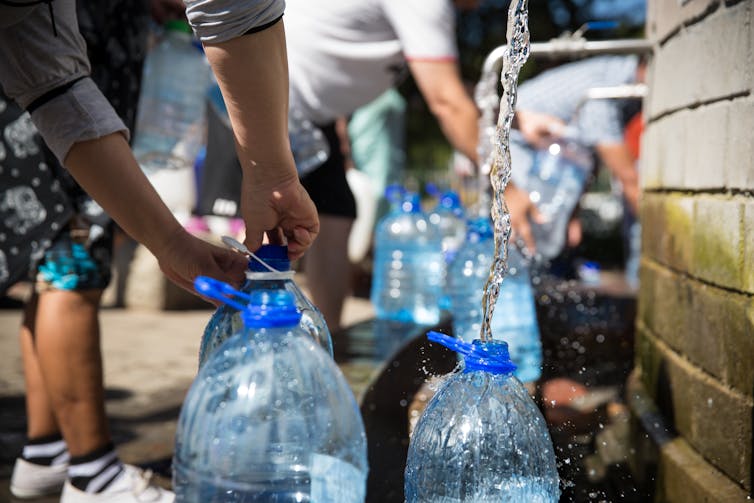
Lessons learned from the threat of Cape Town’s “Day Zero.”
Shutterstock

Gina Ziervogel, University of Cape Town

Extreme weather events, such as Cyclone Idai that has recently devastated Beira, Mozambique, and Hurricane Harvey that hit Houston, USA, in 2017
are the types of climate extremes that cities increasingly have to prepare for.

Cities, particularly those with extensive informal settlements in the developing world, are being hit hard by these new climatic realities. Although rapid onset disasters often have devastating effects, slow onset climate events, such as drought, can also be detrimental.

Cities need to build their capacity to adapt to this range of impacts. One of the best ways to do this is to learn from other cities’ experiences. Drawing lessons from other places that have gone through climate crises is a good way to guard against future shocks and stresses.

One very recent case that cities around the world are watching is Cape Town’s severe drought and the threat of “Day Zero” – when the city’s taps were due to run dry. Although the city came close to having to turn off the taps, they managed to avoid it. After better rains in 2018 and a significant reduction in water use across the city, the dams are now reassuringly fuller than they were in 2017 and 2018, although caution is still needed ahead of the winter rains.

A lot has changed and it’s important to reflect on this, and share.

I conducted research to establish some key lessons to be drawn from the Cape Town drought. I found that local governments must focus on several important areas if they’re to strengthen urban water resilience and adapt better to climate risk. These include improving data collection and communication, engaging with experts and enabling flexible adaptive decision making.

And, crucially, I found that governance must be strengthened. Although three years of low rainfall lead to very low dam levels, there were breakdowns in the interaction between the national, provincial and municipal government that exacerbated the problem.

The findings

The research suggests that effective water management requires systems of mutual accountability between spheres of municipal, provincial and national government.

In South Africa, the national Department of Water and Sanitation is responsible for ensuring that there’s sufficient bulk water available, often in dams, that can be transferred to municipalities. The municipalities are then mandated to provide clean drinking water. This means that intergovernmental coordination across the spheres of government is vital.

As it stands, different spheres’ mandates overlap. This creates confusion and means the buck is often passed: one sphere of government will insist a particular competency isn’t its job, and hand the work on to another sphere.

For this to be resolved there has to be clarity on shared responsibilities and roles, as well as the development of mutual accountability. To achieve this, technical skills, personal and institutional relations need to be strengthened. This requires strong leadership.

Collaboration within municipal departments also needs to improve. The Cape Town drought highlighted the importance of this. Before 2017, there was limited collaboration between city departments on water issues. During the drought, however, the collaboration between certain departments increased considerably as the complexity of the crisis became clear.

Not only is collaboration within government important, but it also needs to extend beyond the government. During a crisis, all of society needs to be engaged, including citizens and the business sector. Technical expertise needs to be balanced with opportunities for a broader group to share its perspectives and concerns. Partnerships can help gather the range of perspectives and support needed to respond to complex problems.

Municipalities which, during the course of their normal business activities, have developed strong relationships with their stakeholders, will be better placed to respond effectively to a crisis. That’s because they will be able to harness stakeholders’ collective knowledge and contributions more easily.

In Nelson Mandela Bay, the Business Chamber has done this by strengthening relations with the municipality to help to facilitate the ease of doing business in the city. They recognise that all businesses require electricity, water, transport, and logistics, for example, and so focus on improving these areas. The municipality developed task teams made up of volunteers from their member companies who have skills set in those areas.

Importantly, there is an agreement that the Metro places high-level executives to sit in the task team meetings to ensure plans are put into practice. These types of relationships can be invaluable during a crisis.

Moving forward

While my study focused on Cape Town, its findings can be applied to other cities that want to strengthen their ability to adapt to climate change. Yes, cities need to pay more attention to how climate variability impacts on their resources, particularly water. But just as important is strengthening the governance of the water system. A well-adapted city is one that understands who is responsible for what and has strong trust and partnerships between and within the government.

In order to build capacity to adapt, new types of skills are needed. Local government needs to pay more attention to how to build partnerships, enable flexibility and support learning. These are the types of skills needed for a well-adapted city, but are still often lacking in local governments.The Conversation

Gina Ziervogel, Associate Professor, Department of Environmental and Geographical Science and African Climate and Development Initiative Research Chair, University of Cape Town

This article is republished from The Conversation under a Creative Commons license. Read the original article.

Like this article? Subscribe for free to ZA Confidential to receive our newsletters: Click here

 

Wine Tasting Podcast. Jordan: The Real McCoy Riesling

We are back.  Another mildly anarchic but nonetheless serious wine tasting with the impressive The Real McCoy Riesling from Jordan in Stellenbosch.

This is followed by a chat on wine marketing.

John Fraser is joined by the inimitable Michael Olivier, who is one of SA’s foremost epicureans.   Also on the panel are Clientele’s Malcolm MacDonald, who helped with the technology, infamous economist Chris Hart, and Gumtree Auto’s best biker Jeff Osborne.

Click here for the podcast, enjoy and maybe even learn a little:


Poor coverage of floods in southern Africa? Blame the media bosses

File 20190326 36256 3ff3f9.jpg?ixlib=rb 1.1
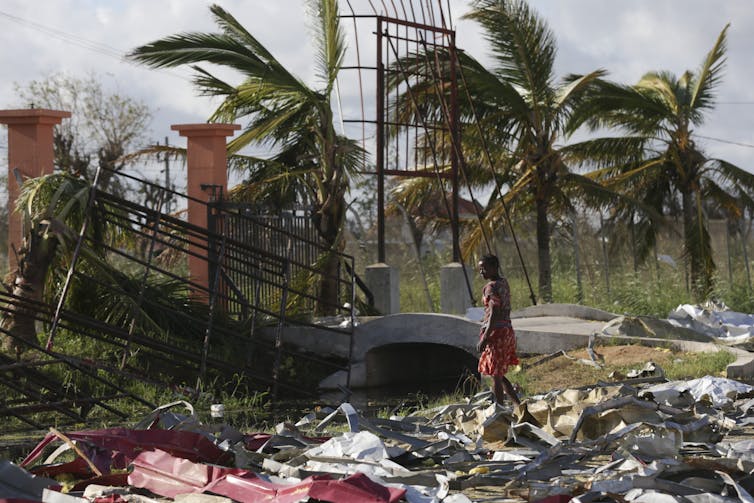
A woman searches for materials to rebuild her home after the passage of Cyclone Idai, in Beira City, central Mozambique.
EPA-EFE/Tiago Petinga

Glenda Daniels, University of the Witwatersrand

South African media has been criticised on social media for its initially superficial and underwhelming coverage of the massive floods in Mozambique, Zimbabwe, and Malawi in the wake of the devastating Tropical Cyclone Idai. Serious news consumers had to rely on foreign news sources instead of local media as the grim picture of the destruction – which included hundreds of deaths, flooding, disease, and havoc to resources and infrastructure – started emerging.

In my view the criticism is valid. The coverage of the floods by South African media has been poor. In fact, I’ve hardly seen a local journalist’s face from on the scene coverage.

Based on my experience of newsrooms, plus my research and as a former coordinator/author of the annual State of the Newsroom report as well as presently coordinator of the Job Losses/New Beats project in South Africa – it’s clear that this is due to the fact that local newsrooms have been depleted of journalists. This, in turn, is because the media companies have not handled the transition to digitisation well.

But are journalists to blame? I would argue that people should scrutinise media companies rather than blame the profession. Those who criticise journalists tend to conflate media companies and the individuals who are the workhorses in the newsroom. They are not the same thing.

This is happening all over the world, where companies are clumsy in how they are handling the transition to digital. It’s a disaster for democracy because the experience of trained journalists is lost and we have little context in reporting on events such as natural disasters as well as elections.

You find that younger journalists don’t have mentors to help them through reporting. Media companies are looking for profits by cutting the experienced journalists’ salaries and employing those who they can pay less.

What this shows is that traditional media is dying. It is also not fulfilling its mandate to be informative, to provide the facts and serve the public.

What’s gone wrong

Newsrooms have mainly become “content producers” made up of people who have technical capabilities such as producing videos and podcasts. Podcasts are good, but even there you need journalists who can ask the pertinent questions and do good intros and angles with context.

Editors are increasingly demanding that journalists stay indoors in the newsrooms so that they can do desk work to fill pages with content rather than to travel out on a breaking story.

The main reason cited for this is that there isn’t budget set aside for travel, which would include flights to Mozambique, Zimbabwe, and Malawi as well as accommodation and food.

Another factor is that newsrooms have been shrinking at an alarming rate. Conservative estimates in research to be published later this year show that South African newsrooms have shrunk by about half in the past decade.

In 2007 there were about 10 000 journalists. Now there are about 5 000.

South Africa fits very much with the developed world global pattern of job losses in the traditional media sector. The losses are mainly in the senior category of journalists (40-60-year-olds). In other words, those who are experienced.

The age-old practice of having journalists who are specialists – they write about specific fields such as science and education, also known as beat-reporters – have all but disappeared. Other layers that have been removed from newsrooms included those responsible for editing articles and fact-checking for accuracy. This explains the spike in mistakes in newspapers as well as online publications.

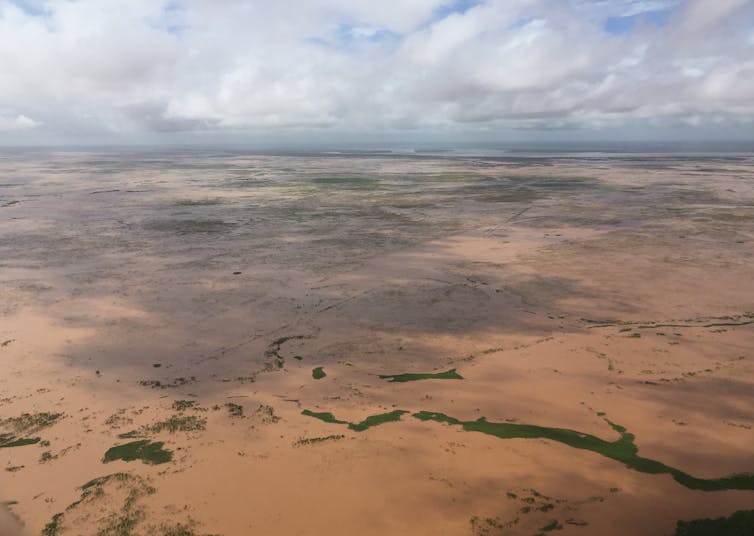
An aerial view shows damage from the flood waters after cyclone Idai made landfall in Sofala Province, Central Mozambique, 21 March 2019.
EPA-EFE/Emidio Jozine

The issue of resources is a particularly big challenge when disasters are being covered. For example, it’s not possible simply to send one person. At the very least a team of two is needed – a camera person or photographer and a journalist. And resources and backup are needed – and journalists just do not get this support.

The role of social media

Social media is partly filling the gap left by traditional media. But not completely. It’s also an arena for misinformation, malinformation (disinformation with malicious intent) propaganda and general falsehoods.

On top of this, there’s a great deal of hatred on social media. The latest and most worrying is cyber misogyny and the trolling and vilification of women, especially women journalists who are prominent, those who speak out and investigate corruption.

There are no checks and verification on social media. Anyone can post anything – unfiltered. Anyone can believe anything. Right-wing movements and populism are growing – enabled by social media. Not because of social media but enabled by – these types are able to connect with each other and discuss strategies on how to kill, for example.

It’s contrary to what we all thought 10 years ago, that social media would act as the equaliser, the leveller – everyone would have access. In fact, what has happened is that the promise of cheap broadband has not been rolled out, nor does everyone have a smartphone to be engaging in debates and discussions.

Social media has become more of a divider between rich and poor than ever. It’s also a platform for great divisiveness.

This is a disaster for democracy. Media companies need to press the pause button to reflect on what they are doing. If they don’t, it will cost democracy dearly.

The New Beats is an international research project based in Melbourne.The Conversation

Glenda Daniels, Associate Professor in Media Studies, University of the Witwatersrand

This article is republished from The Conversation under a Creative Commons license. Read the original article.

Like this article? Subscribe for free to ZA Confidential to receive our newsletters: Click here


The great Eskom reprieve.  Confidence or con?

59afe770-826c-4e2a-a5a4-e9c559029d61

By John Fraser

Aren’t we blessed? After more than a week, with days and nights of revolving power cuts, the lights are back on.  The crisis is over. We are receiving the service for which we are paying – or, in the case of many in Soweto, for which we have not paid in years.

Good stuff Eskom. The parasital parastatal has been transformed into a modern miracle-worker, a savior, a saint for whom we no longer need to light a candle; we just have to flick a switch.

But is all as it seems?   Can we go so effortlessly from Code Red to Code Bright and Shining?

I wonder.

My own conspiracy theory may be totally ridiculous, and I am happy if you dismiss it as the ravings of a light-deprived brain.

However, I just wonder whether the looming election may be responsible for lifting the shadow from Eskom, for the ending of the crisis, for delivering us from the darkness.

Just suppose you were a cynical ANC politician, and just suppose you were worried about your party receiving a knock in the elections? What would you do about the power cuts?

I would opt for the band-aid approach.  No, not by calling in Bob Geldof, but by papering over the cracks, putting a few paper clips in the fuse box, getting the system up and running for a while.

Therefore, we can hobble along towards election day without power cuts, or with very few.  The saint-like Cyril can receive the glowing adulation of the fully-lit disciples, and the ANC can win another four years to repair, or to further bugger-up, the economy.   We may have different views on that one.

Of course, once the wheels start falling off again, and the darkness returns, it won’t matter as much for a newly re-elected ANC.

The ANC will have boosted its election prospects, and if the power cuts resume as the polls close, it can blame apartheid, Steve Hofmeyr, white monopoly capital, global warming, or the level of sugar in fizzy drinks.

The lights will have shone for just long enough.

And, after that?  Well, you can get away with a lot under the cover of darkness.

Like this article? Subscribe for free to ZA Confidential to receive our newsletters: Click here
 

Why South Africans are prone to falling for charlatans in the church

File 20190306 48444 15x2ykw.jpg?ixlib=rb 1.1
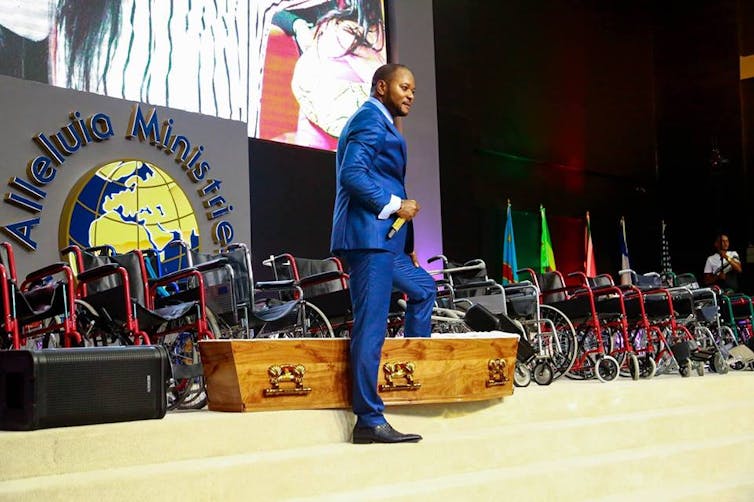
Pastor Alph Lukau – his “resurrection” of a man, made world news.
Alph Lukau/Facebook

Dion Forster, Stellenbosch University

South Africans – like millions of people across the world – are seriously susceptible to religious abuse.

The local media has once again been abuzz with a litany of shocking stories about manipulation, abuse and fraud by pastors. The latest one, a fake “resurrection” made headlines around the world. A video of Pastor Alph Lukau “raising” a man from the dead went viral and even sparked the #ResurrectionChallenge.

Why do South Africans fall for these religious snakeskin oil salesmen (and women)?

One possible reason is that faith continues to play a very significant role in South Africa. In the last household survey over 84% of South Africans indicated that they are Christians. And a 2010 Pew Report found that 74% of South Africans said that religion played an important role in their daily decisions, values and shaping of their morals.

In addition, churches and religious leaders enjoy higher levels of public trust in South African society than either the government or private sector. This is unlike many other modern democracies in the 21st century.

Some suggest that this susceptibility to religious belief is due to the moral and political failures of the state and politicians. Religious leaders and institutions gain trust in situations where the population faces high levels of economic and social vulnerability, as is the daily reality for many South Africans. Religious groups are often the only sources of basic care and hope in many communities.

We believe that South Africans allow charlatan pastors to win their trust, take their money and get them to engage in frightening, and even comical, quasi-religious acts because of a combination of two factors. Many South Africans have high levels of trust in religious leaders. At the same time there’s a great deal of economic need. In situations like this people look to “supernatural” means to solve basic problems. Research on these phenomena in countries such as Brazil and Nigeria shows similar tendencies.

Some answers

People are drawn to what are known as prosperity gospel pastors because they are offered the opportunity of getting out of poverty and becoming rich by means of God’s blessings. South Africans who are losing hope of gaining adequate employment, or dealing with rising debt, see the lavish lifestyles of prosperity gospel pastors is appealing.

The message is that: obedience and sacrificial giving (to the pastor and their church) is the road to wealth.

Second, in a situation in which there is inadequate health care, it isn’t surprising that people turn to “miraculous” healers to find relief from suffering. This phenomenon is not unique to South Africa – it happens in other countries around the world where religion is important and social systems are weak.

How are these unethical leaders and their sectarian communities spotted?

Tell-tale signs

One of the most telling characteristics is an overt and gaudy display of personal wealth. The intention is to extravagantly display the super-abundance of supposed “divine blessing”.

Sadly, the wealth on display is derived by manipulation, even criminality, or excessive and unsustainable debt.

Next, is the tendency towards the supernatural and the spectacular – miracle healings, raising people from the dead, prophesying and sharing visions.

These “miracles” are frequently staged, using actors, psychological tools or technologies. They serve to attract members, and also to establish a hierarchical religious power structure with the pastor at the top.

The veneration and deification of the pastor is another common characteristic. They are presented as a “spiritual elite”, having direct access to God, a special measure of God’s blessing, and particularly powerful spiritual gifts. As God’s “chosen one” these aspects serve both to give the pastors power over their members, but also to shroud them in mystery.

In contemporary religious sociology, this is referred to as “religious exceptionalism”. The laws of nature, culture, the religious tradition, the state and morality do not apply to them since they are an “exception”, supposedly by God’s divine choice.

In some instances, these leaders and their communities display cult-like tendencies, seeking to isolate their members from regular life and their friends and families, who are portrayed as sinful and evil. It is under such conditions of deep trust, sincere faith, great need, facing spiritual manipulation and isolation, that many of the abuses take place.

Rights and freedom

What should be done to curtail such abuses?

The South African government has sought to regulate religious leaders and communities through the Commission for the Promotion and Protection of the Rights, Cultural, Religious and Linguistic Communities. The commission is attempting to set up standards for conduct, registration and qualification of religious groupings and leaders.

There is some concern that the state-appointed commission will use laws and policies to infringe on the legitimate rights to freedom of religion, and possibly even silence critique of the state.

Also, many of the abuses are not primarily religious or theological in nature. They are covered by civil law that should simply be enacted to protect citizens.

South Africa remains a deeply religious nation. The state and religious leaders and their communities bear a shared responsibility to identify and expose corrupt religious leaders, as well as safeguard citizens against abuse while maintaining their rights to religious freedom.

Simbarashe Pondani has contributed to this article.The Conversation

Dion Forster, Head of Department, Systematic Theology and Ecclesiology, Professor in Ethics and Public Theology, Director of the Beyers Naudé Centre for Public Theology, Stellenbosch University

This article is republished from The Conversation under a Creative Commons license. Read the original article.

Like this article? Subscribe for free to ZA Confidential to receive our newsletters: Click here


Why corruption in South Africa isn’t simply about Zuma and the Guptas

File 20190306 100799 1p74up8.jpg?ixlib=rb 1.1
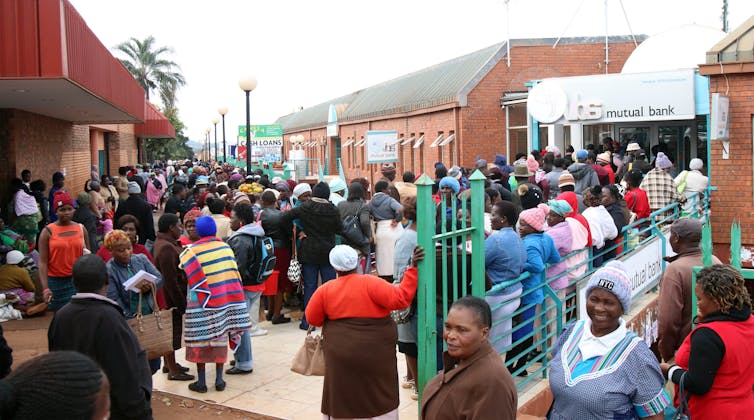
The collapse of VBS Mutual Bank in South Africa shows that corruption is endemic.
Tiso Blackstar

Karl von Holdt, University of the Witwatersrand

Corruption in South Africa isn’t simply a matter of bad morals or weak law enforcement. It’s embedded in processes of class formation – specifically, the formation of new black elites. This means corruption is primarily a matter of politics and the shape of the economy.

In a recently published paper, I attempt to shed fresh light on the unconvincing narratives that have been presented in the media, NGOs and academic circles about the events of the past 10 years.

These narratives generally depict events as a struggle between two opposing forces. On the one side are a network of politicians, officials, brokers and businessmen centred on former President Jacob Zuma and the Gupta family. All are bent on looting, state capture and self-enrichment. On the other are a band of righteous politicians and citizens. This group is seen as drawing together the “old” ANC, activists, “good” business and citizens in general. They are intent on rebuilding institutions and good governance, the rule of law, international credibility and fostering growth and development.

I argue that a much deeper set of social forces underlies and shapes the struggles within the governing party, the African National Congress (ANC), and the society more broadly. These political struggles are inseparable from struggles over the shape of the economy.

Limited access

The primary process to change the economy has been the drive to accelerate the emergence of new black elites. But institutional interventions, such as black economic empowerment, have been insufficient.

Already, during the Thabo Mbeki period as well as the presidency of Nelson Mandela, an alternative informal political-economic system was emerging at national, provincial and local levels. Through this, networks of state officials, ambitious entrepreneurs as well as small-time operators, were rigging tenders or engaging in other kinds of fraud so as to sustain or establish businesses, or simply to finance self-enrichment.

Because of a number of factors, there was little alternative for channelling the aspirations and burning sense of injustice of black elites and would be elites in post-apartheid South Africa. These factors include the property clause in the Constitution, the conservative strategies adopted by the ANC government and the fact that large corporations and white-owned businesses dominated the economy.

This means that opportunities are few, demand is high and competition is fierce. In this context, the state is where people who are locked out are most likely to gain some access.

This links to the issue of violence. The emergence of new elite classes is often a ferociously contested, ugly and violent affair. South Africa is no different from many other post-colonial countries – or indeed the histories of the Euro-American elites that currently dominate the globe.

In South Africa, this violence takes the form of burning down homes and state facilities, intimidation, assault, the deployment of the criminal justice system to protect some and target others, and, increasingly, assassination.

I argue that this set of practices constitutes an informal political-economic system. By a system, I don’t mean a structure which is centrally coordinated or planned. What I’m referring to is a pervasive and decentralised set of interlocking networks that reinforce and compete with one another in mutually understood ways, and include the use of violence as a strategic resource.

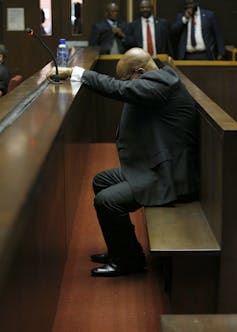
Former South African president Jacob Zuma in court on corruption charges.
EPA-EFE/Rogan Ward / Pool

This system preceded Zuma’s presidency and extended far beyond the Zuma-Gupta network. The recent revelations about corruption at the Zondo commission into state capture, VBS mutual bank or in the book, How to steal a city by Crispian Olver, make this abundantly clear.

It should also be abundantly clear that the informal political-economic system necessarily entangles President Cyril Ramaphosa’s core network of institution builders.

Ramaphosa’s challenge

Ramaphosa’s key challenge is to build a stable coalition within the ANC so as to embark on his project of institution building. His trajectory, and the future shape of corruption in South Africa, will be determined by the character of the coalition he can forge – or that will be forced on him – among party barons within the ANC.

For the purpose of building institutions and attracting investment, it will be necessary to establish as stable a coalition as possible. This means it will have to be a broad coalition. One thing is sure: the coalition will include corrupt figures. It already does. The informal system of patronage politics will remain pervasive.

Even so, Ramaphosa’s power is precarious in the ANC. The odds are stacked against success in establishing stability. For the medium-term, the trajectory of politics is likely to be characterised by multiple contestations over material opportunities, political power and symbolic representation. This will give rise to an increasingly volatile, unstable and violent political space.

To return, then, to the prevailing narrative and its misreading of the politics of corruption.

Deep structural issues

The problem with the narrative is that it assumes it’s possible simply to remove some “rotten apples”, and it sets standards Ramaphosa cannot possibly match.

Perhaps, though, it is a useful fiction for the mobilisation of civil society, journalists and judges, which at the very least may contribute to containing corruption?

There is some validity in this. Yet it fails to direct attention to the deep structural issues which give rise to corruption as an aspect of class formation.

The only long-term and stabilising solution would be to draw into the formal system some of the purposes of the informal system. This would require a much more fundamental redistribution of assets and wealth, which could be deployed in the large-scale formation of a new black business class, primarily located in manufacturing and agriculture, as well as to fixing the education crisis. The result would be the formation of professional, scientific and technical middle classes.

This kind of solution will not emerge from the Ramaphosa administration, which is much more fixed on reproducing the policies of the Mbeki era. The problem is that these were what created the opportunity for the rise of Zuma in the first place.The Conversation

Karl von Holdt, Senior Researcher, Society Work and Politics Institute, University of the Witwatersrand

This article is republished from The Conversation under a Creative Commons license. Read the original article.

Like this article? Subscribe for free to ZA Confidential to receive our newsletters: Click here
 

Beware the ANC pension looters

img_3548-1

By John Fraser

Want to die destitute?  To be buried in a paupers’ grave?  Well, the ANC can help.

Plans to direct even more SA pension fund resources into prescribed assets have been revealed as a major menace.

The warning came from esteemed economist Mike Schussler at a briefing at the SA Institute of Race Relations, which decided to offer an example to its media guests of the plight of paupers by offering no hospitality at the lunchtime briefing.

Schussler explained that, unlike, say, Argentina, South Africa might be able to avoid calling in the IMF if its finances are further damaged by runaway government spending.

Instead, the state could raise more funds by insisting that a larger share of pension funds needs to be invested in government bonds of one sort or another – including those of financially-cancerous Eskom.

He outlined the scale of pension fund resources in SA, where about one in three of we South Africans have some form of pension investment.

“The value is enormous – R4.3 trillion in 2017,” he said.

“We have 8th biggest pension assets in the world.  We are a young country, and it is incredible to have such assets.

“They are the 5th highest in the world, in terms of pension fund assets to GDP.”

Schussler explained that there is already legislation which caps overseas investment of some pension funds, and he suggested it would not be difficult to further cut that percentage.

This strategy has been looked upon favourably by the ANC.

“Public debt is close to pension assets, as a percentage of GDP,” said Schussler.

“Once public debt overtakes pension assets we will be in trouble.

“Government may legislate to keep more of the pension pool here in SA.

“It may drive more investment into government bonds.  You may force people to invest into things they do not want to invest in.

“If we were Argentina, we would have to run to the IMF.  But we have large pension funds and an existing law.  If you have corrupt activites, the more the motivation not to run to the IMF.”

Schussler, who at one time worked for state transport utility Transnet, noted that his fears are not just theoretical.

“You have Transnet pensioners in dire straits, because of the way their pension funds were placed (in poor Transnet-linked investments),” he warned.

“About 60 000 of these Transnet pensioners are left. A lot of people died in abject poverty.

“It is crucial there is professional oversight of pension funds.

“Not getting returns can make you poorer than you think.  Ask the people at Transnet now.  How many of them are in paupers’ graves?”

The IRR is campaigning to have people contact their pension funds, to voice their concerns and to motivate more opposition to the state threat.

Talks are also planned with the financial services representative body ASISA.

Like this article? Subscribe for free to ZA Confidential to receive our newsletters: Click here