A tasting of two very different beers.


By John Fraser

For our regular tasting podcast, we have defected from wine to beer.

  • The ‘Liefmans Fruitesse on the Rocks’, a Belgian concoction which is as delightful as it is unusual.
  • And the ill-named ‘Frasers folly’, an oxymoron if ever we heard one.

Guest tasters are star economists Mike Schussler & Chris Hart,  star brander Jeremy Sampson, and star waffler Chris Gilmour.

Michael Olivier, who has a galactic knowledge of food and wine in SA, introduced the beers, while Malcolm MacDonald helped with the technical stuff.

We also chatted about the merits of wine in cans and boxes.

Click below to give it a listen:

Like this podcast? Subscribe to ZA Confidential to receive our newsletters.  Twitter:  @zaconfidential  

Do also check out:  http://www.michaelolivier.co.za


Coronavirus and handwashing: research shows proper hand drying is also vital

shutterstock/santypan

Julian Hunt, Swansea University and John Gammon, Swansea University

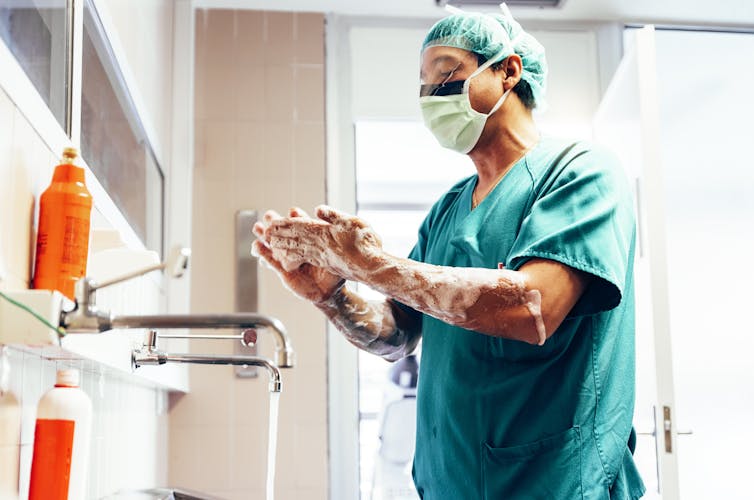
With the number of people infected with coronavirus increasing around the world on a daily basis, the World Health Organization (WHO) has advised everyone to regularly and thoroughly clean their hands. This can be either with an alcohol-based hand rub or with soap and water. The hope is that good hand hygiene will limit the spread of the virus.

To wash your hands effectively, it needs to be done with clean water and soap. Hands should be rubbed together for at least 20 seconds, followed by rinsing. The use of soap is particularly important for handwashing to be effective as research has shown that washing with soap significantly reduces the presence of microbes (viruses and bacteria) on hands. But one often overlooked part of handwashing is hand drying – which is also integral to effective hand hygiene.

Hand drying not only removes moisture from the hands but it also involves friction, which further reduces the microbial load and the environmental transfer of microorganisms. And the transmission of microbes is more likely to occur from wet skin than dry skin.

How you dry matters

But it’s not just as simple as drying your hands off in any old way, because how you dry your hands also matters. And this is particularly the case in hospitals and doctors surgeries.

Our research review has examined the importance of hand drying and the implications of wet hands for patients and healthcare workers. The findings highlight that hot air hand dryers and cloth roller towels can be a problematic way of drying your hands – especially in a hospital.

Our review mainly looked at the impact of hand drying on bacteria, not viruses. But what we found is still relevant when looking at the possible transmission and spread of coronavirus in hospitals and GP surgeries – particularly given the advice from the WHO regarding frequent handwashing.

Drying your hands properly removes a significant number of microorganisms after hand washing.
ALPA PROD/Shutterstock

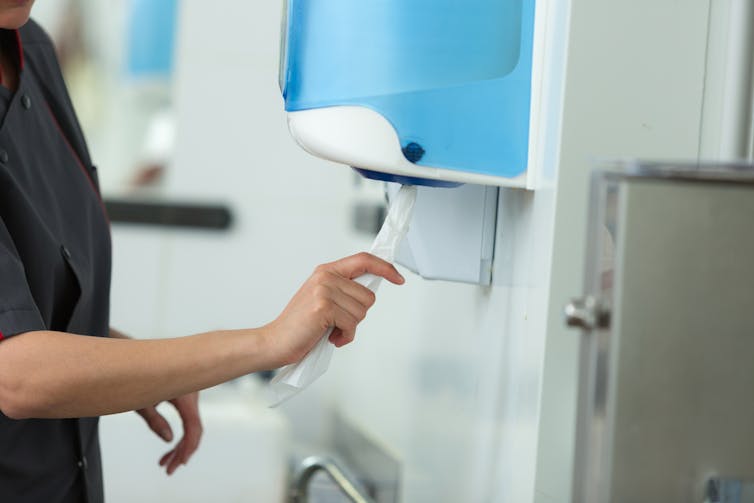
Disposable paper towels offer the most hygienic method of hand drying. Indeed, warm air and jet air dryers are not recommended for use in hospitals and clinics for hygiene reasons. These types of hand dryers can increase the dispersion of particles and microorganisms into the air, contaminating the environment.

Cloth roller towels are also not recommended as they become a general use towel when the roll comes to an end – and can be a source of pathogen transfer to clean hands.

Importance of hand drying

Our review also found that the most appropriate methods for hand drying within a clinical environment – such as a hospital – differed to that recommended for public washrooms. This is because of the higher risk of contamination and cross-infection in hospitals. So while it is important to dry your hands properly wherever you are, paper towels are always the preferred option if you are in hospital as a patient or a visitor – or a member of staff.

As part of our review, we also looked at government policy on hand drying and found that disposable paper towels are recognised as being the quickest and most effective way of removing residual moisture that may allow for the transmission of microorganisms. This is good to know given the current concerns around the spread of the coronavirus.

In this sense, our research serves as a timely reminder that proper and effective hand drying is integral to hand hygiene whether you’re in a hospital, doctor’s surgery or just in the office.

Julian Hunt, Research Officer Human and Health Sciences Central, Swansea University and John Gammon, Deputy Head of the College of Human and Health Sciences, Swansea University

This article is republished from The Conversation under a Creative Commons license. Read the original article.


Like this article? Subscribe to ZA Confidential to receive our newsletters.  Twitter:  @zaconfidential  

Do also check out:   http://www.michaelolivier.co.za

Why hand-washing really is as important as doctors say

handpic
U.S. Surgeon General Vice Admiral Jerome M. Adams, center, demonstrates hand-washing to U.S. Sen. Richard Blumenthal, left, and Connecticut Gov. Ned Lamont, right, in Rocky Hill, Conn., March 2, 2020. 
AP Photo/Jessica Hill 

As the threat from the coronavirus grows, the Centers for Disease Control and Prevention and other public health officials are stressing the importance of hand-washing.

Prevention becomes essential to stopping the spread of the virus because there is no vaccine to prevent it and no anti-virals to treat it.

How can such a simple, low-tech solution make a difference?

Remember – coronavirus spreads easily by droplets from breathing, coughing and sneezing. As our hands touch many surfaces, they can pick up microbes, including viruses. Then by touching contaminated hands to your eyes, nose or mouth, the pathogens can infect the body.

As a microbiologist, I think a lot about the differences between microbes, such as bacteria and viruses, and how they interact with animal hosts to drive health or disease. I was shocked to read a study that indicated that 93.2% of 2,800 survey respondents did not wash their hands after coughing or sneezing.

Let me explain how washing your hands decreases the number of microbes on your hands and helps prevent the spread of infectious diseases.

Two-fisted approach

Bacteria and viruses are different in a number of ways. Bacteria are single-celled organisms that can reproduce on their own, while viruses constitute a core of genetic material encapsulated by a protein coat and can only reproduce by attaching themselves to host cells. Because viruses don’t have the organelles to reproduce, they “hijack” the cellular machinery of host cells to make multitudes of new viruses.

These differences are why antibiotics cannot kill viruses, which typically target specific structures in the cellular components of bacteria that are absent in viruses.

Despite their differences, however, the best way to prevent the disease of bacterial and viral pathogens alike is to effectively wash your hands.

There are two strategies to decreasing the number of microbes on your hands.

The first is to decrease the overall biomass of microbes – that is, decrease the number of bacteria, viruses and other types of microorganisms. We do this by lathering with soap and rinsing with water. Soap’s chemistry helps remove microorganisms from our hands by accentuating the slippery properties of our own skin.

The second strategy is to kill the microbes. We do this by using products with an antibacterial agent such as alcohols, chlorine, peroxides, chlorhexidine or triclosan. However, the efficacy on these agents can be variable depending on a given microbe.

How the World Health Organization suggests you wash your hands.

Are soap and water enough?

Some academic work has shown that antibacterial soaps are more effective at reducing certain bacteria on soiled hands than soaps without them.

However, there’s a problem. Some bacterial cells on our hands may have genes that enable them to be resistant to a given antibacterial agent. This means that after the antibacterial agent kills some bacteria, the resistant strains remaining on the hands can flourish.

Further, the genes that allowed the bacteria to be resistant could pass along to other bacteria, causing more resistant strains. Even more important with respect to coronavirus, antibacterial agents, such as oral antibiotics, don’t kill viruses.

With this in mind, you may want to stick with plain old soap and water.

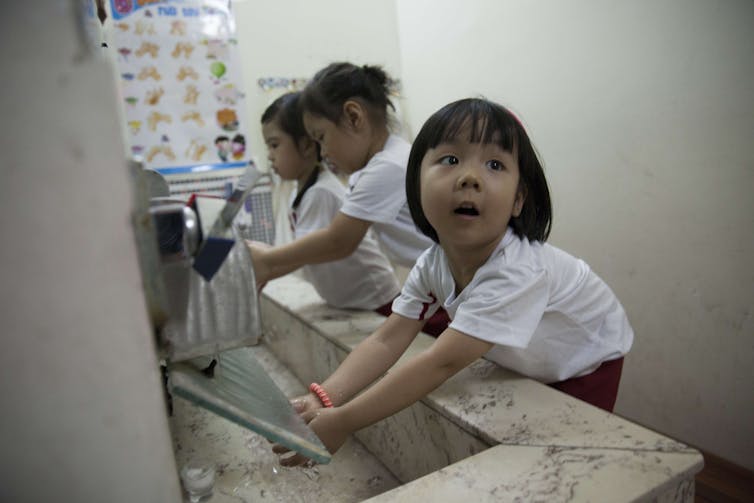
Students washing hands at Sakura Montessori International School in Hanoi, Vietnam, July 3, 2015. Chau Doan/LightRocket via Getty Images

Going back to grade school

To clean our hands, the CDC recommends that we:

  • Wet hands with clean water
  • Apply soap and lather/scrub every nook and cranny of your hands for 20-30 seconds (about the time to sing “Happy Birthday” twice)
  • Rinse well with clean running water
  • Dry hands with a clean paper towel or air-dry.

During the 20-30 seconds of lathering the World Health Organization recommends incorporating six manoeuvres to cover all parts of your hands.

If soap and water are not unavailable, the CDC recommends using an alcohol-based hand sanitizer that contains at least 60% ethanol. Alcohols have a broad-spectrum of antimicrobial activity and are less selective for resistance compared to other antibacterial chemicals. Although alcohol-based hand sanitizers may not work on all classes of germs, the WHO recommends the use of an alcohol-based hand rub to kill viruses that may be on your hands.

Not all microbes are germs

The presence of some microbes isn’t necessarily a bad thing. In fact, many of the microbes that live on or within us are essential for our health.

We live in a microbial world: Trillions of different microbes colonize our skin, gut and orifices. Collectively, this consortium of bacteria, archaea, fungi and viruses are called our microbiota. A plethora of exciting research suggests that the associations of animal hosts with their microbiota are fundamentally important for the host’s biology.

Our microbiota can protect us from germs by training our immune system and by colonization resistance – the characteristic of the intestinal microbiota to block colonization of pathogens. There is ample evidence suggesting that commensal bacteria regulate invading viruses, and in some cases have a suppressive role in their infections. For example, bacteria can prevent influenza virus infection by binding or trapping them directly or by producing metabolites that decrease the stability of influenza virions.

Although more research needs to be done to understand the intricate interactions between microbial communities with host cells, consistent work illustrates that a diverse population of microbes and a balance of this community is important for our health.

Beyond hand-washing

So what is the take-home message?

There is no doubt that washing our hands with liquid soap and water is effective in reducing the spread of infectious microorganisms, including those that are resistant to antimicrobial agents.

When you don’t have the opportunity to wash your hands after touching questionable surfaces, use an alcohol-based hand sanitizer. Limit the touching of your hands to your mouth, nose and eyes.

Furthermore, maintain a healthy microbiota by limiting stress, getting enough sleep and “fertilizing” your gut microbes with a diversity of plant-based foods.

It’s not only a small world but a dirty one as well.

Editor’s note: This article contains updated information from an article that was published originally Dec. 17, 2017.

Enjoy this article?  Subscribe for free to ZA Confidential to receive our newsletters: Click here.   Twitter:  @zaconfidential

Wine Tasting Podcast: De Grendel Viognier 2019

de grendel pic
Lovely Cape white

By John Fraser

Our grape-stomping tasting panel turned up for another session of sniffing and snorting, with the noble De Grendel Viognier 2019.

Michael Olivier introduced the wine to tasters: brander Jeremy Sampson, Economists Chris Hart and Mike Schussler and analyst Chris Gilmour.

There was also a discussion about the frustration of not being able to find all the niche cooking ingredients you need in SA.

Click below to check out the fun:

Like this podcast? Subscribe to ZA Confidential to receive our newsletters.  Twitter:  @zaconfidential  

Do also check out:   http://www.michaelolivier.co.za


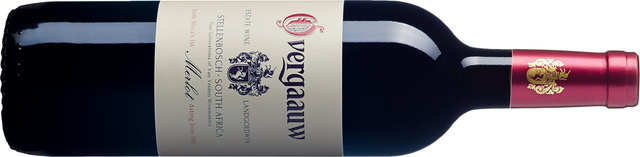
Wine tasting: Overgaauw Merlot 2017

Overgaauw Merlot non vintage
A robust red

By John Fraser

Food and wine guru Michael Olivier pours a robust Cape red to the ZA Confidential team of tasters. It’s the Overgaauw Merlot 2017.

Guest tasters are Economist Chris Hart, analyst and journalist Chris Gilmour, Economist Mike Schussler, and branding bloke Jeremy Sampson.

Some of the panel members found the wine a bit young, but it also found some fans.

There was also a robust chat about the food Nazis who deny us bacon at breakfast.

Click below to take a listen:

Like this podcast? Subscribe to ZA Confidential to receive our newsletters.  Twitter:  @zaconfidential  

Do also check out:   http://www.michaelolivier.co.za

Budget:  No VAT Increase

Tito the tyrant?


By John Fraser

Tiito one; pundits nil.

Those who were sure we would see a VAT hike in the 2020 budget have been proven wrong. 

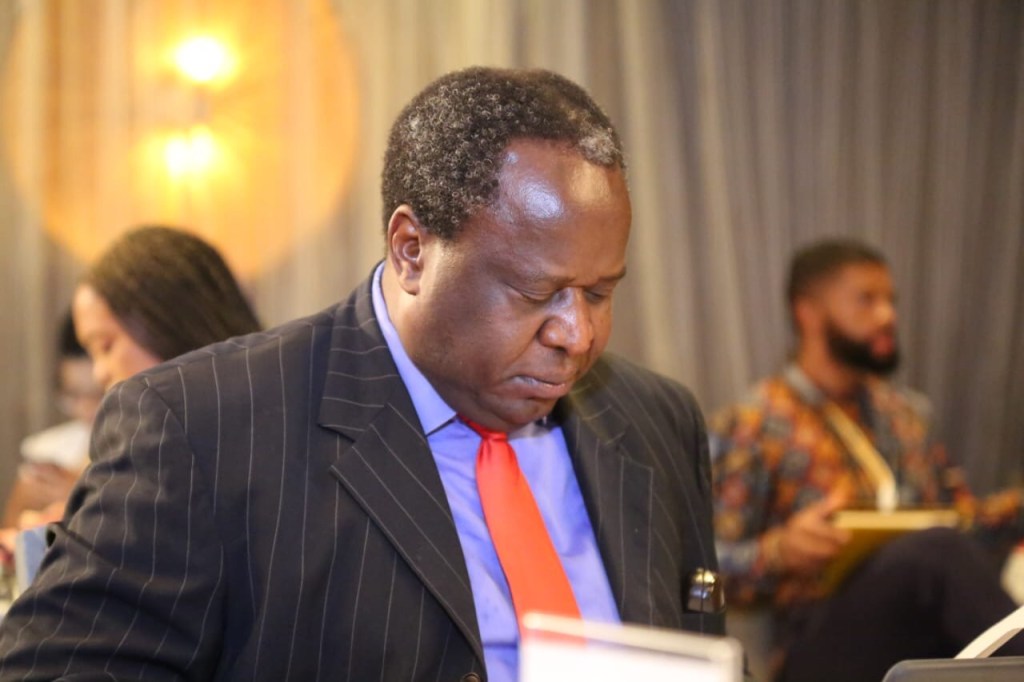
Finance Minister Tito Mboweni says that extra taxes were looked at, but instead it was decided that now is the wrong time to put any further downward pressure on SA’s fragile economy, where GDP is growing at less than 1% a year.  The word he used was “foolhardy”.

He added:  “In difficult situations like this, it would have been far preferable to have had deeper tax cuts.”

Instead of plugging the gap with more revenue receipts, borrowing will increase, and efforts will be made to cut spending, mainly by tackling the oft-inflated wage bill of our public servants.

The taxman is being told to become more efficient, so do await that 5am knock on the door.

Undoubtedly, some budget groupies will find some fault with this, but the Finance Minister did say in his budget speech that there will be some easing of personal income tax and that he is looking at a future reduction in corporate tax.

Excise duties are up across the board, and there will be new taxes on vaping and hubbly bubbly, with higher fuel levies and more to pay on supermarket plastic bags.

Meanwhile, some of the scammiest of scam churches can now expect to have to pay tax.  Fewer luxury limos for the mammon-loving bogus men of god. 

Manufacturers get a raw deal – a major investment incentive known as 12I is being killed off, while the government is speeding ahead with a review of the whole industrial incentive framework. 

Less drama, then, in the speech itself than we had expected.

That will come if rating agency Moody’s clobbers SA with a further downgrade.

Tito had little room for manoeuvre.  So we shall have to wait and see if he has been prudent enough to stave off a kick in the teeth by those moody buggers at Moody’s


.Enjoy this article?  Subscribe for free to ZA Confidential to receive our newsletters: Click here.   Twitter:  @zaconfidential


So few get it right with their website

adult business commerce computer
“Oh, what a tangled web we weave”.   (Sir Walter Scott)

By John Fraser

Like most journalists, writers, barflies and other layabouts, I spend a lot of time on the Internet.

Quite often I am reaching out to link up with companies or government departments, those who pump out info which may be of use, of interest. Or not.

However, while most organisations have an online profile, far too many have shit websites, where you can waste a lot of time and get nowhere.

In my long and extinguished career, I have myself helped with the content of websites, so I understand the motivation and the fears of those who host them.

Given the increasing importance of this communications tool, I have a few ideas which may guide those who have the task of managing websites – a far more demanding and difficult job than it may at first seem.

Why bother?

A website is important because it serves as a shop window, the first point of contact between you and interested clients, suppliers, analysts and all sorts of other irritants – who want to know who you are, what you do, whether and how they should approach you.

Keep it simple, please

In terms of content and design, the landing page of the website should be as easy to navigate and to scan as possible.   By all means, provide a lot of detail which can be accessed through drop-down menus and other portals, but for this initial handshake with a visitor, it should be simplicity itself.    Who are you, what do you do, and how do people get in contact? Pretty photos are fine but don’t sacrifice info to aesthetics.

Contacts are vital 

A well-designed and managed website should be an invitation to engage, and should not annoy and frustrate.   I often seek the media contact of an organisation when I surf around a website, and this is often a fruitless search.   They normally post their media releases and communications to investors – but frequently the contact details are missing from these.   Instead, you are invited to fill in a contact form, and more often than not this is a waste of time.  If you employ people to engage with outsiders, put their cell numbers and e-mail addresses in a prominent place, for all to reach.   If you don’t give a toss about the world, close down the website and piss off down the pub.

Keep it accurate and updated

Government departments are the worst, but all too often we see websites which need a daily spring-clean, which are of more interest to historians than to those of us living and working in the present.    One news site in South Africa has had a story saying President Cyril Ramaphosa is in Brazil – which has been there for the many months since his return.  It looks bad – and, after all, a website is a showcase. If you look sloppy here, where is the confidence that you are not sloppy everywhere?

So get working on an efficient, friendly, helpful website.

And then we can chat about the minefield which is twitter………

Enjoy this article?  Subscribe for free to ZA Confidential to receive our newsletters: Click here.   Twitter:  @zaconfidential


Why South Africa’s white leaders shouldn’t get into comparative politics of sin

de klerck

Former South African President FW De Klerk at the opening of parliament recently. The Economic Freedom Fighters objected to his presence. EFE-EPA/Reuters Pool

By Roger Southall, University of the Witwatersrand

FW De Klerk, South Africa’s last apartheid-era president, and his foundation have learnt the hard way the dangers of the comparative politics of sin.

He recently gave an interview to mark his historic speech to parliament on 2 February 1990 when he announced the freeing of Nelson Mandela and unbanning of political organisations.

During the interview on the national TV broadcaster, when he was asked for his thoughts on the declaration by the United Nations that apartheid was a crime against humanity, he replied:

I don’t fully agree with that.

He went on to assert that he was not justifying apartheid in any way whatsoever, saying:

But there is a difference between calling something a crime. Like genocide is a crime. Apartheid cannot be, for instance, compared with genocide. There was never a genocide.

He added that more black people were killed by other black people than by the National Party government.

But in making this statement he conveniently chose to forget that a great deal of violence was fomented by the government’s security forces.

De Klerk was immediately engulfed in controversy.

Condemnation of his statement came in thick and fast. Big names entered the fray, including former president Thabo Mbeki and Anglican Archbishop Emeritus Desmond Tutu.

The South African Council of Churches issued a statement, as did the governing African National Congress (ANC).

And the opposition party, the Economic Freedom Fighters, called for his ejection from parliament when President Cyril Ramaphosa was waiting to deliver his State of Nation speech.

De Klerk’s foundation responded by dismissing the UN’s statement as a product of Soviet-style ‘agitprop’.

This aroused yet more popular fury. Such was the outcry that De Klerk opted for an immediate and humiliating retreat, issuing an abject apology, and insisting that he remained firmly committed to the politics of national reconciliation.

His foundation also backtracked. It issued an apology for any anger and hurt caused. In its statement, it said it agreed with the International Criminal Court’s definition of a crime against humanity as acts:

committed as part of a widespread or systematic attack directed against any civilian population, with knowledge of the attack.

But it’s unlikely the incident has brought about a sea-change in De Klerk’s personal beliefs, or the political assumptions that guide his foundation.

Indeed, it is not unlikely that his twin beliefs – that apartheid was not a crime against humanity and that apartheid cannot be equated with genocide – are shared by many white South Africans, even though they are rarely so incautiously stated in public.

This is why it’s important to take a little time to challenge them.  Let’s start with the issue of apartheid’s killings not amounting to genocide. If the body count is the only criterion for mass killings to qualify as genocide, then it has to be acknowledged that there is truth in De Klerk’s statement.

The thousands killed under apartheid cannot reasonably be compared to the millions systematically exterminated by, most notoriously, the Nazis during the Holocaust of European Jews between 1941 and 1945.

But is the argument that “we weren’t so bad as the Nazis” really one with which De Klerk really wants to be associated? Can that be regarded as a moral defence, especially if we recall that apartheid was implemented in the wake of World War II, following the revelation of the horrors that had taken place in the Nazi death camps in the name of racial supremacy?

It is, in any event, of no great comfort to people suffering from brutality of any kind to be told that there is always someone else who is suffering worse than them.

Now to the question of the description of apartheid as a crime against humanity.

De Klerk might well respond that his National Party implemented apartheid in good faith in 1948, believing it to be a moral course of action whereby the white minority and black majority could live peacefully and productively alongside one another, without either one dominating the other.

He might back this up by adding that this benevolent view of apartheid was shared and propagated by the Dutch Reformed Churches and that the National Party of the time was confident it was pursuing a genuinely Christian policy.

But De Klerk would also need to engage with the fact that this position was challenged by such outstanding individuals as the anti-apartheid theologian and fellow Afrikaner Beyers Naude. And, the Dutch Reformed Church belatedly confessed that apartheid was a sin.

Despite all these qualifications, it seems that De Klerk continues to find it hard to accept that apartheid was a crime against humanity.

But, the position that apartheid was a crime against humanity was established and pursued by the UN because, first, apartheid entrenched racial superiority and inferiority, and second, it systematically enforced the inferiority and oppression of black South Africans through law.

Questions for philosophers and historians

It is also now well established, even if De Klerk professes not to have known about the atrocities committed by apartheid security forces at the time, that these were a systematic accompaniment of apartheid law, and that in any case, the law was broken by the regime’s operatives if and when they found it convenient to do so.

It was not legal to torture people in detention. But the state did just that, resulting in the deaths of hundreds.

Among them were the trade unionist Neil Aggett, activist Ahmed Timol and black consciousness movement leader Steve Biko.

De Klerk should accept that doubting the criminality of apartheid is an insult to their memories and their families.

He has apologised for causing hurt and offence to South Africans. Let us accept that this apology was genuine.

Nonetheless, we are left with the impression that the former president remains insensitive to the feelings of the mass of South Africans.

He is simply out of touch.

If he learns nothing else from this incident, it is that he should leave assessments of the moral qualities of apartheid to the philosophers and historians – and shut up.

Roger Southall is Professor of Sociology, University of the Witwatersrand

This article is republished from The Conversation under a Creative Commons license.

Enjoy this article?  Subscribe for free to ZA Confidential to receive our newsletters: Click here.   Twitter:  @zaconfidential
How South African Wineland workers used global networks to fight for their rights

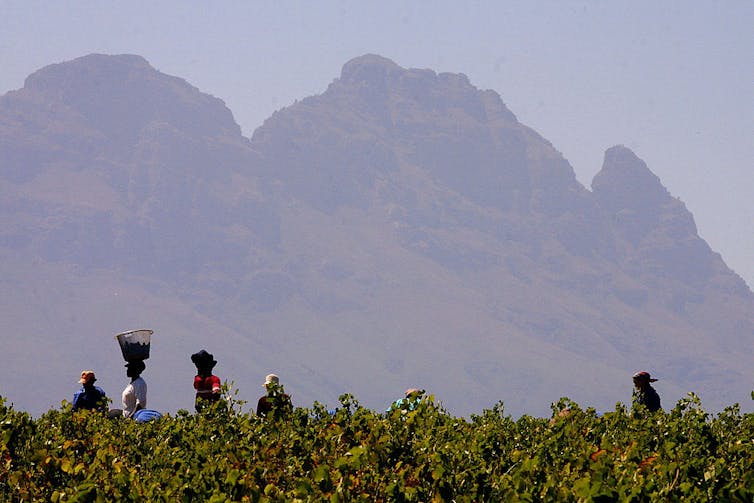
Workers harvest grapes on a wine estate in Stellenbosch outside of Cape Town.
Anna Zieminski/AFP via Getty Images)

Thomas Hastings, Queen’s University Belfast

Echoes of apartheid-style exploitation of workers have resurfaced in recent years in South Africa. Debates around these malpractices were given fresh impetus four years ago with the release of a documentary, Bitter Grapes. Produced by Danish journalist Tom Heinemann, it featured workers from South Africa’s Winelands.

Bitter Grapes cast light on wide-ranging exploitation. Hardships included health and safety violations, underpayment of wages, and illegal efforts by producers to restrict trade union access on farms. These conditions sit uneasily with South Africa’s progressive constitution. They also run counter to numerous International Labour Organisation conventions relating to organised labour rights that the country has signed.

In a recent research paper, I outlined the case for greater optimism around working conditions on wine farms – due in part to the activism which helped create the documentary.

Worker’s networked activism

Key to the production of Bitter Grapes was the role of Ethical Wine Trade Campaign. This was a collaboration of worker organisations and solidarity movements across South Africa, Sweden, Chile and Argentina. All are important wine regions. (Ed: Sweden?).

The campaign makes use of local knowledge about conditions in Winelands in the Global South. This can be used to apply pressure to improve conditions in wine supply chains. An example is the role played by the campaign in connecting actors in Scandinavia and South Africa which informed and made possible the Bitter Grapes documentary. Subsequently, the film has proved key in creating regulatory reforms.

The Commercial Stevedoring and Allied Workers Union played a vital role in the campaign.

The impact of Bitter Grapes reflects a strategy to connect activists in different places connected to common sectors. The links between South Africa and Scandinavia are not incidental. Nordic countries consume around 10% of all South African wine exports. This is mainly via the country’s state monopoly retailers – Systembolaget in Sweden and Vinmonopolet. They have the sole licence for selling alcohol on the high streets of Norway and Sweden. Both governments have faced pressure to better regulate supply chains which are directly funded by taxpayers.

In my paper, I examined how labour can use networks to create public pressure on governments and firms to better regulate supply chains. This has the potential to improve working standards and opportunities. In particular, I look at changes in the regulation of work conditions that have resulted.

Improvements

Several changes to wine farm regulation have emerged since Bitter Grapes, on the back of moral and political appeals to European consumers.

The first set of changes is around formal state-led labour inspections. After Bitter Grapes, the South African labour inspectorate investigated (and verified) several claims made in the documentary. Subsequently, the inspectorate has shown greater interest in the rural sector and has committed to more dialogue with trade unions in gathering intelligence about worker exploitation.

Secondly, there have been major changes in the private regulation of wine producers. A key private labour standards monitor in South Africa, the Wine and Agricultural Ethical Trade Association, has adjusted the way it operates. It has responded to concerns by committing to auditing farms more frequently.

And it’s agreed to use a more transparent grading system. This change will mean that poorly-performing farms are now confronted with a genuine trading threat. Farms getting a low score in an audit are now – in theory – unlikely to be able to sell products to major retailers in Europe.

For their part, Vinmonopolet and Systembolaget have sought to improve standards in wine production through additional strategies. Vinmonopolet commissioned a series of independent audits and developed a new eight-point assessment for producers to adhere to. Findings confirmed a range of “critical” risks in several wine farms.

Systembolaget, meanwhile, has adopted a new and novel approach to reporting standards violations spurred by the Swedish trade union Unionen. This has included a Memorandum of Understanding with the International Food Workers’ Federation. The memorandum is intended to support unions on the ground and offers a reporting mechanism for unions operating on the ground in South Africa, ultimately feeding information back to Systembolaget in Sweden.

Lessons learnt

The creation of progressive labour laws is important in securing improved standards of work. But laws in themselves remain limited in their effectiveness in industries where workers are hidden and isolated, and where inspectorates struggle to attend to the work realities on the ground.

That’s why regulation is so important.

The case study I have done shows that workers are capable of influencing both private and public forms of regulation in their interests. This involves the creation of consumer boycotts, as well as supply lines of pressure from within corporate networks which producers will struggle to ignore.

Workers not only create pressure to reform laws and regulation: they can influence the strategies for policing labour standards too, for example by getting the labour inspectorate to be more active.

In this instance, workers have helped re-orientate regulatory agencies away from merely nudging companies to improve conditions towards a stronger regulatory model with a threat of sanction.

Others could learn from the collaborative networks that were formed.

Despite this positive story it is important to stress that the job of improving labour standards in South African wine is far from finished. Issues such as evictions of workers and the over-reliance on casual labour (often via labour brokers) are not typically addressed by either labour inspectorates or private codes of conduct.

The need for transnational worker activism in monitoring labour standards is sure to remain relevant.The Conversation

Thomas Hastings, Lecturer in Management, Queen’s University Belfast

This article is republished from The Conversation under a Creative Commons license. Read the original article.

Enjoy this article?  Subscribe for free to ZA Confidential to receive our newsletters: Click here.   Twitter:  @zaconfidential


Ramaphosa dodges critical decisions, raising the question: is he a lame duck

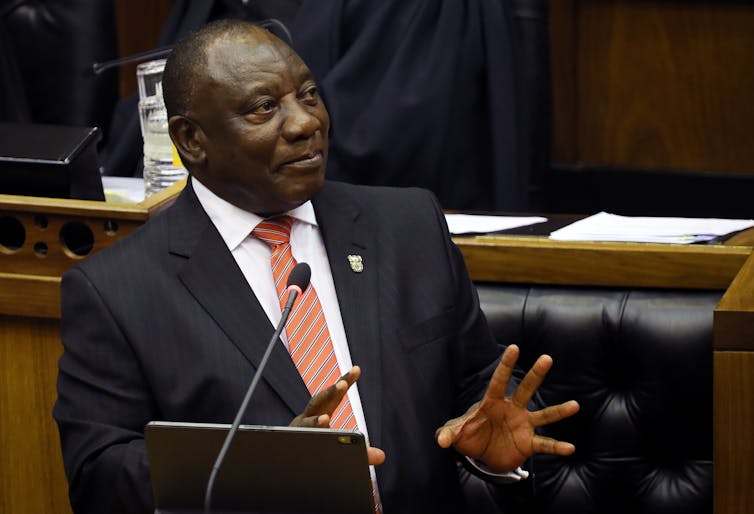
South Africa’s President Cyril Ramaphosa delivers his State of the Nation address.
GCIS/Sumaya Hisham/Pool

Mcebisi Ndletyana, University of Johannesburg

Is it possible that South Africa’s Cyril Ramaphosa has become a “lame duck” president? This often happens towards the end of a leader’s term, especially when a successor has already been identified. But Ramaphosa is not even halfway through his first term.

That I even to ask the question suggests that I have doubts that Ramaphosa is making the necessary decisions. By that I mean catalytic decisions that will define the legacy of his presidency and the fate of the country.

Ramaphosa has the misfortune of being president at the most challenging time in the life of post-apartheid South Africa. Economic activity is at its lowest, with growth this year estimated at below 1%.

The country’s tax agency will collect R250bn below what was forecast in the 2019 budget over the next three years. And unemployment – at 29,1% – remains a grave concern, although perhaps not as immediate a danger as dwindling revenues. South Africa has a massive welfare safety net – from free education and health to monetary grants – which has cushioned the country’s poor against the ravages of unemployment.

But because the tax agency is collecting less – the result of companies closing and jobs being lost – the little that goes into public coffers should be spent prudently.

Is it being spent prudently?

The answer is a resounding no. Nor does the president’s State of the Nation address offer much comfort. It showed that he has a preference for less contentious matters that attract praise. And there were such easy wins in the speech. They included relaxing regulations for independent producers to generate energy and allowing municipalities to procure renewable energy. Students were promised more accommodation and aspiring business people should expect a state bank that will provide affordable loans to start a business.

These are all commendable measures, unlikely to attract any derision – at least not immediately. But the country’s problems will not be solved through safe decisions. This is a “decisive moment”, as the president himself acknowledged, that requires equally bold moves and vocal support for cabinet ministers carrying out his instructions.

The State of the Nation address showed, once again, Ramaphosa’s proclivity to avoid tackling contentious issues. Examples abound, but one of the most telling is his handling of the crisis at the national airline, South African Airways.

Bungling big decisions

South African Airways has been surviving on government bail-outs. After the previous CEO, Vuyo Jarana, quit in exasperation in June 2019, the government eventually conceded that the airline was unsustainable in its current form. Tito Mboweni, the finance minister, thought the airline should simply be shut down, or sold to a private owner. But the government figured that it could still be salvaged. Its preferred course of action was to put it through business rescue.

The understanding was that the rescue practitioners would do whatever was necessary to turn the national airline around.

But when it came to actually doing what was necessary to rescue the airline, the rescue practitioners soon began to realise that they didn’t have carte blanche. This became clear after they’d announced the cancellation of unprofitable routes, a step taken to reduce operational costs.

Khensani Kubayi-Ngubane, the minister of tourism, disagreed with the decision. Some of the cancelled flights, she protested, would harm the tourism industry. The minister’s protestation was understandable – she was protecting her own territory. What was bewildering was Ramaphosa agreeing with her.

As the president, he ought to have a broader appreciation that cutting costs would ease pressure on the airline’s finances. Moreover, the president should know that decisions like this hardly please everybody. A president who has to balance various interests against each other goes with the decision that guarantees the maximum results.


Read more:
Public approval is Ramaphosa’s only defence against his enemies in the ANC


The president didn’t even provide a viable alternative plan. In his State of the Nation address, he said only that the “business rescue practitioners are expected to unveil their plans for restructuring the airline in the next few weeks”. It’s not clear from this whether the plan will be formulated entirely by the practitioners.

Government’s discomfort over the reduction of routes suggests that it wants to determine what the plan should be. This shows its reluctance to allow the practitioners to do what is necessary, however unpleasant, to make the airline commercially viable.

But finding funds to bail it out once more looks increasingly unsustainable. The latest injection – a R3.6bn loan from the Development Bank of Southern Africa – can’t be repeated. And any decision to take additional money out of government coffers will negatively affect other things.

As it is, the minister of finance has the unenviable task of finding money for all the things the president has promised. But Mboweni won’t be able to source money for students and aspirant entrepreneurs without denying others. And he’s likely to have to deal with an even more crippled national power utility as Eskom loses income when consumers –- especially companies and municipalities – opt for independent producers of energy.

And assuming Mboweni does find the money somewhere, will the president come to his defence when he’s attacked?

Formidable foes

It is difficult to sustain a fight against formidable foes all alone without support. Mboweni appears to be showing signs of resilience against severe criticism from the left-wing of the party. But Pravin Gordhan, minister of public enterprises, doesn’t seem to be doing as well. Since taking over this portfolio, Gordhan has exposed widespread maladministration and corruption in state-owned enterprises and led the call for prosecutions.

Yet, after repeatedly supporting the restructuring of the airline, he also backtracked when business rescuers cut down on routes. This suggests he is taking a lot of strain and may be capitulating. It’s not surprising as his detractors even include the country’s deputy president, David Mabuza.

Mabuza is unhappy that Gordhan has bypassed the governing party’s deployment committee when making appointments to boards of parastatals. The committee was partly responsible for appointing unscrupulous individuals that looted parastatals and its current head, Mabuza, is not known for propriety. But Ramaphosa has not been vocal in his public support for Gordhan.

Ramaphosa appears not to have realised that routine decisions are akin to inaction, no different from being a lame duck. Lack of support will alienate allies, which will leave him vulnerable to detractors. Without ardent supporters, Ramaphosa may not even conclude his first term. He has formidable enemies.The Conversation

Mcebisi Ndletyana, Associate Professor of Political Science, University of Johannesburg

This article is republished from The Conversation under a Creative Commons license. Read the original article.

Enjoy this article?  Subscribe for free to ZA Confidential to receive our newsletters: Click here.   Twitter:  @zaconfidential